Flags, fireworks, picnics, patriotism, parades. All of these are part of the 4th of July, and they often appear in the films of Alfred Hitchcock. For this explosive quiz, match the patriotic-themed question to the correct, flag-waving answer.
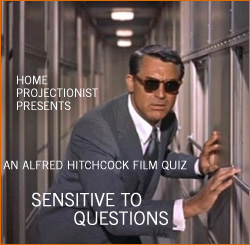
(*The quiz title was inspired by Alfred Hitchcock’s North By Northwest:“Something wrong with your eyes?” “Yes”, says the sunglass-clad Roger O. Thornhill (Cary Grant), “They’re sensitive to questions”. In the opening moments of the movie, as Roger and his secretary climb into a taxi, Roger says, “First stop, the Plaza. “Don’t throw the flag.”)
Doomsday scenarios are the stuff that films are made of — from last year’s melancholic MELANCHOLIAto the newly released comedy SEEKING A FRIEND FOR THE END OF THE WORLD.The demise of the planet can certainly stoke our imagination. (I hate to admit that I was little disappointed when, this past May, a team of archaeologists reported that the rumors regarding the Mayan calendar end-of-the-world predictions were greatly exaggerated.)
Frankly, if the end was nigh and a rogue asteroid was hurtling toward Earth, I don’t think I would choose to watch a movie. More likely, I would be curled up in a dark corner with some extravagantly fine red wine. But one never knows how one will respond to the news of such an event. So I want to be prepared.
After much pondering, I’ve come up with my top three selections for an imaginary End of Days Home Projectionist Film Festival. I’m relatively convinced that my choices are correct — but still waffling about the order in which I would show them. As of this writing, here is what I’m proposing:
PLANET EARTH(2006 BBC version)
Sure, this is really a 10-hour plus mini series but I’m giving myself some leeway. With its astounding images, coupled with Richard Attenborough’s soothing voice, this extraordinary achievement would seem to be the most appropriate love letter to our stunning planet as it departs the universe.
HARD DAY’S NIGHT (1964)
Neuroscientists have determined that the musical influences of our youth have a profound impact on the way our brains develop, and hearing familiar music releases all kinds of pleasure-inducing dopamines. So why not watch one of the most memorable films of my youth and get all the dopamine I can? I can think of no other movie that brings such unbridled happiness to me — for not only the music, but also the spirit, joyfulness, humor, and, of course, larger-than-life Beatles.
CINEMA PARADISO(1988)
This award-winning film — and its soundtrack — can bring me to tears just by thinking about them. (In fact, I’m crying right now.) With this absolute masterpiece, director Giuseppe Tornatore created a profound cinematic experience about the journey of life and how we love, aspire, lose, endure. And it has a perfect ending.
How would you program your own End of Days Film Festival? What would you watch? Let us know and we’ll compile the results. It may be a good list to have on hand. Be prepared, that’s what I always say.
Gloria Bowman is a writer, storyteller, blogger, movie lover, freelance editor,
and author of the novel, Human Slices.
Access her blog at www.gloriabowman.com; on Twitter @GloriaBow
Most of the 2011 Oscar nominees are now available for home theater viewing in some form or another. Are you a self-respecting home projectionist? Do you plan on screening one or more of the nominated films for your friends or family in the near future? As a would-be theater owner, you won’t want to just roll the movie all by itself, naked, alone and afraid. You definitely will want to value-add the experience for your guests. That means giving them the right “appetizer” with their movie meal.
No visit to an actual theater is complete without an opening salvo of policy trailers, a plug for the concession stands, or pleas to pitch your trash. These are aimed at general audiences. But you can tailor yours to be compatible with your audience and the Academy Award nominee:
MY WEEK WITH MARILYN Vanessa Michelle Williams was nominated as Best Actress for her portrayal of Marilyn Monroe during the filming of THE PRINCE AND THE SHOWGIRL. Your audience for this picture might tend to skew a little older. In that case, they’ll probably remember being musically thanked for coming to the theater, and also for sitting back, relaxing, and enjoying the show (and being shushed):
HUGOIt’s possible you’ll have an excited child or two for this really terrific Martin Scorsese Best Picture nominee. “We must insist on absolute quiet!” sounds a little harsh. So why not let this gentleman do it for you:
THE HELP It’s a movie about domestic service–cleaning and (especially) cooking. So, let’s all go to the lobby to have ourselves some treats. Chocolate pie, anyone?
EXTREMELY LOUD AND INCREDIBLY CLOSE If your noisy guests are taking the “extremely loud” part of the title too literally, this short trailer may be just the thing:
MIDNIGHT IN PARISDo you have punctual friends? Friends who expect the movie to end exactly at midnight? Then you need a countdown clock:
WAR HORSEDoes your audience have an appetite like–as well as for–a horse? This elf-like creature consumes mass quantities of refreshments as he counts down the time:
TRANSFORMERS: DARK OF THE MOON This nominee’s extravagant array of visual effects calls for “the most extravagant array of refreshment goodies ever assembled under one roof!”
THE DESCENDANTS Is your audience all approximately the same age (if not as good looking) as George Clooney, the star of this excellent Best Picture nominee? Then they’ll most likely remember this catchy jingle very clearly:
All of these short, short trailers are available on YouTube. Thank you, and please deposit your trash on the way out.
Pride weekend here in Chicago, the weather is fabulous, and everyone’s gearing up for the festivities — I even got a robo phone call last night advising me of the new parade route. That’s some community power.
In honor of Pride Month, I’ve been looking at assorted lists of the Best Gay Films out there, and they include Brokeback Mountain, Beautiful Thing, Maurice, Milk, Hedwig, Priscilla, Jeffrey, and a range of other essential and important movies.
Unfortunately, missing from the lists I’ve seen is DIFFERENT FROM THE OTHERS(1919), Magnus Hirschfield’s groundbreaking and heartbreaking film starring Conrad Veidt.
And I’ve also noted that the smile-inducing documentary, THE TOPP TWINS: UNTOUCHABLE GIRLS (2009) isn’t front and center on the lists as well. I am formally nominating it as a must-see and encourage you put in on your Pride Month Home Projectionist list.
This feel-good, award-winning documentary by Leanne Pooley follows the lives of the absolutely delightful Jools and Linda Topp, lesbian twin sisters who are New Zealand icons (who knew?).
Talented as singers and comedians, and influential as political activists, the Topp Twins are inspirational (although their skits can be corny, they still entertain). The beauty of the film is that it shows how the sisters’ joyfulness, strength, intelligence, honesty, and authenticity lead to love and understanding — and influence a cultural shift. It’s a movie about the power of the human spirit and demonstrates what Pride is all about. In that, the Topp Twinns are totally untouchable girls.
The movie’s title song will stick in your head all weekend:
Happy Pride to all!
Gloria Bowman is a writer, storyteller, blogger, movie lover, freelance editor,
and author of the novel, Human Slices.
Access her blog at www.gloriabowman.com; on Twitter @GloriaBow
For director/writer Billy Wilder’s 96th birthday, five moments that are representative of his witty, acerbic, sentimental and romantic style. (All of these films are widely available.)
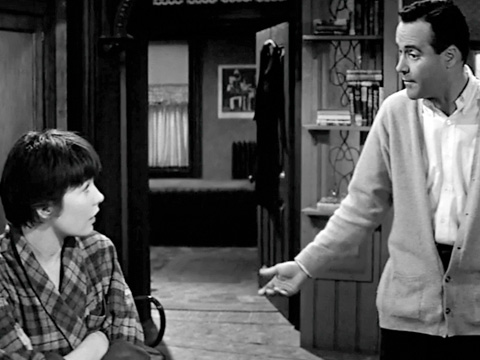
BUD (Jack Lemmon): “You can’t leave yet. The doctor says it takes forty-eight hours to get the stuff out of your system.” FRAN (Shirley MacLaine): “I wonder how long it takes to get someone you’re stuck on out of your system? If they’d only invent some kind of a pump for that…” -THE APARTMENT (1960)
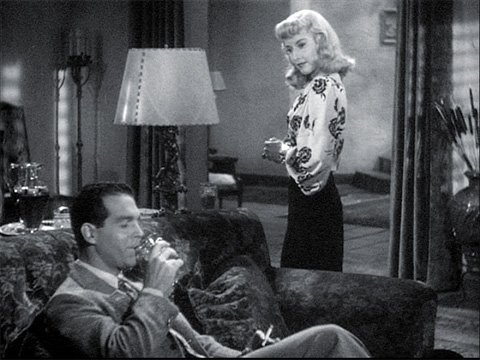
PHYLLIS (Barbara Stanwyck): “There’s a speed limit in this state, Mr. Neff. Forty-five miles an hour.”
NEFF (Fred MacMurray): “How fast was I going, officer?”
PHYLLIS: “I’d say about ninety.” -DOUBLE INDEMNITY(1944)
RICHARD (Tom Ewell): “You look to me like a big Rachmaninoff girl.”
THE GIRL (Marilyn Monroe): “I do? Funny, l don’t know anything about music.” -THE SEVEN YEAR ITCH (1955)
SUGAR (Marilyn Monroe): “I may spill something.”
JERRY (Jack Lemmon): “So spill it. Spills, thrills, laughs, games – this may even turn out to be a surprise party.”
SUGAR: “What’s the surprise?”
JERRY: “Uh-uh! Not yet!” -SOME LIKE IT HOT(1959)
GILLIS (William Holden): “Norma, I can’t take it. You’ve bought me enough.”
NORMA (Gloria Swanson): “Shut up. I’m rich. I’m richer than all this new Hollywood trash. I’ve got a million dollars.”
GILLIS: “Keep it.”
NORMA: “I own three blocks downtown. I have oil in Bakersfield — pumping, pumping, pumping. What’s it for but to buy us anything we want.” -SUNSET BOULEVARD (1950)
Marriage, for better and worse, played its part within the intricate web of Hitchcock’s films. Maybe you are not a lucky June bride, but why not try your hand at finding the compatible answers to these ten Big Questions? The quiz is moderately difficult; passing grade is 50 percent.
(*The quiz title was inspired by Alfred Hitchcock’s North By Northwest:“Something wrong with your eyes?” “Yes”, says the sunglass-clad Roger O. Thornhill (Cary Grant), “They’re sensitive to questions”. Later, as Roger and Eve are clinging desperately to the face of Mt. Rushmore, Roger says to Eve, “Well, if we ever get out of this alive, let’s go back to New York on the train together. All right?” Eve answers, “Is that a proposition?”, and Roger replies, “It’s a proposal, sweetie.”)
The Summer Solstice is many things to many people. The true start of summer, a pagan’s day to rejoice in the sun, to dream a Midsummer’s Night Dream filled with gods and fairies. However for a Home Projectionist with windows in their viewing room it is the day when the shortest viewing opportunities can be had. Every year as the days grow longer and longer I find my movie watching ability is shorter and shorter. In the Fall and Winter I can come home from a long day’s work, make a little dinner and settle down by no later than 7 in the evening for a nice relaxing film. At these times of the year I can watch something extremely long like Doctor Zhivago or maybe 3 episodes in a row of Mad Men. By the time I’m finished them movie it’s 9:30 or 10. If I have people over on the weekends for a group watch we can even have a double feature since we can start by 7:30 or even earlier as I used to do on Sunday afternoons.
Then comes the dreaded summer: Not only does the projector become yet another source of heat blowing into the room, but movies really can’t begin until 8:45 at the earliest. And even then there is the faint glow of the setting sun shining through the windows. Even closing the blinds doesn’t help because I have a west exposure. Having had a projection system for eight years now I’ve naturally begun to make seasonal viewing changes. Summer has been a time to rest the projector. I cut my Netflix movies to two out at a time instead of four. I hardly ever have people over during the summer for a group movie night. My apartment is too warm and by the time the sun sets there is barely enough time for one movie, let alone a cartoon or a short. If I do watch something it’s a short film never more than 90 minutes, especially during the week.
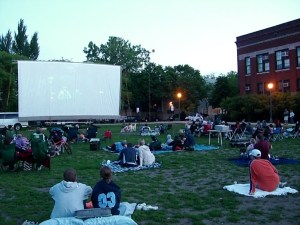
By late July I usually drag the projector outside for outdoor yard movies at a friend’s house. We’ve had many a lovely night under the stars watching Cat People, The General or My Man Godfrey. There is nothing like watching a movie outside. It brings a different dimension to whatever you are watching. Whether it’s the view of the sky behind the screen blending with the sky on the projection or just the feeling of lying down on the grass; It is one of my favorite things of the summer. I guess that’s why it is so exciting to go to a drive-in. Have you noticed that even the worst movie seems better at a drive-in?
So I wish you a happy Summer Solstice. May you have a lovely summer and many star filled, big screen nights.
SUDDENLY, LAST SUMMER (with Katherine Hepburn, Elizabeth Taylor, Montgomery Clift; directed by Joseph L. Manckiewicz; 114 min.; widely available)
“My son Sebastian and I constructed our days. We would carve each day… leaving behind us a trail of days like a gallery of sculpture. Until suddenly, last summer.”
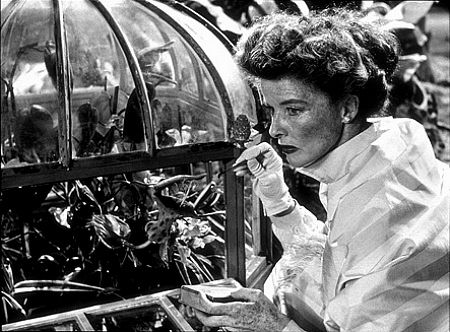
It’s not quite as tender as Night of the Iguana (my personal favorite of Tennessee Williams film adaptations), as sensual as Cat on a Hot Tin Roof (a very close second), or as powerful as A Streetcar Named Desire. Suddenly, Last Summer nevertheless is unforgettable and as steamy as a greenhouse–if only for Katherine Hepburn’s mezmerizing, tour de force portrayal of her character, the nervous and disturbed, slightly-off Violet Venable.
Venable is a wealthy New Orleans woman hiding a web of conflicted feelings and secrets. She brings houseflies (“flown in at great expense”) for her glass-encased Venus Flytrap in her ornate, “Dawn of Creation” conservatory, much like the “flies” (of a human variety) she once attracted for her departed son, Sebastian. Venable blames her son’s cousin, Catherine Holly (Taylor), for Sebastian’s death and, consequently, wants Holly Catherine to pay the price by having a lobotomy. Catherine, even though the handsome Montgomery Clift (Dr. Cukrowicz) would perform the procedure, is understandably a bit reluctant. (“Cut the truth out of my brain… is that what you want Aunt Vi ? Well you can’t. Not even God can change the truth”)
Clift’s acting, in contrast to Taylor’s, is a little on the bland side. But Liz more than makes up for it. Taylor, it goes without saying, is very beautiful in every one of her scenes. She might overact, but this is Tennessee Williams after all–over the top performances are expected and welcome, as are the typical moments of family quarrels and backbiting, and depictions of struggles with sexual identity.
As an example of a character whose every appearance will prompt hissing, look no further than Mercedes McCambridge’s portrayal of the very grating and unlikable Mrs. Grace Holly. The overwrought ending of Suddenly, Last Summer seems out of place given the tone up to that point, and is this movie’s only big drawback. But what comes before is well worth the price. Like the other T.W. films I mentioned, this one’s never dull–a movie for a group of friends to enjoy on a hot, July night, with a Mint Julep or two.
p.s. One thing to keep in mind during when the movie visits a very Snake Pit-like insane asylum is that the story is set in 1937. Things have improved a lot since then. At least one hopes they have.
“Oh, Sebastian, what a lovely summer it’s been. Just the two of us. Sebastian and Violet. Violet and Sebastian. Just the way it’s always going to be. Oh, we are lucky, my darling, to have one another and need no one else ever.”
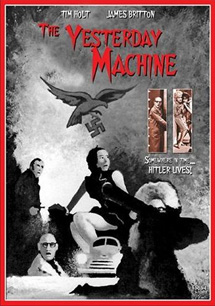
THE YESTERDAY MACHINE (1963; starring Tim Holt; directed by Russ Marker; public domain, available on DVD from Netflix, or watch the entire thing on YouTube, below)
The “plot”: It’s 1963, and an elderly Nazi scientist is attempting to change the outcome of World War II by giving Hitler a second chance via a time machine.
All right, this movie is appallingly bad. Bad print, bad sound. So bad for you kind of bad that it’s actually good. The Yesterday Machine isn’t quite in the realm of such classics as Manos: The Hands of Fate or Plan Nine From Outer Space, however it tries really, really hard.
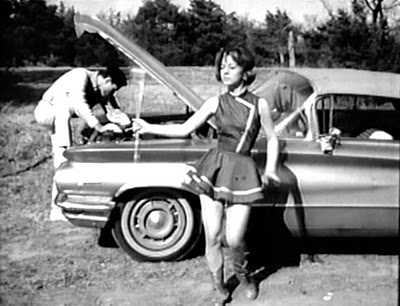
This black-and-white, public domain time travel film opens with a pretty, blonde cheerleader furiously twirling a baton. Generic teen music blares from a transistor radio that’s perched on the fender of a ’59 Buick. A college sweater-wearing, Mitt Romney-like guy–apparently the young woman’s boyfriend–is doing something beneath the hood of the car. Margie the cheerleader mindlessly twirls on. We don’t know if Mitt (actually Howie) is fixing the car, or if he’s about to go with the tried-and-true, “We’re out of gas” line.
Cinematically, things proceed to plunge rapidly downhill the moment the first lines of dialog are spoken.
“Howie, For heaven’s sake! It’s almost dark! If you don’t hurry up, we’re gonna be late for the game!”
“Margie, have you ever tried to fix a fuel pump to a rock and roll beat?”, remarks the perturbed Howie.
To find help, and this being a low-budget, B-movie, they naturally decide to cut through the nearby woods. Howie gets shot even before the credits have finished rolling. Margie and her baton vanish.
Later, at a Big City newspaper (The Sentinel), we meet an intrepid, curious, tough-guy reporter who will stop at nothing to get his story. In an unexpected, Rashomon-like sequence at the hospital where Howie’s being treated, the reporter gets the lowdown, through a flashback, about the incident. Then suddenly, we’re twisting the night away. It’s the music of Nick Niklas and “the girl with the orchid voice”, Sandra de Mar. Sandra’s song, oddly enough titled “Leave Me Alone”, is actually sung by Ann Pellegrino in her one and only film appearance.
“Go on away and leave me alone. I want to be by myself when I cry. And there’s gonna be some cryin’… I just told my baby good bye.
Get out of here and leave me alone. I don’t care whether I live or die. Cause my life’s already over, it ended when you told me good bye.
Why is it everything happens to me and my dreams just explode in my face?”
Sandra is confronted by the police about the disappearance of her sister Margie. Officer Laskey, played by Robert Kelly, shared his memories of making this movie on the Internet Movie Database:
I was honored to play Dectective Laskey in this Yesterday Machine movie. Tim Holt was a true professional to put up with a bunch of local Dallas actors and even thou this is a typically bad science fiction movie– for the time, it is OK to watch. […] I had a recording studio in Dallas, Texas at the time of the shooting of this movie and most of the interior scenes were done in the back rooms of my studio—sets built for the dungeons, and the time machine locations, etc. All of the music was recorded at my studio with the Nick Nicklas band doing the playing.
Accompanied by Tim Holt in suit and tie, De Mar visits the rural, wooded scene of the crime in a tight skirt and high heels. Outside an old farmhouse, Holt gets accosted by a storm trooper to the tune of what sounds unfittingly like the Tonight show theme. Soon, the couple realize they’re lost… in time. Sandra’s hysterical yet orchidly voice is in full flower:
“Jim! The car! It’s gone! There isn’t a telephone pole in sight! The road was paved and now it’s dirt! What’s happening? Where’s the car?? What’s going on?? Jim, someone must’ve stolen it! Tell me what’s going on! Tell me what dreadful thing has happened!! TELL ME!!!”
In a nicely done transition shot, Holt and de Mar are beamed up (or down) to the laboratory of one Professor Von Hauser, and now we are at the real, rotten core of this movie.
Jack Herman, a Yiddish theater actor, hams up his role gloriously with a thick, over the top German accent and sly, menacing expressions and outrageous gestures. I sure hate to give anything away, but prepare yourself to endure the white-haired Von Hauser’s interminably long (but hilarious) blackboard lecture, as a serious but baffled Tim Holt looks on.
“Ziss line represents za vurld… […] Ziss is to illustrate vy vee vood have von da var!! Now, vee are da masters, and time is our servant!! Aahhh, you Americans are an egotistical, arrogant lot! How proud and superior you felt as you strutted through the ruins of our cities!! Soon, Hitler will return!!!”
“I’m afraid you lost me, doctor.”
I wonder if Holt–who once was a star in Orson Welles’ The Magnificent Ambersons and John Huston’s Treasure of Sierra Madre, after all–longed for a real, working Yesterday Machine when he saw the end results of this.
It’s nevertheless a great time, and there are plenty of unintentional laughs for an open-minded group. Serve it with some bratwursts, sauerkraut, and a few Heinekens or a nice Riesling.
He’s still keeps ’em coming: Woody Allen’s new film To Rome With Love kicked off the Los Angeles Film Festival (www.lafilmfest.com) on June 14. Last year, Midnight in Paris (2011) was absolutely delightful (and who knew that I could ever fall madly for Owen Wilson?).
But for me, MANHATTAN(1979)still shines. It’s beautiful look at, has a smart script and memorable performances, and it’s a classic that deserves a revisit. I am always surprised how much I love it every time I see it, and it’s a stellar film for a Home Projectionist event.
Shot in black and white to stunningly show off the grit of the city (and the shades of gray of the dilemmas that characters face), the film is rich with Allen Angst and hapless hilarity (although you may laugh out loud only a few times). Allen — along with Diane Keaton, Michael Murphy, Mariel Hemingway, and Meryl Streep — ruminate, wallow, digress, change partners, fall in love, and fret, fret, fret, good lord how they fret about their daily little lives. And for all their self-absorption, you love them nonetheless.
The film’s locale provides a long list of options for themed entertaining. Manhattans for cocktails and an array of potential menu items from deli trays to Waldorf salad, bagels to dirty water hot dogs, and hot pretzels to New York cheesecake. (The downside is that there are so many options and it’s hard to choose.)
As a special bonus, a recent viewing of the film spawned a spur-of-the-moment, made-up game called “What You Saw In the Movie That You Don’t You See So Much Anymore.” The list included a typewriter, smoking in restaurants, luggage without rollers, a dictaphone machine, big telephones, racket ball, women with really bad perms and tiny boobs and no bras. Oh yes, and when was the last time you heard someone talking about Kierkegaard?
Gloria Bowman is a writer, storyteller, blogger, movie lover, freelance editor,
and author of the novel, Human Slices.
Access her blog at www.gloriabowman.com; on Twitter @GloriaBow
Not every one of these dads is a happy one, but here’s wishing them (and yours) a Happy Fathers Day anyway. This is by no means a list of definitive dad movies. They’re all good for a Fathers Day family screening, depending on how much of a sense of humor your dad has, and whether he and you can tolerate subtitles. (All of these films are widely available.)
MY FATHER’S GLORY (1991; France; directed by Yves Robert; subtitled) “A sweet, beautiful memory of a young boy’s favorite summer in the French countryside of the early 1900s.” –Video Hound. Followed by its equally as good companion film, MY MOTHER’S CASTLE.
THE SHINING (1980; directed by Stanley Kubrick; with Jack Nicholson, Shelley Duvall) Nicholson takes time to be with his family, including his son (Danny Lloyd) and, apparently, with other people. I’d like to see the post-trip, Trip Advisor review.
FATHER OF THE BRIDE(1950; Spencer Tracy, Elizabeth Taylor; directed by Vincent Minnelli) The Steve Martin remake is OK, but the original bride is irreplaceable. Tracy is the walking definition of the word, “curmudgeonly”.
RIVER OF NO RETURN (1954; Robert Mitchum, Marilyn Monroe; directed by Otto Preminger) “Wilder then river fury, wilder than all the savage wilderness of America, was the savageness of their love!” Dad Robert Mitchum has more than he can handle with both his son (Tommy Rettig, co-star of the TV show Lassie) and frontier showgirl Marilyn, not to mention the raging river and several, money-grubbing bad guys.
BIGGER THAN LIFE(1956; James Mason, Barbara Rush, Walter Matthau; directed by Nicholas Ray) Father thinks he knows best, but he doesn’t–it’s the drugs talking. In a way, Mason’s portrayal of a dad is scarier than Nicholson’s in THE SHINING.
DEKALOG IV(1988; Poland; directed by Krystof Kieslowski; subtitled) There’s a lot going on under the surface in this 55-min. movie. It’s thought-provoking and fun trying to figure it all out–and you might not, until the end. Part of a series of ten films, all very loosely (and mostly not all that religiously) based on the Ten Commandments, this concerns the close relationship a young woman has with the architect father she’s living with.
REBEL WITHOUT A CAUSE(1955; James Dean, Natalie Wood, Sal Mineo, Jim Backus, Dennis Hopper; directed by Nicholas Ray) Yes, another Nicholas Ray film. But no one had a better hand on the pulse of 1950s American suburban life. Backus is out of touch with his pessimistic son, who refuses his dad’s advice to wait “ten years!” for his life to change and get better.
Celebrate Fathers Day by reuniting dad with his son or daughter. In true Hitchcock fashion, these paternal figures were sometimes model parents to their offspring, sometimes not. This quiz has a fairly high difficulty level. Good luck, Mr. Thornhill, wherever you are…
*Our quiz title was inspired by Alfred Hitchcock’s North By Northwest:“Something wrong with your eyes?” “Yes”, says the sunglass-clad Roger O. Thornhill (Cary Grant), “They’re sensitive to questions”. Later in the film, the Professor (Leo G. Carroll)-responding to Thornhill’s description of Phillip Vandamm-describes Vandamm as “A rather formidable kind of gentleman, eh?”
Welcome to Home Projectionist, a unique forum for people who love watching movies and sharing the experience with the people in their lives.
Home Projectionistis for the would-be movie theater owner. If someone handed you the keys to Manhattan’s Angelika, Chicago’s Music Box, San Francisco’s Castro, or L.A.’s Egyptian, how would you handle programming?
You know you’re a Home Projectionistwhen you’re inspired (as we are) by the possibilities that exist – be it with the classics, the campy, the quirky, the contemporary, or anything else that we happen to discover to share on our home screens — no matter how big or small they are.
Home Projectionist is about adding a meaningful third dimension to a two-dimensional movie by creating a shared experience with our friends and family. Not only do we enjoy connecting our guests with compelling and entertaining films, but we also have fun adding unique touches — like showing cartoons or clips or serving themed food and drink.
Home Projectionists share a certain fondness for the movie experience of the past, where the draping curtains added an air of mystery, when we weren’t bombarded by commercials and overwhelming prices, when the audience was attentive and respectful, and when there was a definite magic when you went to the theater. Home Projectionists still love going out to the cinema, but they’ve discovered the pleasure of being programming director and host in their own homes.
At Home Projectionist, we’ll be talking about films, resources, technology, industry news, themes, menus — you name it. We want to count you among the proud Home Projectionistsout there.
Join us by subscribing to our blog site, Liking us on our Facebook page, and following us on Twitter. Stay tuned!
(And the award goes to….Home Projectionist blogger Dave Hunter for his talent and commitment to creating this site, graphics, and the outstanding Home Projectionist logo. See Dave’s work at http://www.dhdd.net/ )
If I set my Way Way Back Machine to 1976, I can recall being addicted to the Masterpiece Theatre I, CLAUDIUSmini series the same way I am addicted today to Downton Abbey, Mad Men, and the Housewives of New Jersey.
Earlier this year, the 35th anniversary edition of the BBC I, CLAUDIUSseries was released. What memories that announcement brought back.
Although I clearly remember being enthralled with every episode of I, CLAUDIUSthat I watched on television in the ‘70s, I don’t clearly remember the home projection screening of the series we did sometime in the ‘90s.
Blame the summer heat and copious amounts of red wine for the fuzzy recollections, but our screening of I, CLAUDIUS was memorable nonetheless. (It still comes up once in awhile when friends reminisce – a true sign of a Home Projectionist success.)
A small group of us who are old enough to have seen the original airing of I, CLAUDIUSwere raving about it to our friends who hadn’t seen it. We wanted to show off our new big screen and agreed to make a true marathon event out of it — hunkering down for a screening of 13 episodes on two consecutive Sundays during one of the hottest spells of summer.
Everyone came in on the first Sunday at noon looking limp from the 90-degree heat and 100 percent humidity. They immediately perked up when the blast of over-conditioned air hit them at the door.
The food theme was “Bring Something Mediterrean,” and the kitchen was overflowing with olives, grapes, dried meats, roasted peppers, bruschetta, fabulous cheeses, and an obscene number of bottles of Italian wines. After eating a drinking a bit, people moved into the living room and scrunched up on the couch, grabbed dibs on chairs. We didn’t have enough seating, so in true Roman style, there was also a lot of lying around on the floor.
The opening credits were riveting, the theme, and that snake sliding over the tile floor. So far, so good. But I remember feeling a bit panicked when the first scene appeared with its playhouse production style. I could sense a collective groan.
But within only minutes, really, everyone was drawn in and my worries were over. How could they not be mesmerized?
The cast and performances are over-the-top stellar. Derek Jacobi stammers his way through the leading role as hapless Claudius. Sian Phillips brilliantly plays the evil matriarch Livia while Brian Blessed blusters around as Emperor Augustus. Star Trek fans will be excited to see a young Patrick Stewart in a leather skirt playing the handsome and crafty military officer Sejanus. And John Hurt absolutely kills it as Caligula. Absolutely kills it.
The whole series is a kind of Survivor game show with insider politics and power plays, murder and mayhem, insanity and sexual intrigue…and more sexual intrigue, a few battles, and more sexual intrigue.
During the first day of our mini series marathon, we took long breaks between episodes, and even though we started watching at noon, we didn’t stop until the late, late evening. And copious bottles of wine were empty. Everyone had a bleary-eyed Monday morning.
The next Sunday, the same group of friends reappeared for Round Two, bringing along a repeat of the last Sunday’s Mediterranean spread, as well as a few new participants. We held a plot recap to catch up everyone on the story so far and settled in for the last six episodes.
As the day went on, the breaks between episodes got longer and longer. Sam, who knew the in’s and out’s of Roman history, helped clarify some of the genealogy and missing links. (Note that the 35th anniversary edition has featured extras that will help in that arena.)
I had anticipated that the group would go home early on the second Sunday and that there was no way that we would have a late-night repeat of the week before. But when the last episode was done and I, CLAUDIUSreached its wonderful conclusion, no one went home.
Everyone migrated back to the kitchen to refill glasses and happily pick at leftover dried up cheese and other unappetizing bits and pieces. There was a weird kind of spirit in the air and a sense of ensuing late-night drama. I knew that our own little reenactment of a Roman soiree was going to continue when I walked in on an improbable make-out scene (that still makes me shake my head), and then later when, courtesy of Miss P. Caster, some rock band’s tour bus and entourage pulled up in front of the house.
Sometimes, life can imitate art.
I woke up in the morning to find one friend asleep on the bathroom floor, and he was holding a bowl of grapes.
If you’ve never seen I, CLAUDIUS put it on your Home Projectionist must-see list. And let the intrigue begin.
Gloria Bowman is a writer, storyteller, blogger, movie lover, freelance editor,
and author of the novel, Human Slices.
Access her blog at www.gloriabowman.com; on Twitter @GloriaBow
FAHRENHEIT 451 (1966; Oscar Werner, Julie Christie; directed by Francois Truffaut; widely available)
“You see, it’s… it’s no good, Montag. We’ve all got to be alike. The only way to be happy is for everyone to be made equal. ”
Author Ray Bradbury passed away last week at the age of 91. He wrote for television, including for Alfred Hitchcock, but the most famous movie to be adapted from one of his books was Fahrenheit 451. The best-selling Bradbury novel (which I read way back when) was directed by Francois Truffaut (his first and only English film) and released in 1966. Its critical reputation has improved (“meandering narrative…”, “pretentious and pedantic…”, “an interesting miss”, in the words of critics then). I’d seen Fahrenheit before, but in light of Bradbury passing away, I wanted to re-watch it. It’s gotten better with each viewing. A very good film; not quite perfect though.
From the start, Truffaut startles with quick zooms towards what appear to be ordinary, old rooftop TV antennas. But upon closer look, they are not. They’re a little bit different. This is the future. Over these dramatic shots, we hear the credits being read by an ominous, off-screen voice. The absence of the printed word is in keeping with Bradbury’s novel (a 1984-like future in which fire departments-in-reverse burn all books–“even this one (Mein Kampf)”–and sometimes their owners, with extreme prejudice. I don’t recall seeing (actually, hearing) this technique anywhere except in Welles’ Magnificent Ambersons (readers may want to help me out here…). Composer Bernard Herrmann created one of his best scores for Fahrenheit 451, and to his credit he (reportedly) resisted requests to use it during these opening “titles’. Immediately after these credits, however, Herrmann’s music gets underway. It’s urgent, unique, oppressive and authoritarian, all at once. The childlike xylophone has an accompanying visual: a bright red fire truck carrying a squad of fire lighters. It looks remarkably like a child’s toy as it races through the countryside–not to put out a blaze but to start one.
With the exception of glimpses of the pages of books, and “The End”, there is no text anywhere in the film. Not on or in any building (the fire station exterior simply reads “451”). Not during the odd, intrusive and sterile television programs Linda Montag (Julie Christie) watches on her “wall screen”. Christie’s husband, Guy, (Oscar Werner), aspires to a second screen (and, being a “guy”, he will most likely want a bigger one).
Christie also plays the part of Clarisse, a free spirit compared to the Stepford Wife behavior of her Linda character. She’s very direct while commuting via the monorail, initiating a conversation with the reclusive fellow traveler Montag, who is intrigued by her persistence. “Why do you burn books?”, she questions cheerily.
This is a thought-provoking film. Books in Fahrenheit 451 are looked upon much like how we view illegal drugs today. Books in this book-less new world are “used” even though they can “cause unhappiness”. They’re hidden away in homes. People who’ve read them all their lives, can’t stop–and would rather die than withdraw from reading. Confiscations of books are announced by weight (“Today’s figures for operations in the urban area alone account for the elimination of a total of 2,750 pounds of conventional editions…”). Whether you’re a casual or an avid reader, these firemen are not your friends.
A middle-aged “book lady” says, “These books were alive; they spoke to me!”. She meets, voluntarily, a horrible fate. Perhaps she didn’t know that books could continue to speak to her, in the true sense of the word. Some distance away from this restrictive society, there is a place where books are kept alive. A precious few have memorized one book a piece. With these wandering souls, books will live forever. They’ll be passed on to other, younger people.
Questions remain. There are only so many folks out there in that forest along the river and abandoned railroad tracks. Just how many books can possibly be saved? Why do the authorities leave them alone? Wouldn’t they suspect Montag (who is not as sympathetic a character as he should be) would be hiding among them? With helicopters and men in jet packs (an unfortunately poor special effect) at their disposal, how could the authorities miss this community–a community that could easily be wiped out without consequence.
Then there’s the two, trouble-prone young firemen at the station. What are the misdeeds they are berated for? It’s sort of funny that it’s never explained; it appears as though it might be a subplot left on the cutting room floor–one of a few plot threads that don’t go anywhere. There’s also Montag’s surprise (or is he faking it?) that there could be such a thing as a non-fireproof house, and his response to Clarisse’s astonishment that fireman once extinguished fires. (Surely large fires must still occur… .)
In the end, the literary scofflaws who’ve become the books they’ve read and memorized, walk through the snow-covered, leafless woods–woods that once, in a way, were the carriers of those words. It’s a moving and unforgettable scene, sad and yet a little hopeful, with beautiful, moody music to match. But the pace is off a bit there, too–the film ends a little bit abruptly. The romance here is about our love of books. The romance between Clarisse and Guy, which needs some resolution or fulfillment–one more chapter–is a loose end that is not tied-up.
This dark, cold movie is not going to be everyone’s cup of tea. But it’s a thoughtful, cautionary story, and it’s not to be missed by anyone who’s ever read a book they wished would never end. Machines are gradually intruding on the lives of the film’s inhabitants, says one character, slowly taking them over. It’s the future in Fahrenheit, but that line was written 50 years ago. “Wall screens” (big, LCD and plasma sets), street corner cameras, satellite views, mindless TV programming and drone surveillance are a reality here in 2012. This is entertainment for us in the here and now, but once the movie’s over, you’ll wonder if the bleak future the movie depicted is as far-fetched as it seemed in 1966.
Not just another WordPress.com site, but an extraordinary place to spend a weekend, grill a cheese sandwich and watch a film to improve your life and stimulate a few of the grey cells.










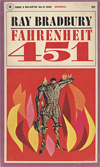 Author Ray Bradbury passed away last week at the age of 91. He wrote for television, including for Alfred Hitchcock, but the most famous movie to be adapted from one of his books was Fahrenheit 451. The best-selling Bradbury novel (which I read way back when) was directed by Francois Truffaut (his first and only English film) and released in 1966. Its critical reputation has improved (“meandering narrative…”, “pretentious and pedantic…”, “an interesting miss”, in the words of critics then). I’d seen Fahrenheit before, but in light of Bradbury passing away, I wanted to re-watch it. It’s gotten better with each viewing. A very good film; not quite perfect though.
 Then there’s the two, trouble-prone young firemen at the station. What are the misdeeds they are berated for? It’s sort of funny that it’s never explained; it appears as though it might be a subplot left on the cutting room floor–one of a few plot threads that don’t go anywhere. There’s also Montag’s surprise (or is he faking it?) that there could be such a thing as a non-fireproof house, and his response to Clarisse’s astonishment that fireman once extinguished fires. (Surely large fires must still occur… .)


 Home Projectionist