Nestor Studios, the first film studio in Hollywood, 1913. (Photo credit: Wikipedia)
Would anyone be surprised by a huge implosion in the film industry?
As reported by FirstShowing.net, George Lucas and Steven Spielberg recently predicted a list of dramatic adjustments, from pricing to distribution and competition from the networks. Hollywood is not immune from the upheavals that technology brings to every industry. Their presentation was held June 12 at the University of Southern California.
I’ll predict that there will be home theaters in every house in the country — and as costs go down and business models change, lots of community theaters or at least community watching events where people can gather and pick their own programming. What fun! Cheaper popcorn too!
At this blog, we coined the term “Home Projectionist” as a way to identify film fans (like us!) with a broad range of tastes and sensibilities who are always on the lookout for the next interesting movie to watch.
Our goal is to create a community of like-minded Home Projectionists because we like recommendations and feedback from real live people. It’s more fun than algorithms alone. Over the last few months, we’ve found that the liveliest conversations are taking place on with our Home Projectionist “What Are You Watching?” group on Facebook.
So, in the name of making HP-to-HP (Home Projectionist-to-Home Projectionist) connections, I’m introducing a new HP blog feature: Home Projectionist of the Month.
Meet HAROLD J. GAUGLERof Phoenixville, Pennsylvania (which, by the way, is northwest of Philadelphia).
I recently posed a few questions to Harold about his love for the movies, his top recommendations, favorite directors, and assorted other topics in Harold’s Movie Brain.
Was there a defining moment, a movie or a memory (or both) that made you a true film fan?
GAUGLER: As a child of the 1960s, I was part of the generation of kids who ran home from school every day to watch DARK SHADOWS (1966-1971), the popular afternoon soap opera about vampires, witches, ghosts, and werewolves. The star was Joan Bennett, who’d had a 30-year film career before moving into television.
Watching DARK SHADOWS with my mom all those years ago, I remember my mom saying, “That’s Joan Bennett. She used to be a movie star.” Immediately, I wanted to see her old movies.
Cropped screenshot of Joan Bennett from the film The Son of Monte Cristo (Photo credit: Wikipedia)
Back in those days, there was a total of maybe eight TV stations, and on weekends the UHF channels would fill their schedules by showing old B&W movies from the 1930s through the 1950s. I spent many Sunday afternoons watching old movies with my mom. Her favorite star was Joan Crawford. I learned to love her too, and loved seeing old Joan Bennett movies, and seeing Barbara Stanwyck from THE BIG VALLEY (1965-1969) and Joan Blondell from HERE COME THE BRIDES (1968-1970) in their old films. I’ve been a fan of the movies and stars of Hollywood’s Classic Era, and in general all movies, ever since.
Are there any films (current or older) that you recently discovered and would recommend?
GAUGLER: I’m always discovering new movies, both current and older. One classic I recently watched for the first time was GUN CRAZY (1950), a highly regarded, low-budget film noir drama. John Dall plays a decent, honest man who has had a gun fixation since childhood (though not for killing), who falls in love with psychopathic carnival performer Peggy Cummins, who leads him into a life of crime. A fascinating look at violence in America and the link between sex and violence, with beautiful B&W cinematography, camera angles, plot twists, and superb performances by two underrated stars.
What are the top movies are you happy to watch again and again and again — and why?
GAUGLER: I have many stars who I count among my favorites, including Cary Grant, James Stewart, and Humphrey Bogart. But going back to my childhood, I’ve ALWAYS loved actresses! Starting with Joan Bennett, I’ve always loved watching movies with a strong female lead. Bette Davis in almost anything. Joan Crawford in her 1940’s Warner Brothers period. The heroines of screwball comedies. The femme fatales of film noir.
One I happily watch again and again in John Cromwell’s CAGED (1950), with Eleanor Parker, as an innocent accomplice to her husband’s crime, who is corrupted by the heartless penal system and the career criminals she is incarcerated with. A superb star performance by Eleanor Parker and a great cast of supporting actresses highlight this grim but entertaining film.
Another, much more recent is THE HOURS (2002). Every moment of this film fascinates me. And in her sequences, Julianne Moore gives one of the all-time great performances of any actress.
THE BIG CHILL (1983) may be my favorite movie of the last 30 years. I’m slightly younger than the amazing ensemble cast, but I identify with their struggles between the free spiritedness of the hippie era and the conformity of moving into middle age. It’s a landmark film in my life, one I never tire of watching again and again.
Who are your favorite directors and actors?
GAUGLER: Jean Arthur, Joan Bennett, Ingrid Bergman, Humphrey Bogart, Charles Boyer, James Cagney, Joan Crawford, Bette Davis, Irene Dunne, John Garfield, Cary Grant, Audrey Hepburn, Katharine Hepburn, Burt Lancaster, Charles Laughton, Ida Lupino, Joel McCrea, Dorothy McGuire, Robert Mitchum, Marilyn Monroe, Eleanor Parker, William Powell, Edward G. Robinson, Barbara Stannwyck, James Stewart, Margaret Sullavan.
Do you have a favorite era or genre?
GAUGLER: I love film noir, like DOUBLE INDEMNITY (1944), SCARLET STREET (1945), MILDERD PIERCE (1945), OUT OF THE PAST(1947) and screwball comedies like MY MAN GODFREY (1936), THE AWFUL TRUTH(1937), THE LADY EVE (1941), and THE MORE THE MERRIER (1943) — among many others.
What kind of equipment or setup do you have — a home theater? big screen tv? pc? other? What do you prefer?
GAUGLER: I have a DVD player and a small 28” flat screen TV. I’m not interested in interactive menu’s, alternate endings, and whatever else Blu-ray has to offer. I enjoy the commentaries on some films, especially the classics. But when I watch a movie, I want to watch a movie. I don’t need the extras. I do plan to get a much bigger flat screen TV when it’s in my budget. But having grown up on watching TV on a small screen, it’s really not that big a deal for me….
What are your go-to movie sites or blogs, including any blogs you contribute to?
Any final thoughts on movies or being a “Home Projectionist”?
GAUGLER: Most of my answers have been about films from Hollywood’s classic era. But I also watch films of today. I think Sean Penn is an amazing actor. There’s not a better actor among his generation today. I love Diane Keaton with all my heart! Meryl Streep, Susan Sarandon, Kevin Costner, Viggo Mortenson, and so many others….
___
If you want to find out more about what Harold is watching next — or tell us about what you’re watching as well — visit the Home Projectionist “What Are You Watching?” Facebook page.
‘Til next time…
Gloria Bowman is a writer, storyteller, blogger, movie lover, freelance editor,
and author of the novel, Human Slices.
Access her blog at www.gloriabowman.com; on Twitter @GloriaBow.
SOMETIMES A MOVIE SURPASSES its source material, as PSYCHO does.
Sometimes a movie uses its source material as a launching pad, as CABARET does.
Then there’s James Joyce’s short story “The Dead” and John Huston’s movie THE DEAD.
Rarely are a movie and its source material such well-met equals.
My God, this movie is good.
The Book (1914)
“The Dead” is the closing story in a collection by James Joycecalled The Dubliners. This collection had a long strange trip to publication, being rejected eighteen times by fifteen publishers. One time it was accepted and then rejected because the printer found one of the stories objectionable and refused to set it. Another printer burned the proofs.
The story starts with guests arriving at a party given by two unmarried sisters, Kate and Julia Morkan, on January 6, 1904—the Feast of the Epiphany. It ends in a Dublin hotel room, where the nephew of Kate and Julia, a college professor named Gabriel Conroy, sees himself suddenly as “a pitiable fatuous fellow.”
His wife Gretta has just confessed a passionate affair in her youth with a boy named Michael Furey, who died for love of her. What stirred Gretta’s memories is a song she heard at the party, “The Lass of Aughirm.” Her lover used to sing it to her.
As he watches Gretta sleeping, Gabriel perceives that he does not know her, this woman with whom he lives and with whom he has had children. He never felt toward any woman the passion that Michael Furey felt toward her.
Snow continues to fall. Gabriel imagines the death of his aunt Julia, who is frail, and the death that comes to all. He feels his soul approaching “that region where dwell the vast hosts of the dead.”
“The Dead” has the reputation of being one of the finest short stories ever written. It does not seem to be doing anything remarkable as it goes along—it is difficult to pinpoint its artistry. But it builds upon itself and ends in a way that you know is brilliant, even if you cannot explain why.
The Movie (1987)
John Huston directed 37 movies over a 46-year career. THE MALTESE FALCON was the first. THE DEAD was the last. He mostly had to direct the movie from another room, speaking to the actors through a microphone. He strong-armed the angel of death all through filming and did not live to see it released.
John Huston had Irish citizenship and lived in Galway, Ireland, for twenty years. He lived a rich and colorful life. In 1987 he was eighty years old, used a wheelchair, and needed oxygen. All these made him the perfect director to bring this Irish story about passion and death to the screen.
The opening shot is of a Dublin street in blue winter light. There is a soft, welcoming glow in the windows of a tall townhouse—the place where the guests gather. At the party, they have easy, polite conversations, except when the subject of music comes up. Music calls up another life entirely—more emotional, less amenable to reason.
A guest recites a poem called “Broken Vows.” (“You have taken the East from me. You have taken the West from me.”) It brings all conversation to a stop and prefigures Gretta’s encounter with the melancholy song that reminds her of the lover who died.
The movie has a delicate, beautiful score by Alex North.
Where it is going
Toward the end of the film, Gretta Conroy (Anjelica Huston) stands on the stairs listening to a tenor named Mr D’Arcy sing “The Lass of Aughirm.” She listens as if in a trance. Her husband Gabriel (Donal McCann) stares at her, not understanding.
Later that night in their hotel, Gretta tells Gabriel about her first love, Michael Furey. The scene, which plays out via two monologues, first hers and then his, is a powerhouse.
Where you can see it
Netflix, Amazon, iTunes, and Vudu, and YouTube have it for sale or rent. Amazon Prime members can watch it for free.
The story of the movie
YouTube has several clips available, including “The Lass of Aughirm” scene (another powerhouse). Here is the official trailer.
But there is another trailer, a commentary by Dan Ireland. He was head of acquisitions for Vestron Pictures, which produced the movie after initially passing on it. Ireland talks about how the movie got made and why he thinks it is great. (“It’s a tea party, but it’s John Huston’s tea party.”)
Lindsay Edmunds blogs about robots, writing, life in southwestern Pennsylvania, and sometimes books and movies at Writer’s Rest. She is the author of a novel about love in the age of artificial intelligence: Cel & Anna.
At HOME PROJECTIONIST, we’re always on the lookout for recommendations for movie/food/drink themed events.
WineClubGuide’s list of “The Top 6 Appearances by Wine in a Movie” offers programming ideas for your next home viewing party where WINE is the main attraction. (But wait, isn’t wine the main attraction at all home viewing parties????)
6.French Kiss (1995) – Meg Ryan and Kevin Kline star in a sweet romantic comedy.
5. Silence of the Lambs (1991) – OK, so it’s not about wine, but it does boast a brilliant mention of wine.
4. Sideways (2004) – Rocking the wine world and flatlining Merlot.
3.Bottle Shock(2008)– Wine history docu-drama…complete with gorgeous light and scenery.
2. Mondovino (2004) – “Struggle and survival” in the wine business documentary.
English: An old drive-in movie theater in California (Photo credit: Wikipedia)
Happy 80th Birthday to the drive-in movie!
One man’s brainstorm in New Jersey changed American culture forever.
What great drive-in memories I have: A dusk-til-dawn PLANET OF THE APES festival, getting scolded by security for singing “Freddie’s Dead” too loud while watching SUPERFLY, seeing WHERE THE BOYS ARE with my mom…and of course the unmentionable memories as well:)
Besides the movies I can recall, I remember the warm nights, those metal speakers, and the cars we were in — like the green Chevy, the yellow Barracuda, the aqua Rambler.
What a score for film fans: The discovery of the talkie version of HIGH TREASON (1929). It was thought that only the silent version survived.
Kudos to the Northwest Chicago Film Society for its June 5 screening, “only the second showing since 1930, outside of the Library of Congress.” The sound restoration of this gem was completed by the Library of Congress in partnership with the Film Foundation, Chace Audio, and the Alaska Moving Image Preservation Association.
It would be nearly treasonous if this piece of cinema history wasn’t readily available one day.
Directed by Maurice Elvey, “the most prolific film director in British history,” HIGH TREASON takes us to an eccentric, Metropolis-like, and very contemporary future vision of 1940.
The United States of Europe and the Empire States of the Atlantic are at the tipping point of declaring war. In the mix are national pride, terrorists, squabbling border patrols, a split war council, and greedy munitions industrialists. The President (Basil Gill) seeks the fight. He doesn’t expect that the leader of the Peace League, the virtuous Dr. Seymour (Humberston Wright), will commit murder to change the course of events.
Regardless of the threat of mayhem, there’s always time for love and romance. Dr. Seymour’s lovely daughter Evelyn (Benita Hume) is not only beautiful, vivacious, charming, and fashionable — but she’s also willing to stand down an entire army in the name of peace, even if it threatens her relationship with her suitor, Michael Deane (Jameson Thomas), the commander of the Air Force. His troops, by the way, have a very cool black leather fashion sense.
Regardless of Evelyn’s moral fortitude, we get to watch her ready for a shower and dry herself off, not with a towel, but with an impractical handheld blow dryer while she maneuvers behind a peekaboo screen. Women can hold their own in this future world, but they are indeed vulnerable to being exposed in various states of undress when being rescued from rubble and inducted into public service.
In and around the politics and cheesecake, what amazing technology there is! Blade-Runner-esque public projection screens. A one-man orchestra with automated instruments. Electronic scoreboards tallying up peacenik enrollment numbers (like the National Debt Clock in Times Square).
The lovers chat and woo through their retractable Skype machines, albeit with a bit of difficulty in a humorous, modern-day “Can you hear me now?” situation.
My favorite scene in the film is set in an Art Deco nightclub where glitzy couples take to the dance floor, alternating between a traditional twirl and a kind of Vogue, simultaneously freezing for breaks in the music. I’m still wondering why there is a floor show with a fencing demonstration, but maybe it’s a comment on the art of conflict, better that it be practiced as entertainment and a demonstration of skill rather than as a real battle to the death.
A compelling piece of cinema history, HIGH TREASON addresses a conundrum of human existence: We are capable of such powerful and wondrous things — like being in love and creating grand cityscapes with skies full of floating dirigibles. Unfortunately, we are also capable of justifying our self-destruction.
Fun facts about HIGH TREASON: Raymond Massey makes his first film appearance here. Basil Gill, who plays the President, was renowned as one of the finest voices in early cinema.
Gloria Bowman is a writer, storyteller, blogger, movie lover, freelance editor,
and author of the novel, Human Slices.
Access her blog at www.gloriabowman.com; on Twitter @GloriaBow.
When I saw the clip below from THE GREAT LIE (1941), I had to see the entire movie right away.
Why is Davis SO hell bent on monitoring Astor’s intake of booze and sandwiches?
After all, Sandra, Astor’s character, is HUNGRY. “I’m not one of you anemic creatures who can get nourishment from a lettuce leaf — I’m a musician, I’m an artist! I have zest and appetite — and I LIKE FOOD,” Sandra rails. “I’ve been lying awake in there thinking about FOOD!”
With an almost nonchalant grace, Davis’s Maggie pulls off one of the most striking double slaps in cinema history.
What fun these actresses must have had creating this scene. I can imagine them on set, sharing a satisfying cigarette after filming, as if they just had sex. (Together, Davis and Astor rewrote much of the original script, and Astor won the 1942 Oscar for Best Supporting Actress for her performance.)
All in all, THE GREAT LIE is a treat, full of goofy plot twists and turns. Watching Davis play the “good girl” counterpoint to Astor’s paryting diva is worth the entire 108 minutes. The drag on the whole movie is George Brent’s dud character and wooden performance. The character of Pete, played by Brent, doesn’t deserve one iota of either women’s attention. Every time he appears on screen, he does something worthy of a big sigh and a dose of disdain, like demanding that Sandra cancel her piano concert to marry him — even though they could probably go to City Hall after her concert, right?
In a nutshell (spoiler alert), both of the gals love Pete. He’s dumped Maggie to marry Sandra, then finds out that their marriage isn’t legal (due to Sandra’s delayed divorce). He has regrets, sees a way out, reconnects with Maggie, and goes off to the jungle. When the women think that he’s died in a plane crash — and Sandra realizes she’s pregnant and on her way to ruining her career as a concert pianist — the women conspire: Sandra will have the baby and give it to Maggie who will raise it as her own.
Hence, THE GREAT LIE.
But there is a GREATER, BIGGER, JAW-DROPPING LIE in this film. It’s a simple statement spoken by the doctor who is tending to Sandra as she goes through labor. While Sandra writhes and moans, Maggie waits outside, pacing, looking much like the traditional expectant father. On a break, the doctor says to Maggie: “A woman without a baby is like a man without a right arm.”
WHAT??? That’s SO not true, Doc! And could you come up with a worse metaphor?
Not only does the doctor imply that a man without an arm is worthless and devoid of all prospects (pity his poor patient in that sticky situation), but in his position of authority, the doc also gives voice to a big ball of hooey.
Certainly, being a mother may be one of the most fulfilling roles of a woman’s life.
But is a woman without a baby crippled? dysfunctional? broken? useless?
Of course not.
And that’s the BIG, BIG LIE in THE GREAT LIE.
To be sure, cultural messages upholding and reaffirming the positive role of motherhood resonate in film. On the opposite side of the spectrum, we all know about the cold-hearted and childless spinsters and stepmothers who appear in everything from traditional fairy tales to contemporary cinema. But I’ve not often caught such a specific line in a movie that so directly carries the message of “Procreate or Fail.”
Can you cite any other specific lines like that in movies? I want to make a list of them. Bad metaphors, big lies, and all.
Gloria Bowman is a writer, storyteller, blogger, movie lover, freelance editor,
and author of the novel, Human Slices.
Access her blog at www.gloriabowman.com; on Twitter @GloriaBow.
IN THE MOVIE CABARET, several people get writing credits:
Jay Allen, the screenwriter.
Joe Masteroff, author of the book of the 1966 play CABARET.
John Kander, composer of the music for the play and the movie.
Fred Ebb, the lyricist for the play and the movie.
John Van Druten, author of the 1951 play I AM A CAMERA, on which CABARET (the play) was based.
Based on the stories of Christopher Isherwood.
It is right that Isherwood is mentioned last, because all the others are standing on his back. That collection of stories has a name: GOODBYE TO BERLIN.
If not for Isherwood, Liza Minnelli would not have won an Oscar for her portrayal of Sally Bowles in CABARET in 1972. Bob Fosse would not have achieved a triple crown in 1973: a Tony for Pippin, an Emmy for the TV special Liza With a Z, and an Oscar for CABARET.
Neither would I AM A CAMERA exist. It was a play first (1951), then a movie (1955), just as CABARET was. Both play and movie starred Julie Harris as Sally Bowles.
Isherwood thought Julie Harris was “more essentially Sally Bowles than the Sally of my book, and much more like Sally than the real girl who long ago gave me the idea for my character.”
Goodbye to Berlin (1939)
Goodbye to Berlin consists of six semi-autobiographical stories. Judging by his writing, Isherwood did not think life was a cabaret. At least not in the 1930s in Berlin.
A surprise is that Sally is not much of a singer:
She had a surprisingly deep husky voice. She sang badly, without any expression, her hands hanging down at her sides—yet her performance was, in its own way, effective because of her startling appearance and her air of not caring a curse what people thought of her. Her arms hanging carelessly limp, and a take-it-or-leave-it grin on her face.
What did she look like? Like this:
Her fingernails were painted emerald green, a colour unfortunately chosen, for it called attention to her hands, which were much stained by cigarette smoking and as dirty as a little girl’s. . . . Her face was long and thin, powdered dead white. She had very large brown eyes.
There was a real person behind the fictional Sally Bowles. Her name was Jean Ross, she was English, not American, and she refused all invitations to see CABARET. Her children disputed Isherwood’s portrayal of her, but that is the nature of stories. They may begin with reality, but never end there.
Cabaret (1972)
Although Liza Minelli’s performance is the spectacular one, all the actors are excellent. When I saw the movie again, I noticed how good Michael York is in the difficult role of Brian Roberts, a gay man trying earnestly to deny that he is gay, and failing. Sally catches on faster than he does.
The relationship between Sally and Brian is an invention. In GOODBYE TO BERLIN, she and the narrator, Chris, are not lovers. This is because Chris’s sexual orientation is not in doubt.
The reimagined Sally Bowles resembles a more worldy version of Pookie Adams, a character Liza Minelli played in her first movie: THE STERILE CUCKOO. Like Sally, Pookie overpowers a nice guy (though in THE STERILE CUCKOO he isn’t gay). She has self-esteem issues related to feeling unloved by her father.
None of these qualities belong to Isherwood’s Sally. His Sally has no particular issues with her father or family. She astonishes them—that’s all.
Elements from Goodbye to Berlin that survive more or less intact are: Sally’s emerald green fingernails and her fondness for prairie oysters; her abortion (though the circumstances and the probable father are different); her obsessive desire to be a famous actress and her willingness to sleep with any man who might be a position to make that happen; Brian’s job as an English tutor.
In both book and movie, the Nazis slither around Berlin like poisonous snakes. Isherwood wrote:
People laugh at them, right up to the last moment. . . .
Natalia, book and movie
In CABARET, the decadence of 1930s Berlin is counterbalanced by the love story of Fritz and Natalia. This relationship, which is a play/movie invention, sweetens the movie and makes it poignant in a way it would not be otherwise.
In Goodbye to Berlin, Natalia flees to Paris and marries a French doctor with whom she is very much in love.
Casting
In CABARET, Natalia was played by Marisa Berenson. In I AM A CAMERA, Natalia was played by Shelley Winters. Imagine that.
A Story Turned Loose
There is a theory about stories: that writers do not write them so much as turn them loose. Once committed to print, they develop a life of their own. Readers complete a story in their own way (an unread story is never finished).
The movie CABARET is not Christopher Isherwood’s story. It is Bob Fosse’s story; Liza Minelli’s, Joel Grey’s, and Michael York’s; John Kander and Fred Ebb’s; cinematographer Geoffrey Unsworth’s; and the screenwriter’s story, too.
This is as it should be. After watching rehearsals for the play I AM A CAMERA in the 1950s, Isherwood wrote:
Watching my past being thus reinterpreted, revised and transformed by all these talent people upon the stage, I said to myself “I am no longer an individual. I am a collaboration. I am in the public domain.”
Lindsay Edmunds blogs about robots, writing, life in southwestern Pennsylvania, and sometimes books and movies at Writer’s Rest. She is the author of a novel about love in the age of artificial intelligence: Cel & Anna.
In Otto Preminger’s 1968 film SKIDOO, actor Austin Pendleton talks Jackie Gleason through an LSD trip and smokes pot with Groucho Marx.
What a mind-blowing way to start his film career.
“Here’s a movie that was made all those years ago, and it’s still controversial and being talked about. That’s sort of amazing,” Pendleton said in a recent interivew with HOME PROJECTIONIST.
“I mean, the majority of movies you make are just forgotten. People don’t even know what you’re talking about when you bring one up.”
Madeline Kahn with Pendleton in What’s Up, Doc? (1972), Warner Bros. Photo: movieactors.com
If you bring up Pendleton’s name, some moviegoers will respond, “Oh, I loved him in WHAT’S UP, DOC?” — or fill in the blank with another title in the long list of his films.
Others will say, “Austin who?”
“Oh, that’s all right,” Pendleton said in his self-deprecating style.
Over the years, it would have been hard to miss seeing Austin Pendleton on the silver screen. He’s brought his distinctive presence and talent to more than 40 feature films — plus stage and television — during a prolific career that’s still going strong. He’s kind of a national treasure. (See below for more on Pendelton’s career.)
AN INAUSPICIOUS BEGINNING
Austin Pendleton Photo: Steppenwolf Theatre
As soon as Pendleton settled in at his dreary motel near Paramount Studios to start work on SKIDOO, all he wanted to do was turn around and go back to the stage in New York.
“SKIDOO was the first time I ever played a part of any size at all in a film,” Pendleton said.
“When we first began to shoot, I thought, ‘Oh, I don’t know how to do this.’ I mean, for the first week I would call my agent in New York and I would say, ‘I gotta get outta here. I don’t know what I’m doing. I don’t know how to function in front of a camera.’ And my agent would say, ‘Well, dear, you just can’t get out of a film.'”
With no easy escape route, Pendleton continued to endure Preminger’s demands and tirades. “You’re an amateur,” Preminger railed to the struggling actor one day.
“We were about a week into filming,” said Pendleton, “and at that point, I just agreed with him. I said, ‘Yes, I know I’m inexperienced, Mr. Preminger. I really don’t know what to do.'”
Pendleton’s words of resignation instantly transformed the difficult director. “From then on, Otto took me under his wing,” Pendleton said. “He taught me just about everything I know about film acting. ”
“He was very kind and patient. Before each scene was shot, he would talk to me, mainly about how every take was like an opening night in the theatre, and I found that very helpful, since that was what I was most familiar with. He talked about how important simplicity was. He told me to just keep it small, to talk and listen, essentially, not to act too theatrically.
“He would repeat these things over and over to get them into me. And it meant so much that he was taking the time to do that. As an actor, I still call upon what Otto taught me.”
With Preminger’s coaching and support, Pendleton created the memorable SKIDOO character of Fred the Professor, an endearing, low-key, mastermind hippie whose stash of LSD changes everyone’s lives…for the better.
A LOVE IT OR HATE IT THING
Critics and movie fans have called SKIDOO all things scathing — a train wreck, a hot mess, a hatchet job.
It’s also been praised by its evangelists as being one of the most delightful, must-see films of all time.
“You know,” Pendleton said, “I sort of still don’t know what I feel about it. I certainly am happy I made it because I got to know Otto Preminger. That was wonderful. But there are two schools of thought about SKIDOO. One is that it’s a total disaster, an embarrassment, infamous, and all of that.
“On the other hand, there are a lot of people, either I know or know of, and who I’ve read on the subject who seem to be very intelligent, who just love that movie. It has a real following.”
Once you see SKIDOO, you can’t ever forget it. It’s a comedy that’s not a comedy, a spoof that’s not a spoof. Literally, it’s a “trip” — enigmatic, to be sure, blundering and odd, yet also rich with well crafted and executed scenes that will feed your head for a long time.
You’ll be asking yourself: “Did I really just see Carol Channing dancing in her underpants and see-through bra? Did I really just watch Jackie Gleason ingest LSD and hallucinate a vision of mathematics?”
In a nutshell, the plot is wacky. Tony (Jackie Gleason) is full of existential angst because he’s wondering if his wife Flo (Carol Channing) has been untrue and if he is really the father of his daughter Darlene (Alexandra Hay).
He’s also been called upon by God (Groucho Marx), the head of his old mob outfit, to knock off Blue Chips (Mickey Rooney) in Alcatraz because of an upcoming investigation in which Chips is going to testify. Tony doesn’t want to do the hit, but he finally agrees after discovering his friend Harry (Arnold Stang) in a car wash with a bullet hole right through his head.
How’s that for a comedic setup?
Tony has other trouble brewing as well. The hippies have come to town, and daughter Darlene has taken up with Stash (John Phillip Law) and his crew of dope-smoking, body-painting anarchists.
As an incognito prisoner, Tony sneaks into Alcatraz to do the hit. He befriends his cellmate, Fred the Professor (Austin Pendleton), a long-haired draft dodger. When Tony realizes he won’t be able to get to Blue Chips because of tight prison security, he and the Professor devise a scheme to escape from prison in a makeshift hot air balloon, oh yes, while all of the guards and the other convicts are happily hallucinating.
In the meantime, Carol Channing, dressed in a Napoleonic admiral suit, bugaloos and breaks into the SKIDOO theme song (by Harry Nilsson), leading a flotilla of hippies to rescue her daughter from God, who is hiding out on his yacht in the Pacific Ocean.
Most hilarious — and historic — is the closing shot where we find Pendleton and Groucho, now serene as Hare Krishnas, making their getaway in a psychedelic sail boat. After Groucho takes a hit off a joint, he utters what will end up being his last line ever in a movie: “Mmmm…pumpkin.”
“Doing that scene,” Pendleton said, laughing, “was one of the most delicious parts of the whole experience, you know?
“We were on location, by the ocean. We had dinner the night before, and everything Groucho said was funny, in a relaxed and inviting way. We talked about all kinds of things, mostly related to the acting profession.
“Looking back, I guess I was relieved that the last scene was being shot. But more than that, I was having a wonderful time at dawn with Groucho Marx. It was heaven, actually, exactly what you’d think it would be like.
“As soon as I got back to New York, I told everybody about that scene. In fact, I still tell everybody about it.”
CHANGING SCRIPTS & VISIONS
Preminger needed a film in 1968. He was facing a contractual obligation to get a movie completed by the end of the year. He chose the SKIDOO script, which was written by screenwriter Doran William “Bill” Cannon. Cannon asked the director to cast his friend Pendleton in the role of Fred because he had written the part specifically for him. Preminger met Pendleton and agreed.
“I think the script of that movie was pretty good,” Pendleton recalled. “I think Otto was not exactly the right director for it. It should have been somebody like Brian DePalma, who was very young then and who was making those counterculture movies. It should have been directed by somebody like that. On the other hand, Otto is a very original director, you know. What he does is very striking.”
Script changes were relentless. Cannon had written a “love, peace, and sunshine” script, and Preminger ended up making it something else, something still indefinable. He contributed to the jumble himself with his own script changes and brought in other writers as well, including Mel Brooks, Rob Reiner, Elliott Baker, and Stanley Ralph Ross, who was the writer for the BEACH PARTYmovies and several episodes for “The Monkees” and “Batman” television series. The film certainly shows his influence.
[Trivia buffs like to note that the SKIDOO cast includes Batman villains The Riddler (Frank Gorshin); The Penguin (Burgess Meredith); and The Joker (Cesar Romero). Otto Preminger himself played Mr. Freeze.]
Once Preminger established a relationship with Pendleton, he expanded his role as Fred the Professor. “That kind of knocked me out,” Pendleton said. “I wanted to be done with the whole thing. Although Otto was brilliant, there was this sense of despair on the set. What was happening didn’t seem to be really igniting.”
Pendleton said he learned from his later film experiences that there is often a sense of anxiety and fear during filming, and it doesn’t necessarily impact the success of a movie.
“I mean, it was true of the first few films that I did after SKIDOO. CATCH-22and WHAT’S UP, DOC? are both terrific films, but difficult in the making. On the other hand, sometimes the set is heaven and the film just sits there in the end.”
Certainly Preminger wasn’t trying to fail or crank out a meaningless throwaway piece of work. In addition to the star-studded “old school” Hollywood cast of Gleason, Channing, Rooney, and Marx, Preminger added Frankie Avalon, Fred Clark, Michael Constantine, Peter Lawford, Slim Pickens, Richard Kiel, and George Raft. For cinematographer, he opted for Leon Shamroy, an 18-time Oscar nominee. He chose avant-garde designer Rudi Gernreich for costumes, newcomer Harry Nilsson for original music, and renowned Saul Bass for titles.
But what in the world was he trying to do?
“One of the most interesting things about SKIDOO,” said Pendleton, “is that it’s a comedy with a dark, even sad, pull under it. Jackie’s got a comic persona and everything, but he’s depressed. So these comic and serious qualities are pulling against each other and pulling together. That’s what creates something distinctive to Preminger, I think. He was no fool, you know. A different director would have emphasized the comedy.
“That’s Otto’s specific contribution to it. I think that combination of feelings is what gives SKIDOO a quality all of its own and why people want to see it again and again and again.”
A YEAR LACED WITH ACID AND UPHEAVAL
Preminger produced SKIDOO during a monumental crossroads in time. Old Hollywood was still hanging on while it tried to figure out what to do with the growing influence of the counterculture on everyone’s daily lives and the film business itself.
“It’s important to remember that SKIDOO was filmed in that momentous spring of 1968,” Pendleton said, setting the stage for the film’s place in history. “In the middle of our shoot, Martin Luther King was assassinated, and before that was the withdrawal of LBJ from the presidential race and the primaries and all of the Viet Nam protests.
“We shot on the Paramount lot, and at the end of each day Otto would invite a few of us to his office and pour some vodka, and we would talk politics. Otto would lead the discussions; he was a famous liberal. Well, everyone there was a liberal, and that spring of 1968 was at once exhilarating and sobering, a mixture strongly reflected in Otto’s office on those evenings.”
That same mixture of exhilaration and sobriety is apparent in the film. While there were riots in the streets from Memphis to Paris, there was also an emerging counterculture of hope and new horizons.
The hippies intrigued Preminger. He was a 63-year-old classic Hollywood director turned hipster in a Nehru suit, and he was sympathetic to their cause. Straddling a cultural divide, Preminger had one foot grounded in his own history and generation while the other struggled to find a place in a groovy and cool world gone crazy with change.
Maybe he could find a bridge with lysergic acid diethylamide.
LSD’s appearance as a driving force in a movie certainly wasn’t strange in 1968. As TCM’s Millie de Chirico summarized in The Gist, “1968 in fact was a big year for acid movies. PSYCH-OUT, WILD IN THE STREETS, ALICE IN ACIDLAND, MANTIS IN LACE and others were released in the wake of Roger Corman’s THE TRIP (1967) and EASY RIDER (1969) was just around the corner.”
SKIDOO was created in the middle of them all. In preparation for the film, Preminger dropped acid with Timothy Leary (who appeared in the movie’s trailer). Likewise, Groucho Marx enjoyed a trip with Paul Krassner. All accounts tell of wondrous rides. (See reference links below.)
What made SKIDOO so different from the other acid movies of its time is that Preminger portrayed the LSD experience as a positive, liberating, empowering, and cathartic experience.
The movie still seemed “square.”
THE WILL TO SURVIVE
Paramount released SKIDOO in 1968 as part of a double bill with UP-TIGHT!
“On the set, even though I thought the film wasn’t quite working, I didn’t think it would be a catastrophe,” Pendleton said.
Nonetheless, due to scathing reviews and lackluster box office receipts, the film disappeared within weeks of its Miami premiere, sunk, buried, its memory erased, and it appeared that Paramount and the Preminger estate liked it that way. The film stayed out of view for many, many years.
“Oh, I remember the premiere very vividly,” Pendleton said. “People were walking out. And I remember thinking that they were wrong. I thought, ‘No way, it’s not a film you walk out on.’ We’ve all been in those and we’ve all seen those. It’s just not right.”
No one even talked about the movie at the gloomy after party. “It was so awkward and unpleasant,” said Pendleton. “I thought they were underrating the movie, but it was just the way it went.
“I put it behind me, flew back to New York, and kind of forgot about it. And it wasn’t too long after that that I did CATCH-22. The SKIDOO premiere was in late 1968, and I was shooting CATCH-22 in early 1969.”
Olive Films
SKIDOO was out of distribution for decades, a scarcity that increased demand and created a kind of mythology and mystery around it. It was a movie of its time whose time didn’t come until appropriately aged on the shelf.
Movie buffs coveted and shared bootlegs of it. In the late ’70s, it periodically showed up on cable and special screenings. New audiences appeared when TCM featured it, along with THE LOVE-INS, as part of its 2008 Underground Series.
At last, in July 2011 SKIDOO was released on DVD by Olive Films, followed by the Blu-Ray release of The Otto Preminger Collection in November 2012. The collection includes SKIDOO, SUCH GOOD FRIENDS (1971), and HURRY SUNDOWN (1967), which claims a spot in the book, TheFifty Worst Films of All Time.
PENDLETON AND SKIDOO: TOTAL ORIGINALS
“I saw SKIDOO again recently, ” Pendleton said. “I hadn’t seen it since it came out essentially, except once in 1997 at the Dallas Film Festival where they were going to have a midnight screening of it and they invited me down. I was in Los Angeles so I went there. SKIDOO was in a category called “Films You Love to Hate,” and I thought, ‘Wait a minute. I’ve flown all the way down here for that?!’
“They had me do a Q&A before it started. I told the audience, ‘Well, I haven’t seen the movie in years, and I’m looking forward to seeing it again.’ I said that I thought Otto was one of the great film directors, and they thought I was joking.
“Now that’s ridiculous. I mean the man made several classic movies, LAURA, ANATOMY OF A MURDER. Even the ones that aren’t classics, there are a lot of them that are, you know, very well made. Otto was much admired by a lot of people who are knowledgeable about the movies. A lot of actors do some of their best work in his movies. He’s very supportive and thorough with actors and he’s also difficult, so you get the pull of those two things.”
The festival audience still had to be convinced that Preminger was one of the greats.
“But then as I watched SKIDOO that night, after the Q&A,” Pendleton said, “I thought, ‘God, no, it doesn’t work.’
“But what’s good about the movie is that there isn’t anything else like it. It’s totally original. I just don’t think it works, that’s all. I don’t think it’s either this undiscovered classic or a disaster. I just think it’s this weird thing that doesn’t work.”
Pendleton paused and thought for a moment about the crazy movie that launched his film career.“And although SKIDOO‘s this ‘weird thing,'” he said, “it’s a film that still has its moments.
“That’s what I kind of love about it.”
_____________________
Postscript: Even the harshest critics of SKIDOO give high marks for Nilsson’s singing of the closing credits. It’s good in the movie, but it’s even better when Nilsson does it with an introduction by Otto Preminger in a “Playboy After Dark” segment.
MORE ON PENDLETON’S PROLIFIC CAREER
Pendleton has brought his inimitable presence to more than 40 feature films, including THE FRONT PAGE (1974); THEMUPPET MOVIE (1979); MR. & MRS. BRIDGE (1990); A BEAUTIFUL MIND (2001); and BAD CITY (2009) aka DIRTY CITY. His voice-over work includes Gurgle in FINDING NEMO (2003).
A long, long list of television appearances includes “Tales from the Crypt,” HBO’s “Oz,” “Law & Order,” “The Cosby Show,” “The West Wing,” and going way back, “Love, American Style.”
“I also direct,” Pendleton said,”so that keeps me busy a lot of the time. I do plays in attics. I’m kind of like a moving target,” he said. That’s a bit of an understatement. In the world of theatre, Pendleton is a well-respected and award-winning actor, playwright, and director whose presence is vast and still going strong.
In 1964, he originated the role of Motel the Tailor, singing the wonderful “Miracle of Miracle” in FIDDLER ON THE ROOF with Zero Mostel. He was nominated for a Tony for directing Elizabeth Taylor and Maureen Stapleton in the THE LITTLE FOXES.
Today he is still garnering rave reviews, currently starring in and directing the off-Broadway premiere of THE LAST WILL, by Robert Brustein. He recently directed Harold Pinter’s THE BIRTHDAY PARTY for Chicago’s Steppenwolf Theatre, where he’s been a member of the ensemble since 1987, and concurrently, a New York Mississippi Mudd production of SUDDENLY, LAST SUMMER. He’ll be back at Steppenwolf next season to direct TRIBES.
In addition to all of that, he teaches acting and directing at The New School in New York.
“Well, I do a whole lot of things,” Pendleton said. “I take a lot of work, and so that kind of keeps me going, and I try not to worry whether a role is going to promote my career or destroy it because you just simply can’t ever tell. But sometimes you can’t help worrying.”
Pendleton attributes his longevity and success to always being available and open to new work. “I think you have to follow your instincts and just go. That opens you up to a lot more things than if you tried to figure everything out. I guess thick-skinned and curious are the words I’d pick to describe myself. Sometimes I don’t pull off the thick-skinned part, though. I think everybody falls down with that one in this business sometimes.”
With support from an Indiegogo fundraising campaign, his students are producing a tribute to the man and his work with a new documentary, THE AUSTIN PENDLETON PROJECT: WHERE THE WORK IS. Set to be released this year, it’s described as Pendleton’s “five-decade journey…the colorful and dramatic life of this unsung artist…a portrait of the most famous actor you have never heard of.”
“You know,” he said, “I don’t know that much about it. It started out when two students of mine wanted to tape some of my classes. I sort of said ‘O.K.,’ although I got kind of nervous about it, but then it turned into this thing where they interview people.”
So far, the film includes interviews with the likes of Meryl Streep, Natalie Portman, and Laurie Metcalf, to name a few of Pendleton’s colleagues and biggest fans.
“I haven’t really seen any of it. I don’t think I should interfere with it because I would start trying to shape it in ways. I would start even if I resisted it,” he said, laughing.
IN THE QUEUE
Of all his movie performances, Pendleton’s favorites include: MR. AND MRS. BRIDGE (1990) with Joanne Woodward and Paul Newman and BAD CITY (2009), aka DIRTY WORK, where, Pendleton said, “I play the worst human being you can imagine.”
A special thanks to Austin Pendleton
for his time, kindness, and attention
and to Jeffrey Fauver of Steppenwolf Theatre
for making it happen.
Gloria Bowman is a writer, storyteller, blogger, movie lover, freelance editor,
and author of the novel, Human Slices.
Access her blog at www.gloriabowman.com; on Twitter @GloriaBow.
Like Brigadoon, the 2013 TCM Classic Film Festival arose as a dreamlike haven for movie lovers, and now, this morning, begins to fade away, not to appear again for another year.
During the four days it lived, fest goers were thrilled, enchanted, and happy. They (including yours truly) were also sleep-deprived, hungry, and sometimes frustrated. But I feel safe in saying that almost every one of us is sad that it’s over, and would be ready to do it again next week, after a brief food and rest break.
Sunday was just as much fun as the previous four days, but also presented even more tough choices. I would like to have caught Debra Winger at GILDA, or Norman Lloyd at THE LADY VANISHES, Tippi Hedrin/Melanie Daniels at THE BIRDS, or a film I’ve never seen, SCARECROW–Gene Hackman’s favorite of the ones he’s worked on.
However, the double, wide screen features of CINERAMA HOLIDAY and IT’S A MAD (etc.) WORLD were just too compelling. The former, a very corny but fascinating 1955 travelogue, had the two female co-stars discussing the production. IAMMMMW was preceded by a discussion with Mickey Rooney, Barrie Chase, and demolished gas station co-owner Marvin Kaplan. On stage was an empty chair, in tribute to the late Jonathan Winters, who’d been a scheduled guest.
Dashing out of the fabulous Cinerama Dome on Sunset Blvd., I made it safely to SAFE IN HELL, a little pre-code gem from 1931. Dorothy MacKahill plays a vamp and accused murderer on the lamb, fleeing to a Carribean isle crawling with degenerates—and centipedes. The son of director William Wellman spoke afterwards.
Then it was on to the final screening, Buster Keaton’s amazing Civil War picture, THE GENERAL. It was a new, beautifully restored print. What made it extra special was The Alloy Orchestra’s live accompaniment as well as our surroundings, the lovely, historic Graumann’s Chinese Theater.
TCM’s Robert Osborne—a rock star to Festival attendees—thanked us all for coming, and received a standing ovation. He had some sad news for us though. Graumann’s new owners plan to close the palace for some time, while they convert it into an IMAX theater with stadium seating. This announcement was followed by a loud chorus of boos from us classic film fans, but Robert was diplomatic, saying that change can be good, but also asking us to take a good, long last look at the place where movies like CASABLANCA and so many other classics had their premieres. And so we did.
And thus ends TCM’s fourth annual Classic Film Festival. Disneyland is said to be “the happiest place on Earth”. But for four days in April, we movie lovers borrowed the phrase. See you next year!
Tomorrow I may have tears in my eyes when I say goodbye to the Festival and sunny Hollywood. Yesterday though, I had tears of laughter. I was a kid again at the Saturday morning screenings of about a dozen Bugs Bunny animated shorts. It was Bugs’ 75th anniversary bash, hosted by Leonard Maltin. A sold-out audience showed their appreciation for the bunny’s irreverent sense of humor.
Immediately after that, it was time to paddle downstream with Jon, Burt, and Ned at DELIVERANCE. The guys were hilarious, as was the film’s director, John Boorman.
On to Nicholas Ray’s first feature film, THEY LIVE BY NIGHT. A sweet and tragic film noir starring Farley Granger, with a tone that later would be evident in his REBEL WITHOUT A CAUSE.
TALL TARGET, at 6:30 pm, was a mystery aboard a train, much like THE LADY VANISHES and MURDER ON THE ORIENT EXPRESS. Dick Powell is a detective in 1861, attempting to thwart a would-be assassination of president-elect Lincoln.
My final movie was that old Joan Crawford, tear-up-the-scenery classic, MILDRED PIERCE. Co-star Ann Blythe, looking very young, discussed her experience beforehand.
This bright Sunday morning we are off to CINERAMA HOLIDAY and IT’S A MAD, MAD (etc.) WORLD–both at the CINERAMA Dome. Later, it’s a live orchestra playing along with Keaton’s THE GENERAL.
Going out with a flourish here on the Festival’s final day.
Some guys enjoy an early morning round of golf. Me, I prefer a swim. Namely, Burt Lancaster in the unique and remarkable movie aptly named THE SWIMMER. This “allegorical picture”, as it was described by Roger Ebert, is one that will stay with me for a long time. Set in the 1960s, upper class, materialistic and snobbish, outlying suburbs of Connecticut, the atmosphere will be very familiar to any Mad Men fans. The 9 am screening truly afterwards as though I had dived right into the deep end.
Next up, leaving on Track 2—er, the Egyptian Theater—was a terrific film noir set within the small confines of a train, THE NARROW MARGIN. Co-star Jacqueline White charmed the audience with her recollections of this low-budget, three-week shoot, including how impressed with it RKO Studio head Howard Hughes was. Great dialog like Marie Windsor’s, “There’s another train… The gravy train!”
I skipped the next block of films entirely to indulge in some food and sun. But I was up and around for the early evening’s IT, starring an amazingly contemporary Clara Bow, and a live orchestra performing a newly-composed score.
Capping off the day was yet another unique experience: HONDO, with John Wayne, in 3-D. This Western was part of the very short-lived, 1953 fad. But the effects were, with a couple of exceptions (such as an arrow shot right into the audience) downplayed, the main focus being on the story–particularly Wayne’s relationship with Geraldine Page.
And so today brings more Gunfight at the OK Corral moments. Which movies win out? Most likely we begin with DELIVERANCE and an appearance with the cast and director. Then a choice between GIANT, THE BIG PARADE or THE TRAIN. Followed by SHANE, or THE LADY EVE, or TALL TARGET? Later it’s a choice between FLYING DOWN TO RIO, MILDRED PIERCE, LE MANS, or AIRPLANE.
Beloved TCM on-air host Robert Osborne added a special guest to the Festival at the start of its second day: the Sun. After a cloudy, damp Wednesday, it was wonderful to soak up some warmth prior to entering the often too-chilled theaters.
On Thursday, pass holder gift bags were dispersed, Club TCM opened at the Hollywood Roosevelt, more feast goers arrived, trivia contests were played, a red carpet screening of FUNNY GIRL was held at Grauman’s (now TCL) Chinese (special pass required) and–most importantly–the first two blocks of films kicked-off. Which, of course, required some decision-making.
I was set to watch SOUTH PACIFIC poolside, but made a last-second switcheroo and, coffee in hand, bolted over to Stanley Kubrick’s THE KILLING. Co-star Colleen (pronounced KO) recalled receiving no direction at all, and suggested we pay special attention to actor Tim Carey’s teeth.
Next at 9 pm was my first-time seeing David Lean’s 1955 SUMMERTIME. Absolutely mesmerizing, for the amazing views of Venice as well as Katherine Hepburn’s face and touching performance. Lean certainly had a thing for trains, and for love’s bittersweet moments.
The Festival kicks into full-metal gear today, with a 14-hour schedule and dozens of movies. Among personal choices I must make: Burt Lancaster in THE SWIMMER vs. Bette Davis in LIBELED LADY, Jean Gabin inLA TRAVERSEEÉ DE PARIS or RUGGLES OF RED GAP, a discussion with Mel Brooks at THE TWELVE CHAIRS up against a live orchestra at Clara Bow’s IT and, last but no less difficult, there’s ON THE TOWN at the beautiful Egyptian theater, or a 3-D HONDO, or Billy Wilder’s A FOREIGN AFFAIR.
Hello from the 2013 TCM Classic Film Festival in Hollywood!
This is my third time here at the Festival, or the TCMFF as us denizens refer to it. We’re psyched to the limits for things to get underway today. However, decisions must be made. So many great films and guests. If the Festival stretched out over three weeks we could see them all. But—- it’s only four days.
Today’s dilemmas include deciding between a poolside screening of SOUTH PACIFIC, Stanley Kubrick’s noir heist film THE KILLING, Ernst Lubitsch’s NINOTCHKA, a Hope/Crosby road picture, FROM RUSSIA WITH LOVE, David Lean’s SUMMERTIME, and a fairly obscure, 1930s crime picture with the intriguing title, SAFE IN HELL.
What to see? If your senses have ever been overwhelmed at a bakery, you’ll know how I feel.
More about the Festival in my next on-the-scene summary.
I’m all for viewing parties that have perfect pairings of food and film — like fish tacos being served at a screening of JAWS.
And I will be forever grateful that I went to a home screening of the documentary, OFF THE MENU: THE LAST DAYS OF CHASEN’S(1997). I probably would never have savored Chasen’s chili. How good is it? Liz Taylor had batches shipped to her every two weeks when she was in Rome filming CLEOPATRA. I don’t blame her.
Chasen’s was one of the Old Hollywood legendary eateries, and it managed to stay alive until 1995 when it was demolished to make room for a new retail site.
This delicious documentary, by independent filmmakers Shari Springer Berman and Robert Pulcini, is an homage to the stories of its glamorous clientele — from Hitchcock to Sinatra, Gable to Gleason — and even contemporary stars like Donna Summer who wrote “She Works Hard for the Money” in honor of a female bathroom attendant at the restaurant.
But the real emphasis of the work is on the stories and recollections of Chasen’s dedicated captains, waiters, and staff who loved doing their jobs as much as they loved rubbing elbows with celebrities. Like an extended family with all of its ups and downs, love and dysfunction, arguments and clashes, they stuck together and had a helluva a good time.
The New York Times called OFF THE MENU, a “poignant farewell” to another era, gone but not at all forgotten. Some critics assailed the film for not delving into the labor and social inequities of the time. That’s another story for another documentary.
This film is a charming celebration of character and characters. I can only dream of sitting in one of those banquettes watching Humphrey Bogart and Peter Lorre get drunk.
Siskel & Ebert talk about OFF THE MENU: THE LAST DAYS OF CHASEN’S
Gloria Bowman is a writer, storyteller, blogger, movie lover, freelance editor,
and author of the novel, Human Slices.
Access her blog at www.gloriabowman.com; on Twitter @GloriaBow
Not just another WordPress.com site, but an extraordinary place to spend a weekend, grill a cheese sandwich and watch a film to improve your life and stimulate a few of the grey cells.


 IN THE MOVIE
 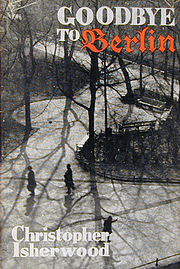 Goodbye to Berlin consists of six semi-autobiographical stories. Judging by his writing, Isherwood did not think life was a cabaret. At least not in the 1930s in Berlin.
 Although Liza Minelli’s performance is the spectacular one, all the actors are excellent. When I saw the movie again, I noticed how good Michael York is in the difficult role of Brian Roberts, a gay man trying earnestly to deny that he is gay, and failing. Sally catches on faster than he does.





 Home Projectionist