Flags, fireworks, picnics, patriotism, parades. All of these are part of the 4th of July, and they often appear in the films of Alfred Hitchcock. For this explosive quiz, match the patriotic-themed question to the correct, flag-waving answer.
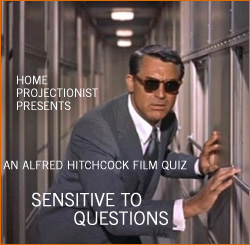
(*The quiz title was inspired by Alfred Hitchcock’s North By Northwest:“Something wrong with your eyes?” “Yes”, says the sunglass-clad Roger O. Thornhill (Cary Grant), “They’re sensitive to questions”. In the opening moments of the movie, as Roger and his secretary climb into a taxi, Roger says, “First stop, the Plaza. “Don’t throw the flag.”)
Most of the 2011 Oscar nominees are now available for home theater viewing in some form or another. Are you a self-respecting home projectionist? Do you plan on screening one or more of the nominated films for your friends or family in the near future? As a would-be theater owner, you won’t want to just roll the movie all by itself, naked, alone and afraid. You definitely will want to value-add the experience for your guests. That means giving them the right “appetizer” with their movie meal.
No visit to an actual theater is complete without an opening salvo of policy trailers, a plug for the concession stands, or pleas to pitch your trash. These are aimed at general audiences. But you can tailor yours to be compatible with your audience and the Academy Award nominee:
MY WEEK WITH MARILYN Vanessa Michelle Williams was nominated as Best Actress for her portrayal of Marilyn Monroe during the filming of THE PRINCE AND THE SHOWGIRL. Your audience for this picture might tend to skew a little older. In that case, they’ll probably remember being musically thanked for coming to the theater, and also for sitting back, relaxing, and enjoying the show (and being shushed):
HUGOIt’s possible you’ll have an excited child or two for this really terrific Martin Scorsese Best Picture nominee. “We must insist on absolute quiet!” sounds a little harsh. So why not let this gentleman do it for you:
THE HELP It’s a movie about domestic service–cleaning and (especially) cooking. So, let’s all go to the lobby to have ourselves some treats. Chocolate pie, anyone?
EXTREMELY LOUD AND INCREDIBLY CLOSE If your noisy guests are taking the “extremely loud” part of the title too literally, this short trailer may be just the thing:
MIDNIGHT IN PARISDo you have punctual friends? Friends who expect the movie to end exactly at midnight? Then you need a countdown clock:
WAR HORSEDoes your audience have an appetite like–as well as for–a horse? This elf-like creature consumes mass quantities of refreshments as he counts down the time:
TRANSFORMERS: DARK OF THE MOON This nominee’s extravagant array of visual effects calls for “the most extravagant array of refreshment goodies ever assembled under one roof!”
THE DESCENDANTS Is your audience all approximately the same age (if not as good looking) as George Clooney, the star of this excellent Best Picture nominee? Then they’ll most likely remember this catchy jingle very clearly:
All of these short, short trailers are available on YouTube. Thank you, and please deposit your trash on the way out.
For nearly ten years from the 2nd week in July to the end of August, the Chicago Park District used to put up a huge screen in Grant Park and show classic films for free. It was a very urban experience sitting outside on that classic park lawn with thousands of people watching great films. That meant that every summer, instead of watching movies at home, I would finally be getting outside, relaxing in the cool green grass…and watching movies. Redundant, isn’t it?
Several years ago when the city began to make cutbacks in events, such as no more Venetian Nights and Fourth of July fireworks, the Movies in the Park were the first to go. They were wonderful evenings. For my next few posts I’ll be remembering some of my favorite movies in the park.
There were many memorable nights in the park but nothing compares to the showing of Citizen Kane.
Now supposedly the founders of the Movies in the Park were Gene Siskel and Roger Ebert. As many of you may know, Roger had been really sick with throat cancer. For a couple years it looked like he wasn’t going to make it so for a couple seasons they let him pick the Movies in the Park. The movies shown those years came from a book he wrote about the movies you ‘need’ to see. The problem was that they were all film study class films, The Hustler, High Noon, On the Waterfront, all good movies, but not really movies that inspire festive, high spirits. Well, the opening night of the festival Roger was there to introduce his favorite movie, Citizen Kane.
(
Citizen Kane is of course a great movie, but not a movie that you want to see while sitting in the dirt in a sling chair; it’s not very campy. People can’t yell “you go girl” or “woo-hoo”.) Com Ed, one of the sponsors that year, gave out these big foam hands with the thumbs up. We were instructed that at some point everyone in the audience was supposed to hold the hands and yell “Thumbs up, Roger!”
Well, Roger came out and did his speech about the movie and how wonderful the opening shot is “blah, blah, blah.” Then we did the ‘Thumbs up, Roger,” applauded his years as a reviewer, and waited for the movie to start. I was completely unprepared for what I was about to experience.
For some unknown reason, the sound was turned up full blast. And it was DEAFENING. I grew up next to an airport and the Southwest Flight to Miami had nothing on the opening credits. I’M TELLING YOU LOUD. To top it off, Citizen Kane is a loud movie anyway. When it got to part where it jumps into the March of Time newsreel about Kane’s life and the announcer yells, “Legendary was the Xanadu where Kubla Kahn decreed his stately pleasure dome” I thought the windows on all the buildings on Michigan Avenue were going to shatter. It just seemed to get louder and louder. I remember at one point yelling in my friend Jonathan’s ear that I couldn’t stand it for very much longer: “What?” he yelled back unable to hear me. There was a very large crowd to see the film and Roger, several thousand people, but by the time Kane and his wife, the opera singer, start fighting, the sound of her screeching voice made people gathering up their blankets and run out of the park as if there was a sniper in the bushes, their hands covering their ears.
Our group couldn’t really get up and run because Hugh always brought a most elaborate spread with mini tables, candles, and silverware. The sound didn’t seem to be bothering him at all and he wasn’t about to give up one of his Movies in the Park nights for something as little as hearing loss. A couple in front of us had a great idea and they turned around to us to share it. They were ripping up the foam Ebert “Thumbs Up” hands and were frantically tearing them up and stuffing them in their ears. We all did the same and we were able to get through the film.
It was the most insane movie going experience I’d ever been through. And come to think of it, I’ve never been able to watch that film again.
For director/writer Billy Wilder’s 96th birthday, five moments that are representative of his witty, acerbic, sentimental and romantic style. (All of these films are widely available.)
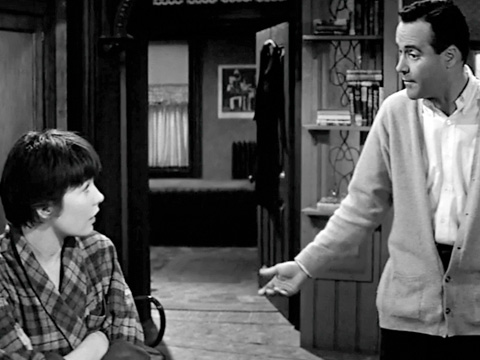
BUD (Jack Lemmon): “You can’t leave yet. The doctor says it takes forty-eight hours to get the stuff out of your system.” FRAN (Shirley MacLaine): “I wonder how long it takes to get someone you’re stuck on out of your system? If they’d only invent some kind of a pump for that…” -THE APARTMENT (1960)
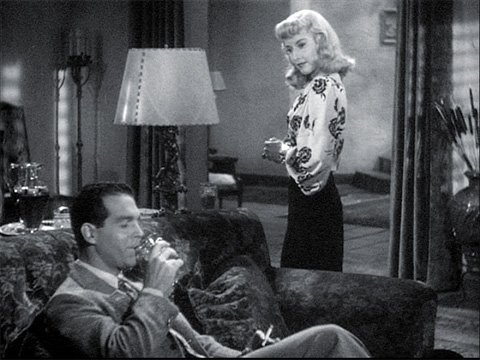
PHYLLIS (Barbara Stanwyck): “There’s a speed limit in this state, Mr. Neff. Forty-five miles an hour.”
NEFF (Fred MacMurray): “How fast was I going, officer?”
PHYLLIS: “I’d say about ninety.” -DOUBLE INDEMNITY(1944)
RICHARD (Tom Ewell): “You look to me like a big Rachmaninoff girl.”
THE GIRL (Marilyn Monroe): “I do? Funny, l don’t know anything about music.” -THE SEVEN YEAR ITCH (1955)
SUGAR (Marilyn Monroe): “I may spill something.”
JERRY (Jack Lemmon): “So spill it. Spills, thrills, laughs, games – this may even turn out to be a surprise party.”
SUGAR: “What’s the surprise?”
JERRY: “Uh-uh! Not yet!” -SOME LIKE IT HOT(1959)
GILLIS (William Holden): “Norma, I can’t take it. You’ve bought me enough.”
NORMA (Gloria Swanson): “Shut up. I’m rich. I’m richer than all this new Hollywood trash. I’ve got a million dollars.”
GILLIS: “Keep it.”
NORMA: “I own three blocks downtown. I have oil in Bakersfield — pumping, pumping, pumping. What’s it for but to buy us anything we want.” -SUNSET BOULEVARD (1950)
Marriage, for better and worse, played its part within the intricate web of Hitchcock’s films. Maybe you are not a lucky June bride, but why not try your hand at finding the compatible answers to these ten Big Questions? The quiz is moderately difficult; passing grade is 50 percent.
(*The quiz title was inspired by Alfred Hitchcock’s North By Northwest:“Something wrong with your eyes?” “Yes”, says the sunglass-clad Roger O. Thornhill (Cary Grant), “They’re sensitive to questions”. Later, as Roger and Eve are clinging desperately to the face of Mt. Rushmore, Roger says to Eve, “Well, if we ever get out of this alive, let’s go back to New York on the train together. All right?” Eve answers, “Is that a proposition?”, and Roger replies, “It’s a proposal, sweetie.”)
SUDDENLY, LAST SUMMER (with Katherine Hepburn, Elizabeth Taylor, Montgomery Clift; directed by Joseph L. Manckiewicz; 114 min.; widely available)
“My son Sebastian and I constructed our days. We would carve each day… leaving behind us a trail of days like a gallery of sculpture. Until suddenly, last summer.”
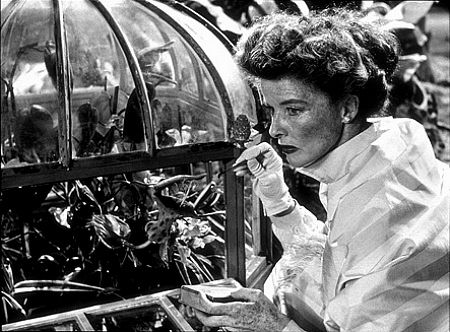
It’s not quite as tender as Night of the Iguana (my personal favorite of Tennessee Williams film adaptations), as sensual as Cat on a Hot Tin Roof (a very close second), or as powerful as A Streetcar Named Desire. Suddenly, Last Summer nevertheless is unforgettable and as steamy as a greenhouse–if only for Katherine Hepburn’s mezmerizing, tour de force portrayal of her character, the nervous and disturbed, slightly-off Violet Venable.
Venable is a wealthy New Orleans woman hiding a web of conflicted feelings and secrets. She brings houseflies (“flown in at great expense”) for her glass-encased Venus Flytrap in her ornate, “Dawn of Creation” conservatory, much like the “flies” (of a human variety) she once attracted for her departed son, Sebastian. Venable blames her son’s cousin, Catherine Holly (Taylor), for Sebastian’s death and, consequently, wants Holly Catherine to pay the price by having a lobotomy. Catherine, even though the handsome Montgomery Clift (Dr. Cukrowicz) would perform the procedure, is understandably a bit reluctant. (“Cut the truth out of my brain… is that what you want Aunt Vi ? Well you can’t. Not even God can change the truth”)
Clift’s acting, in contrast to Taylor’s, is a little on the bland side. But Liz more than makes up for it. Taylor, it goes without saying, is very beautiful in every one of her scenes. She might overact, but this is Tennessee Williams after all–over the top performances are expected and welcome, as are the typical moments of family quarrels and backbiting, and depictions of struggles with sexual identity.
As an example of a character whose every appearance will prompt hissing, look no further than Mercedes McCambridge’s portrayal of the very grating and unlikable Mrs. Grace Holly. The overwrought ending of Suddenly, Last Summer seems out of place given the tone up to that point, and is this movie’s only big drawback. But what comes before is well worth the price. Like the other T.W. films I mentioned, this one’s never dull–a movie for a group of friends to enjoy on a hot, July night, with a Mint Julep or two.
p.s. One thing to keep in mind during when the movie visits a very Snake Pit-like insane asylum is that the story is set in 1937. Things have improved a lot since then. At least one hopes they have.
“Oh, Sebastian, what a lovely summer it’s been. Just the two of us. Sebastian and Violet. Violet and Sebastian. Just the way it’s always going to be. Oh, we are lucky, my darling, to have one another and need no one else ever.”
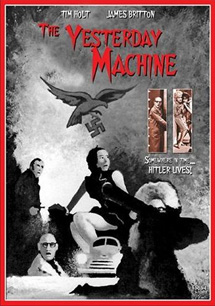
THE YESTERDAY MACHINE (1963; starring Tim Holt; directed by Russ Marker; public domain, available on DVD from Netflix, or watch the entire thing on YouTube, below)
The “plot”: It’s 1963, and an elderly Nazi scientist is attempting to change the outcome of World War II by giving Hitler a second chance via a time machine.
All right, this movie is appallingly bad. Bad print, bad sound. So bad for you kind of bad that it’s actually good. The Yesterday Machine isn’t quite in the realm of such classics as Manos: The Hands of Fate or Plan Nine From Outer Space, however it tries really, really hard.
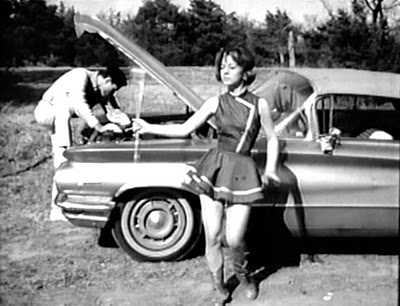
This black-and-white, public domain time travel film opens with a pretty, blonde cheerleader furiously twirling a baton. Generic teen music blares from a transistor radio that’s perched on the fender of a ’59 Buick. A college sweater-wearing, Mitt Romney-like guy–apparently the young woman’s boyfriend–is doing something beneath the hood of the car. Margie the cheerleader mindlessly twirls on. We don’t know if Mitt (actually Howie) is fixing the car, or if he’s about to go with the tried-and-true, “We’re out of gas” line.
Cinematically, things proceed to plunge rapidly downhill the moment the first lines of dialog are spoken.
“Howie, For heaven’s sake! It’s almost dark! If you don’t hurry up, we’re gonna be late for the game!”
“Margie, have you ever tried to fix a fuel pump to a rock and roll beat?”, remarks the perturbed Howie.
To find help, and this being a low-budget, B-movie, they naturally decide to cut through the nearby woods. Howie gets shot even before the credits have finished rolling. Margie and her baton vanish.
Later, at a Big City newspaper (The Sentinel), we meet an intrepid, curious, tough-guy reporter who will stop at nothing to get his story. In an unexpected, Rashomon-like sequence at the hospital where Howie’s being treated, the reporter gets the lowdown, through a flashback, about the incident. Then suddenly, we’re twisting the night away. It’s the music of Nick Niklas and “the girl with the orchid voice”, Sandra de Mar. Sandra’s song, oddly enough titled “Leave Me Alone”, is actually sung by Ann Pellegrino in her one and only film appearance.
“Go on away and leave me alone. I want to be by myself when I cry. And there’s gonna be some cryin’… I just told my baby good bye.
Get out of here and leave me alone. I don’t care whether I live or die. Cause my life’s already over, it ended when you told me good bye.
Why is it everything happens to me and my dreams just explode in my face?”
Sandra is confronted by the police about the disappearance of her sister Margie. Officer Laskey, played by Robert Kelly, shared his memories of making this movie on the Internet Movie Database:
I was honored to play Dectective Laskey in this Yesterday Machine movie. Tim Holt was a true professional to put up with a bunch of local Dallas actors and even thou this is a typically bad science fiction movie– for the time, it is OK to watch. […] I had a recording studio in Dallas, Texas at the time of the shooting of this movie and most of the interior scenes were done in the back rooms of my studio—sets built for the dungeons, and the time machine locations, etc. All of the music was recorded at my studio with the Nick Nicklas band doing the playing.
Accompanied by Tim Holt in suit and tie, De Mar visits the rural, wooded scene of the crime in a tight skirt and high heels. Outside an old farmhouse, Holt gets accosted by a storm trooper to the tune of what sounds unfittingly like the Tonight show theme. Soon, the couple realize they’re lost… in time. Sandra’s hysterical yet orchidly voice is in full flower:
“Jim! The car! It’s gone! There isn’t a telephone pole in sight! The road was paved and now it’s dirt! What’s happening? Where’s the car?? What’s going on?? Jim, someone must’ve stolen it! Tell me what’s going on! Tell me what dreadful thing has happened!! TELL ME!!!”
In a nicely done transition shot, Holt and de Mar are beamed up (or down) to the laboratory of one Professor Von Hauser, and now we are at the real, rotten core of this movie.
Jack Herman, a Yiddish theater actor, hams up his role gloriously with a thick, over the top German accent and sly, menacing expressions and outrageous gestures. I sure hate to give anything away, but prepare yourself to endure the white-haired Von Hauser’s interminably long (but hilarious) blackboard lecture, as a serious but baffled Tim Holt looks on.
“Ziss line represents za vurld… […] Ziss is to illustrate vy vee vood have von da var!! Now, vee are da masters, and time is our servant!! Aahhh, you Americans are an egotistical, arrogant lot! How proud and superior you felt as you strutted through the ruins of our cities!! Soon, Hitler will return!!!”
“I’m afraid you lost me, doctor.”
I wonder if Holt–who once was a star in Orson Welles’ The Magnificent Ambersons and John Huston’s Treasure of Sierra Madre, after all–longed for a real, working Yesterday Machine when he saw the end results of this.
It’s nevertheless a great time, and there are plenty of unintentional laughs for an open-minded group. Serve it with some bratwursts, sauerkraut, and a few Heinekens or a nice Riesling.
He’s still keeps ’em coming: Woody Allen’s new film To Rome With Love kicked off the Los Angeles Film Festival (www.lafilmfest.com) on June 14. Last year, Midnight in Paris (2011) was absolutely delightful (and who knew that I could ever fall madly for Owen Wilson?).
But for me, MANHATTAN(1979)still shines. It’s beautiful look at, has a smart script and memorable performances, and it’s a classic that deserves a revisit. I am always surprised how much I love it every time I see it, and it’s a stellar film for a Home Projectionist event.
Shot in black and white to stunningly show off the grit of the city (and the shades of gray of the dilemmas that characters face), the film is rich with Allen Angst and hapless hilarity (although you may laugh out loud only a few times). Allen — along with Diane Keaton, Michael Murphy, Mariel Hemingway, and Meryl Streep — ruminate, wallow, digress, change partners, fall in love, and fret, fret, fret, good lord how they fret about their daily little lives. And for all their self-absorption, you love them nonetheless.
The film’s locale provides a long list of options for themed entertaining. Manhattans for cocktails and an array of potential menu items from deli trays to Waldorf salad, bagels to dirty water hot dogs, and hot pretzels to New York cheesecake. (The downside is that there are so many options and it’s hard to choose.)
As a special bonus, a recent viewing of the film spawned a spur-of-the-moment, made-up game called “What You Saw In the Movie That You Don’t You See So Much Anymore.” The list included a typewriter, smoking in restaurants, luggage without rollers, a dictaphone machine, big telephones, racket ball, women with really bad perms and tiny boobs and no bras. Oh yes, and when was the last time you heard someone talking about Kierkegaard?
Gloria Bowman is a writer, storyteller, blogger, movie lover, freelance editor,
and author of the novel, Human Slices.
Access her blog at www.gloriabowman.com; on Twitter @GloriaBow
Not every one of these dads is a happy one, but here’s wishing them (and yours) a Happy Fathers Day anyway. This is by no means a list of definitive dad movies. They’re all good for a Fathers Day family screening, depending on how much of a sense of humor your dad has, and whether he and you can tolerate subtitles. (All of these films are widely available.)
MY FATHER’S GLORY (1991; France; directed by Yves Robert; subtitled) “A sweet, beautiful memory of a young boy’s favorite summer in the French countryside of the early 1900s.” –Video Hound. Followed by its equally as good companion film, MY MOTHER’S CASTLE.
THE SHINING (1980; directed by Stanley Kubrick; with Jack Nicholson, Shelley Duvall) Nicholson takes time to be with his family, including his son (Danny Lloyd) and, apparently, with other people. I’d like to see the post-trip, Trip Advisor review.
FATHER OF THE BRIDE(1950; Spencer Tracy, Elizabeth Taylor; directed by Vincent Minnelli) The Steve Martin remake is OK, but the original bride is irreplaceable. Tracy is the walking definition of the word, “curmudgeonly”.
RIVER OF NO RETURN (1954; Robert Mitchum, Marilyn Monroe; directed by Otto Preminger) “Wilder then river fury, wilder than all the savage wilderness of America, was the savageness of their love!” Dad Robert Mitchum has more than he can handle with both his son (Tommy Rettig, co-star of the TV show Lassie) and frontier showgirl Marilyn, not to mention the raging river and several, money-grubbing bad guys.
BIGGER THAN LIFE(1956; James Mason, Barbara Rush, Walter Matthau; directed by Nicholas Ray) Father thinks he knows best, but he doesn’t–it’s the drugs talking. In a way, Mason’s portrayal of a dad is scarier than Nicholson’s in THE SHINING.
DEKALOG IV(1988; Poland; directed by Krystof Kieslowski; subtitled) There’s a lot going on under the surface in this 55-min. movie. It’s thought-provoking and fun trying to figure it all out–and you might not, until the end. Part of a series of ten films, all very loosely (and mostly not all that religiously) based on the Ten Commandments, this concerns the close relationship a young woman has with the architect father she’s living with.
REBEL WITHOUT A CAUSE(1955; James Dean, Natalie Wood, Sal Mineo, Jim Backus, Dennis Hopper; directed by Nicholas Ray) Yes, another Nicholas Ray film. But no one had a better hand on the pulse of 1950s American suburban life. Backus is out of touch with his pessimistic son, who refuses his dad’s advice to wait “ten years!” for his life to change and get better.
Celebrate Fathers Day by reuniting dad with his son or daughter. In true Hitchcock fashion, these paternal figures were sometimes model parents to their offspring, sometimes not. This quiz has a fairly high difficulty level. Good luck, Mr. Thornhill, wherever you are…
*Our quiz title was inspired by Alfred Hitchcock’s North By Northwest:“Something wrong with your eyes?” “Yes”, says the sunglass-clad Roger O. Thornhill (Cary Grant), “They’re sensitive to questions”. Later in the film, the Professor (Leo G. Carroll)-responding to Thornhill’s description of Phillip Vandamm-describes Vandamm as “A rather formidable kind of gentleman, eh?”
FAHRENHEIT 451 (1966; Oscar Werner, Julie Christie; directed by Francois Truffaut; widely available)
“You see, it’s… it’s no good, Montag. We’ve all got to be alike. The only way to be happy is for everyone to be made equal. ”
Author Ray Bradbury passed away last week at the age of 91. He wrote for television, including for Alfred Hitchcock, but the most famous movie to be adapted from one of his books was Fahrenheit 451. The best-selling Bradbury novel (which I read way back when) was directed by Francois Truffaut (his first and only English film) and released in 1966. Its critical reputation has improved (“meandering narrative…”, “pretentious and pedantic…”, “an interesting miss”, in the words of critics then). I’d seen Fahrenheit before, but in light of Bradbury passing away, I wanted to re-watch it. It’s gotten better with each viewing. A very good film; not quite perfect though.
From the start, Truffaut startles with quick zooms towards what appear to be ordinary, old rooftop TV antennas. But upon closer look, they are not. They’re a little bit different. This is the future. Over these dramatic shots, we hear the credits being read by an ominous, off-screen voice. The absence of the printed word is in keeping with Bradbury’s novel (a 1984-like future in which fire departments-in-reverse burn all books–“even this one (Mein Kampf)”–and sometimes their owners, with extreme prejudice. I don’t recall seeing (actually, hearing) this technique anywhere except in Welles’ Magnificent Ambersons (readers may want to help me out here…). Composer Bernard Herrmann created one of his best scores for Fahrenheit 451, and to his credit he (reportedly) resisted requests to use it during these opening “titles’. Immediately after these credits, however, Herrmann’s music gets underway. It’s urgent, unique, oppressive and authoritarian, all at once. The childlike xylophone has an accompanying visual: a bright red fire truck carrying a squad of fire lighters. It looks remarkably like a child’s toy as it races through the countryside–not to put out a blaze but to start one.
With the exception of glimpses of the pages of books, and “The End”, there is no text anywhere in the film. Not on or in any building (the fire station exterior simply reads “451”). Not during the odd, intrusive and sterile television programs Linda Montag (Julie Christie) watches on her “wall screen”. Christie’s husband, Guy, (Oscar Werner), aspires to a second screen (and, being a “guy”, he will most likely want a bigger one).
Christie also plays the part of Clarisse, a free spirit compared to the Stepford Wife behavior of her Linda character. She’s very direct while commuting via the monorail, initiating a conversation with the reclusive fellow traveler Montag, who is intrigued by her persistence. “Why do you burn books?”, she questions cheerily.
This is a thought-provoking film. Books in Fahrenheit 451 are looked upon much like how we view illegal drugs today. Books in this book-less new world are “used” even though they can “cause unhappiness”. They’re hidden away in homes. People who’ve read them all their lives, can’t stop–and would rather die than withdraw from reading. Confiscations of books are announced by weight (“Today’s figures for operations in the urban area alone account for the elimination of a total of 2,750 pounds of conventional editions…”). Whether you’re a casual or an avid reader, these firemen are not your friends.
A middle-aged “book lady” says, “These books were alive; they spoke to me!”. She meets, voluntarily, a horrible fate. Perhaps she didn’t know that books could continue to speak to her, in the true sense of the word. Some distance away from this restrictive society, there is a place where books are kept alive. A precious few have memorized one book a piece. With these wandering souls, books will live forever. They’ll be passed on to other, younger people.
Questions remain. There are only so many folks out there in that forest along the river and abandoned railroad tracks. Just how many books can possibly be saved? Why do the authorities leave them alone? Wouldn’t they suspect Montag (who is not as sympathetic a character as he should be) would be hiding among them? With helicopters and men in jet packs (an unfortunately poor special effect) at their disposal, how could the authorities miss this community–a community that could easily be wiped out without consequence.
Then there’s the two, trouble-prone young firemen at the station. What are the misdeeds they are berated for? It’s sort of funny that it’s never explained; it appears as though it might be a subplot left on the cutting room floor–one of a few plot threads that don’t go anywhere. There’s also Montag’s surprise (or is he faking it?) that there could be such a thing as a non-fireproof house, and his response to Clarisse’s astonishment that fireman once extinguished fires. (Surely large fires must still occur… .)
In the end, the literary scofflaws who’ve become the books they’ve read and memorized, walk through the snow-covered, leafless woods–woods that once, in a way, were the carriers of those words. It’s a moving and unforgettable scene, sad and yet a little hopeful, with beautiful, moody music to match. But the pace is off a bit there, too–the film ends a little bit abruptly. The romance here is about our love of books. The romance between Clarisse and Guy, which needs some resolution or fulfillment–one more chapter–is a loose end that is not tied-up.
This dark, cold movie is not going to be everyone’s cup of tea. But it’s a thoughtful, cautionary story, and it’s not to be missed by anyone who’s ever read a book they wished would never end. Machines are gradually intruding on the lives of the film’s inhabitants, says one character, slowly taking them over. It’s the future in Fahrenheit, but that line was written 50 years ago. “Wall screens” (big, LCD and plasma sets), street corner cameras, satellite views, mindless TV programming and drone surveillance are a reality here in 2012. This is entertainment for us in the here and now, but once the movie’s over, you’ll wonder if the bleak future the movie depicted is as far-fetched as it seemed in 1966.
Sometimes movie nights can be unplanned and spontaneous. I’ve stressed out many times over what movie to show feeling that if it wasn’t right and a success that it somehow was a reflection on me. I’ll do some posts later on this, but I wanted to relate an alternative to the planned movie night. I’ve been calling them Random Noir Nights. This Saturday was sixth of these nights that have sort of sprung up organically. A few friends know I have a 100 inch screen and that usually on the weekends I’ll be watching something.
The past couple weeks I’ve had a small group of friends stop by and instead of planning a movie I’ve been just going to my Netflix Streaming queue in which I have over 400 movies lined up and we just pick a movie at random. The only bit of planning we might do is to read the short description of film to see if its something that we all agree on. But I don’t like this process to go on more than a couple minutes. The other thing I’ve been insisting on is that the film be no more than an hour and a half; and less than that is even preferable. This way if its bad, its not that big of an investment of time and usually you fit in two movies in an evening.
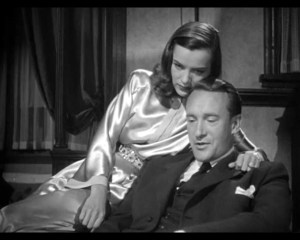
Surprisingly this process has come up with some interesting and delightful surprises. This week we picked a movie pretty much on its name alone. The Strange Affair of Uncle Harry (1945, Universal).
Now I consider myself a pretty knowledgeable film buff and especially of films that are a little out of the ordinary. So I was shocked I’d never head of this bizarre little thriller, film noir that plays like the lost, illegitimate child of Alfred Hitchcock and Carson McCullers . The story is about a three siblings living in the family home in a small town where they were once leading citizens. Their fortune was lost in the depression and the youngest son (George Sanders) is forced to work drawing flowers for fabric for the local textile mill. I found this fascinating because I always wondered who designed those sad flowers that are always found on sheets and pillowcases. George is living with his two older sisters who depend on him to keep the family home running. The eldest is a widow played by Moyna MacGill (Angela Lansbury’s mother) The other sister is played by the brilliant Geraldine Fitzgerald. Early on you learn that Lettie (Fitzgerald) is a drama queen who uses a fake heart aliment to keep Sanders under her thumb. Complications ensue when a beautiful lady designer comes from New York and sweeps timid George off of his feet.
This is where the plot gets strange as Lettie begins to sabotage her brother’s wedding plans. I’ve never seen incest played so delicately, yet so blatantly in a film. There is no doubt in the audience’s mind that Fitzgerald is in love with her brother and she will do anything so that no other woman will have him. For once George Sanders as Uncle Harry is a sympathic character, even though he is driven to extremes, you are rooting for him to get free of his clinging family.
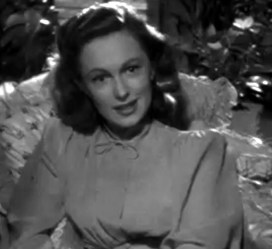
One of the best scenes in the film (posted below) is where Uncle Harry is getting to know Miss Brown played by the beautiful and largely forgotten, Ella Raines. The scene is a masterful dance of double entendres. It’s all seemingly innocent. but you can read between the lines as they the talk of hung stars that need polishing and Uncle Harry’s nine inch telescope which they will watch Saturn’s rings, but they’ll have to wait until it rises high enough. It got a few gasps out of the group.
The whole production has a feel of Hitchcock’s 1940’s films. That is probably because Joan Harrison, screenwriter of Suspision, Foreign Correspondent, Rebecca, and Sabatouris credited as the producer. It is rare that you see a female producer on any films, let alone one made in 1945. Robert Siomak (Cobra Woman, Spiral Staircase) does a fine job of directing. And even though he’s no Hitchcock he does elevate this B-film to a quality production. The film reminded me in some ways of Shadow of a Doubt because of the colorful town characters that are peppered throughout the film. Most notably. Ethel Griffies who is best known to Hitchcock fans as the Mrs. Bundy, the know it all ornithologist from The Birds.
Director Robert Siodmak does a fine job in pulling all of the elements together and makes this a tight, little thriller. Not to give away any spoilers for this film, but it has to be noted. As I’ve said this film was a wonderful surprise and everyone who watched it on Saturday loved it. However, the ending of this film nearly ruins the previous 78 minutes that came before it. You’ll go away shaking your head and saying ‘What, the hell just happened?’ It’s like the movie swirves off the road and goes into a corn field. You’ll know when it happens!
But it was a lucky and happy random movie pick. At a quick 80 minutes its the perfect length, lots of fun campy lines, a good story that never seems to go where you think its going. And on top of that a softball team comprised of 1940’s beauties. That alone is worth the price of admission!
A toast to Dino, who might’ve celebrated his 95th birthday today by visiting the beverage cart and fixing himself “a salad”. Five recommended movies; all are widely available:
THE YOUNG LIONS(1958; directed by Edward Dmytryk) Martin plays “the Broadway wise-guy” in this seriously underrated WWII picture. Also starring Marlon Brando and Montgomery Clift.
.
HOLLYWOOD OR BUST (1956; directed by Frank Tashlin) Dean and Jerry’s last picture. It’s a lighthearted, colorful, cross-country road trip, with a dog who almost steals the show. Martin’s annoyance with Lewis sometimes appears to be more than just acting. Lots of fun.
.
KISS ME STUPID (1964; directed by Billy Wilder) Dino plays himself as a visitor to Climax, Nevada, in this dark and suggestive Billy Wilder comedy. Great lines, like “I need another Italian song like a giraffe needs a strep throat” and “You ain’t heard nothin’ sung until you heard me sung it!”. Also with Kim Novak.
.
RIO BRAVO (1959; directed by Howard Hawks) Terrific western with Angie Dickinson, John Wayne, Walter Brennan and Ricky Nelson. Dean is a cowboy with a drinking problem and a reputation to repair.
.
SOME CAME RUNNING (1959; directed by Vincent Minnelli) Bitter WWII vet Frank Sinatra (“Buy yourself a Quonset hut!”) bumps into Bama Dillert (Martin), a professional gambler. Dillert wears a big hat–no matter what he’s doing. Also with Shirley MacLaine.
If I ever write a Ten Tearjerkers list for Home Projectionist, The Umbrellas of Cherbourg (1964) will be on it. Its director, Jacques Demy, died too young (1990); he would’ve been 81 years old today. Because it has its very sad moments (in addition to many joyous ones), I hesitate to say it’s a “crowd pleaser” but, it is–so long as you have a box of Kleenex near your guests in addition to the popcorn. Make it a Demy double feature by showing its equally-as-good sequel, The Young Girls of Rochefort. (Starring Catherine Deneuve; Music by Michel Legrand; both films are widely available.)
How well do you know Alfred’s authors? We’re talking about Alfred Hitchcock, of course. For this ten-question quiz, the first in a series, you’ll have to match the Master of Suspense’s movie with the writer whose book the film was based on. I’d rate the quiz moderately difficult, but let me know what you think. Good luck, Mr. Thornhill, wherever you are…
*Our quiz title was inspired by Alfred Hitchcock’s North By Northwest (Dave’s favorite movie): “Something wrong with your eyes?” “Yes”, says the sunglass-clad Roger O. Thornhill (Cary Grant), “They’re sensitive to questions”. Locked in the villainous Van Damme’s (James Mason’s) elegant and fully-stocked library, Grant cracks, “Don’t worry about me, I’ll catch up on my reading.”
Not just another WordPress.com site, but an extraordinary place to spend a weekend, grill a cheese sandwich and watch a film to improve your life and stimulate a few of the grey cells.







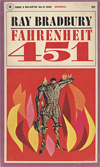 Author Ray Bradbury passed away last week at the age of 91. He wrote for television, including for Alfred Hitchcock, but the most famous movie to be adapted from one of his books was Fahrenheit 451. The best-selling Bradbury novel (which I read way back when) was directed by Francois Truffaut (his first and only English film) and released in 1966. Its critical reputation has improved (“meandering narrative…”, “pretentious and pedantic…”, “an interesting miss”, in the words of critics then). I’d seen Fahrenheit before, but in light of Bradbury passing away, I wanted to re-watch it. It’s gotten better with each viewing. A very good film; not quite perfect though.
 Then there’s the two, trouble-prone young firemen at the station. What are the misdeeds they are berated for? It’s sort of funny that it’s never explained; it appears as though it might be a subplot left on the cutting room floor–one of a few plot threads that don’t go anywhere. There’s also Montag’s surprise (or is he faking it?) that there could be such a thing as a non-fireproof house, and his response to Clarisse’s astonishment that fireman once extinguished fires. (Surely large fires must still occur… .)





 Home Projectionist