
ear•nest (adjective) Resulting from or showing sincere and intense conviction.
Forgive my play on words, but one of the late Ernest Borgnine’s finer qualities as an actor was, indeed, yes — his earnestness. Sincerity. Conviction. Borgnine brought both to the many roles he played in movies and television. Two examples:
In one of the best, most thoroughly entertaining World War II films (if any war movie can be termed ‘entertaining’), THE DIRTY DOZEN (1967), I have a sense that Borgnine plays himself. He is a no-nonsense, professional soldier, General Sam Worden. Early in the picture as Worden explains to Major Reisman (Lee Marvin) the task he’s being given–to take 12 irredeemable inmates on a suicidal, behind-the-lines sabotage mission–Borgnine is hard-as-nails tough. He’ll have none of Marvin’s snide sarcasm, even though, as the movie progresses, we’ll see the mutual respect and understanding they have for each another.

“Well you hold it, right there. This war was NOT started for your private gratification! And you can be DAMN sure this Army isn’t being run for your personal convenience either!”
Nothing captures Borgnine’s basic affability (despite the bulldog-like barking) better than the war games sequence, during which he gives a knowing wink and a nod to Lee Marvin’s gang’s clever but barely permissable shenanigans. Realizing just what the Dozen are up to, and he, himself, probably having seen it (and done it) all before, he can’t help himself from showing his jolly, inner core. It seems very unfeigned, and it’s a terrificly memorable moment from Borgnine–one of the best in a movie that has plenty of great ones.

So then, how could anyone not like Ernest Borgnine. Well, in FROM HERE TO ETERNITY (1953), he plays Sgt. Judson, better known, unaffectionately, as “Fatso” (but yet it’s a moniker he can deal with, in more ways than one). Fatso is in charge of the stockade. He has a reputation, a very bad one, and everyone is aware of it. Borgnine shows his amazing range in this role, making us really and truly despise this lowlife, bigoted bully who abuses his power. (Of course, a bravura performance from Frank Sinatra (as Maggio) helps, too.)
Fatso has set up a nice little fiefdom for himself, one in which he’s free to dole out whatever physical punishment he chooses, while his superiors, who are aware of it, apparently look the other way. The sheer ease with which Borgnine pulls-off this out-of-character role is something to behold. He barely smiles in any of his scenes. But when Borgnine does, it’s somehow not the ingratiating grin we’re used to (as in THE DIRTY DOZEN, above). He makes Fatso into an unquestionably unlikable character–not a single redeeming quality (“I’m gonna cut this Wop’s heart out…”), and then makes it a pleasure for us to watch him get brought down to size by (brilliant) Burt Lancaster. Fatso’s met his match and knows it, but within seconds he’s back to his old, despicable self, taunting and name-calling Maggio once again (“Tough monkey…”).
Sincerity and conviction. It’s found in Borgnine’s other films, too. JOHNNY GUITAR, FLIGHT OF THE PHOENIX, MARTY, THE POSEIDON ADVENTURE, and many others. But if you and/or your friends and family haven’t seen him in anything but McHale’s Navy, you can’t do any better than to start with these two, outstanding films. (FROM HERE TO ETERNITY and THE DIRTY DOZEN are both widely available, including on Netflix and iTunes.) 







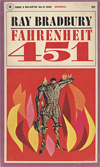 Author Ray Bradbury passed away last week at the age of 91. He wrote for television, including for Alfred Hitchcock, but the most famous movie to be adapted from one of his books was Fahrenheit 451. The best-selling Bradbury novel (which I read way back when) was directed by Francois Truffaut (his first and only English film) and released in 1966. Its critical reputation has improved (“meandering narrative…”, “pretentious and pedantic…”, “an interesting miss”, in the words of critics then). I’d seen Fahrenheit before, but in light of Bradbury passing away, I wanted to re-watch it. It’s gotten better with each viewing. A very good film; not quite perfect though.
 Then there’s the two, trouble-prone young firemen at the station. What are the misdeeds they are berated for? It’s sort of funny that it’s never explained; it appears as though it might be a subplot left on the cutting room floor–one of a few plot threads that don’t go anywhere. There’s also Montag’s surprise (or is he faking it?) that there could be such a thing as a non-fireproof house, and his response to Clarisse’s astonishment that fireman once extinguished fires. (Surely large fires must still occur… .)


 Home Projectionist