ON THIS DAY in 1963, the Moscow-Washington “hotline” or “red telephone” between Russia’s Kremlin and the White House, went into operation. In 1964, the Sidney Lumet film FAIL-SAFE featured the hotline in scenes with Henry Fonda as the President.


ON THIS DAY in 1963, the Moscow-Washington “hotline” or “red telephone” between Russia’s Kremlin and the White House, went into operation. In 1964, the Sidney Lumet film FAIL-SAFE featured the hotline in scenes with Henry Fonda as the President.

ON THIS DAY in 1930, the last 36 remaining inhabitants of St. Kilda, Scotland, were evacuated to the mainland at their own request. Director Michael Powell’s 1937 film, THE EDGE OF THE WORLD, shot on the Shetland Island of Foula, was inspired by the the St. Kilda story.
ON THIS DAY in 1963, the March on Washington for Jobs and Freedom took place near the Lincoln Memorial in Washington, D.C. The rally called for civil and economic rights for African Americans, and featured Martin Luther King Jr.’s “I have a dream” speech. The 1963 short film, THE MARCH ON WASHINGTON, documented this historic event.
IF YOU HAPPEN to be a Londoner who loves movies, or a movie lover who loves London, you will be, or can be, exactly where you should be starting September 1st. And that is at the BFI Southbank for screenings of Sight and Sound’s Ten Greatest Films of All Time…
ON THIS DAY in 1172, Henry (“the Young King”), 17-year-old son of King Henry II, married Margaret of France and was crowned King of England. In 1964, he was portrayed by Riggs O’Hara in the film BECKET, directed by Peter Glenville, and starring Peter O’Toole and Richard Burton.

If you spent most of your time watching movies this past week, you might have missed these articles here at Home Projectionist:
Visit Home Projectionist on Facebook
ON THIS DAY in 1429, Joan of Arc, patron saint of France, marched triumphantly into Paris during the Hundred Years War. In 1957, Otto Preminger’s film, SAINT JOAN, starring Jean Seberg and adapted from a George Bernard Shaw play, told the story of this and other events in her life.
ON THIS DAY in 1758, King Frederick the Great’s Prussian army defeated Russian troops at the Battle of Zorndorf during the Seven Years War. Segments of Stanley Kubrick’s 1975 film, BARRY LYNDON, with Ryan O’Neal, were set against this conflict.
A WESTERN set in the 1800s would seem to have little or nothing in common with a Christmas movie set in the 1940s. One is about a dangerous outlaw seeking revenge on the sheriff who sent him to jail. And the other is about an angel getting his wings. So I would have thought up until last Monday night. That’s when I saw–for only the second time in my life–HIGH NOON, the 1951 Fred Zinnemann classic, and began comparing the two films (as well as realizing I was surely not the first moviegoer to do so).
Maybe it was the appearance of character actor Thomas Mitchell (playing a trusted friend in both films) early on that made me think of IT’S A WONDERFUL LIFE. Or maybe it was seeing a happy couple having their wedding day abruptly interrupted. In NOON’s case, the imminent run-in with a dangerous outlaw; in LIFE’s case, a dangerous run on George Bailey’s father’s bank. A curious coincidence. But then there are other similarities–some more obvious than others–between the two.
The hero is an American everyman. A man with ideals, character, and dreams–dreams of romance with a lovely, wholesome woman (Grace Kelly–a Quaker; and Donna Reed), unhappy with his life in the small town.
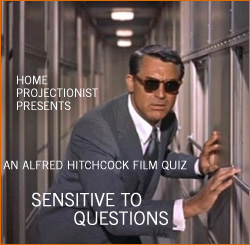
Good evening. A great many of Hitchcock’s characters had brushes with death. Jimmy Stewart, for example, was asked, somewhat unkindly, to exit his apartment via the REAR WINDOW. Which, unfortunately for him, was not at ground level. But sometimes Hitch’s protagonists were more concerned about paint brushes than the art of survival. This quiz will test your knowledge of the art of Alfred Hitchcock. Specifically, the artful works contained within his films.
Good luck, Mr. Thornhill, wherever you are…
Take the Quiz!(*The quiz title was inspired by Alfred Hitchcock’s North By Northwest: “Something wrong with your eyes?” “Yes”, says the sunglass-clad Roger O. Thornhill (Cary Grant), “They’re sensitive to questions”. At an art auction, Vandamm (James Mason) asks Roger about the purpose of his visit: “Could it be an overpowering interest in art?”)
ON THIS DAY in 1944, General Patton’s Third Army joined French forces to begin the Liberation of Paris. The 1965 film, IS PARIS BURNING?—with Jean-Paul Belmondo, Alain Delon, Orson Welles, and a screenplay by Francis Ford Coppola and Gore Vidal—documented this event.
Artist Andrew DeGraff is a fan of Alfred Hitchcock’s 1959 film, NORTH BY NORTHWEST. He’s also a terrific artist, as is evident with his detailed, graphic homage to Hitch’s masterpiece. DeGraff:
I’ve loved “North by Northwest” since the first time I saw it – the visuals, the music, the tiny razor gags, but most of all, the urban/rural scene hopping, from New York, to Chicago, to South Dakota. So – I thought I’d throw together a sort of scenic chart of all the actual locations in the movie – the only fictional one being the Northwest Airlines terminal, which no longer exists and I couldn’t find reference for (but for “North by Northwest”, I figured I’d take a little liberty).
Also not included are the 1212 Michigan Ave Auction house and the hospital in Rapid City, as they were shot on soundstage in Hollywood. Even with that, it was a bit of a beast.
Lots of research, lots of windows . . . The cars are also accurate from the initial 57 Skoda 440 cab to the ’51 White Freightliner the plane crashes into, to the ’52 Ford Customline Cary Grant rescues the girl in. I took color from the footage to get some of that “technicolor” feel, and blatantly ripped off Saul Bass’ opening credit arrows to show the action.

As a big fan of the movie myself, of course, I’ve taken the liberty of identifying the locations DeGraff has so beautifully and painstakingly illustrated. Be sure to check out some of his other, excellent work here.
ON THIS DAY in 79 A.D. (the feast day of Vulcan, Roman god of fire), Italy’s Mount Vesuvius began erupting, eventually leading to the destruction of the city of Pompeii. In 1959, THE LAST DAYS OF POMPEII, starring Steve Reeves, and written by Sergio Leone, documented the events.
ON THIS DAY in 1952, the notorious penal colony of French Guiana (Devil’s Island)-in operation since 1852-was permanently closed. The 1973 film, PAPILLON, with Steve McQueen and Dustin Hoffman, was based on the book of the same name, written by a Devil’s Island prisoner’s memoir.



A bucket list blog: exploring happiness, growth, and the world.
this blog will disappear on the day that my heart is alive again
Where classic films stand out above the rest
The Power of Words
Incredible tips for Classrooms and Staffrooms
Watch as I amaze and astound with opinions about what TV shows I like!
Political Co-Dependency Intervention
Tablecloths, Table Toppers, Placemats our specialty
I blog about everything and anything, never hesitate to question....
The works and artistic visions of Ken Knieling.
entertainment & belief go heart to heart
the Story within the Story
Horror With Humour
unparalleled film reviews, news, and top 10s
Mostly movies with a smattering of TV, books, and LEGO thrown in!
MUSINGS : CRITICISM : HISTORY : NEWS
Film, Comics, Music, News, You want it? We've got it!
On This Day....
Celebrate Silent Film
...a classic film and TV blog
Entertainment and Everyday News brought to you in a flash
wendy maruyama, art work, executive order 9066, the tag project
A guy with a desk...
www.attentiallupo2012.com
Improving the English language one letter at a time
Seek first the kingdom of God and his righteousness. (Matthew 6:33)
draws comics
Canadian trivia and history in bite size chunks!
“There are always two people in every picture: the photographer and the viewer.” -Ansel Adams
Independent movie reviews and more...
Stories
The life and times of Erik, Veronica and Thomas
a site for movie lovers' eyes
Short reviews on high quality films. No spoilers.
For the Love of Leading Ladies
A blog for movie enthusiasts and weed lovers
A Blog For Every Movie Lover
knitting and blogging in Italy in times of economic crisis
** OFFICIAL Site of Artist Ray Ferrer **
Not just another WordPress.com site, but an extraordinary place to spend a weekend, grill a cheese sandwich and watch a film to improve your life and stimulate a few of the grey cells.
 Home Projectionist