ON THIS DAY in 1832, novelist Louisa May Alcott was born in Germantown, Pennsylvania. Her most famous novel, LITTLE WOMEN, was adapted for the screen in 1933 by director George Cukor, and starred Katharine Hepburn.


ON THIS DAY in 1832, novelist Louisa May Alcott was born in Germantown, Pennsylvania. Her most famous novel, LITTLE WOMEN, was adapted for the screen in 1933 by director George Cukor, and starred Katharine Hepburn.
Before the creation of censorship guidelines, Hollywood loved its lascivious stories. And while not every “pre-code” film is a winner, SEARCH FOR BEAUTY (1934) is a stunner, complete with laugh-out loud lines…and even naked butts!
The story follows three hapless ex-cons (brilliantly played by James Gleason, Robert Armstrong, and Gertrude Michael) who are looking to get into something “legit.” They buy a defunct business operation that includes a health magazine and a spa facility, referencing the notoriety of real-life health guru/pulp publisher Bernarr MacFadden (who is a full story in himself).
The cons attend an Olympics competition and are inspired by the bodies beautiful of Ida Lupino, a champion diver, almost unrecognizable with bleached blonde and Harlow eyebrows, and hottie Buster Crabbe, U.S. Olympic swimmer. Crabbe is delightfully innocent as Don Jackson, who makes a plea to the audience cheering the receipt of his gold medal, “You guys in the seats! Get out of the stands and exercise!”
The cons get the idea to recruit the athletes as their magazine editors to give their new “health” publication credibility. In reality though, they’re looking to market a beefcake and cheesecake rag.
While the cons start working on their ruse, they send Crabbe on a global tour to find the most beautiful bodies in the world. After coming up with a boatload of healthy and bright bathing beauties, Crabbe and Lupino quickly discover the cons’ true motive and make a deal to get out their contract. The cons negotiate and Crabbe and Lupino end up with the dilapidated health farm. But Crabbe has a big vision that he can make a spa a viable operation.
Unfortunately, trouble ensues when the cons cut back into Crabbe’s business and promote the health farm as a sexcapade getaway.
The film is funny , filled with great lines like, “You can’t treat our guests like a bunch of Bo-Hunks in a box car,” but it does border on creepy when the masher guests (both male and female) start soliciting their innocent trainers for sex. A scene in one of the hotel rooms is a disturbing cautionary tale for the “good girls” out there. “I have nothing against sex,” one of the cons says, “Either you have it or you’re looking for it.”
Not every pre-code movie is a crowd pleaser, but check out this inspired production number for opening night at the fat farm. Get ready to work out!
COLLECTION NOTES: Every film fan needs a good collection of pre-code films and they’re readily available. Warner Bros., with TCM, released “Forbidden Hollywood Collection” in 2006, and just recently Sony and TCM have recently released “Columbia Picture Pre-Code Collection” and “Frank Capra: The Early Collection.” Go to TCM for for a look.
Gloria Bowman is a writer, storyteller, blogger, movie lover, freelance editor,
and author of the novel, Human Slices.
Access her blog at www.gloriabowman.com; on Twitter @GloriaBow
ON THIS DAY in 1582, William Shakespeare and Anne Hathaway purchased their marriage license while at Stratford-upon-Avon. Shakespeare’s marriage to Hathaway was depicted in the 2005 BBC drama, A WASTE OF SHAME.

WILL THE RECENT debut of Sacha Gervasi’s HITCHCOCK spawn similar films that deal with singular, cinematic efforts to create a single motion picture? The field seems ripe for exploitation. Sure, there are interviews and short documentaries with directors on many DVDs and Blu-Ray disks nowadays. But maybe someone, someday will mine the minefield that was Michael Cimino’s HEAVEN’S GATE, for instance, and turn it into a major motion picture in its own right.
Here we present eight-and-a-half films about films, by no means a definitive list, and in no particular order–directorial efforts in which a director had to struggle, take a personal journey, or by sheer force of will, will them into existence:
WHITE HUNTER, BLACK HEART (1990; directed by Clint Eastwood) Ostensibly about an adventuring movie director named John Wilson, it’s quite obvious that the hunter with the black heart really is John Huston. The film is based upon Peter Viertel’s book about the storied filming of THE AFRICAN QUEEN, which Huston shot mainly on location, and which Huston/Wilson uses as an excuse to pursue the pleasures of life, pleasures that included ending the lives of African elephants–whether those pursuits have a negative effect on the movie production or not. 
~~~
HEARTS OF DARKNESS: A Filmmaker’s Apocalypse (1991) By now, everyone knows that Francis Ford Coppola’s APOCALYPSE NOW was a troubled production, to say the least. All you need to do is add together Martin Sheen’s heart trouble, the Phillipine climate and the name Marlon Brando. This fascinating documentary follows the shooting of this terrific movie-one that captures the essence of the Vietnam war experience.
~~~
CRIMES AND MISDEMEANORS (1989; directed by Woody Allen) This is a personal favorite of mine, among all of Allen’s films. Actually, several stories converge here, only one of which is really about Allen’s filming woes. His task is to create a documentary about his brother-in-law, the conceited character played by Alan Alda, who says to Allen, “You’re not my first choice”. During the course of the filming, Allen falls in love and grows to detest the obnoxious Alda, who delivers the classic line, “Comedy equals tragedy plus time.” 
~~~
ON THIS DAY in 1978, San Francisco mayor George Moscone and city supervisor Harvey Milk were assassinated. The 2008 Gus Van Sant film, MILK, starring Sean Penn, documented this event.
WUTHERING HEIGHTS IS THE ONLY NOVEL by Emily Brontë, who died in 1848 at age thirty. It has been adapted for the movies nine times (1920, 1939, 1954, 1970, 1985, 1988, 1992, 1998, 2011) and for television at least four times. Bernard Herrmann wrote an opera based on it.
Its theme: deny the heart at your peril.
 The Novel
Wuthering Heights is a difficult read, with two narrators, a tricky timeline, and complicated family relationships. Brontë buries plot points deep within long paragraphs.
It plays like an operatic tragedy. This is the story:
Cathy and Heathcliff have known since childhood that they are soul companions. However, at around age twenty Cathy decides to marry Edgar Linton. He is wealthy, handsome, intelligent, and kind, and he is smitten with her. She believes she can marry Edgar and continue to love Heathcliff. Really.
Ellen, a young woman who is both family servant and friend, subjects Cathy to a “catechism of love.” Cathy breaks down and admits that the marriage would be a mistake.
She marries Edgar anyway.
Cathy dies shortly after giving birth to her and Edgar’s daughter. Edgar’s sister, Isabella, goes after Heathcliff in the long tradition of nice girls throwing themselves at bad boys. He detests her. One of the first things he does is hang her pet dog from the garden gate (Ellen cuts the dog down before it dies).
He marries Isabella anyway.
Isabella wises up fast, flees from him, gives birth to their son, and dies a few years later. Heathcliff, embittered by the great unresolved passion in his life, becomes a monster. He is abusive to his son and cruel to Cathy’s daughter. He is tormented by memories of Cathy and visions of her ghost. Eventually he stops eating and dies.
Passionate, brutal, and darkly mystical—those are some words for Brontë’s novel. It has a fourth quality not always associated with the first three: it is very smart. Emily Brontë obviously was the sort of person who could walk into a room and see straight through everyone in it. She did not keep quiet about what she saw.
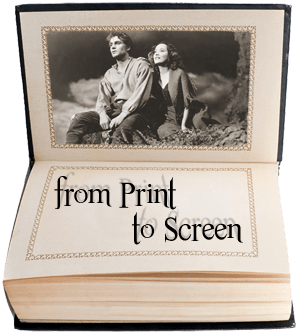
William Wyler’s WUTHERING HEIGHTS, with Laurence Oliver and Merle Oberon, is the distilled, purified essence of Brontë’s novel: romantic and beautiful even in tragedy. It has a happy ending that Wyler disowned.
Merle Oberon’s Cathy is passionate. However, it is impossible to imagine her getting into such a rage that her ears turn red, or ripping open a pillow with her teeth—though Brontë’s Cathy does both those things. Olivier’s Heathcliff is angry and tormented, but he is not a monster.
Never are viewers given cause to go out of sympathy with this pair.
The movie leaves out the children. Inconvenient children are often omitted in the translation from print to screen. (For example, GONE WITH THE WIND’s Scarlett O’Hara has three children in the book, but only one in the movie.) However, this omission removes a point Brontë thought important: how unresolved passion blights not only the present but the future (shades of CLOUD ATLAS there).
While browsing the WUTHERING HEIGHTS YouTube clips, I noticed that removing the dialogue punches up the movie’s power. Without words, it becomes more fiery, more like its source material.
Here is a video set to “My Immortal”:
Lindsay Edmunds blogs about robots, writing, life in southwestern Pennsylvania, and sometimes books and movies at Writer’s Rest. She is the author of a novel about love in the age of artificial intelligence: Cel & Anna.
ON THIS DAY in 1939, singer and actress Tina Turner was born. Turner was portrayed by Angela Bassett in the 1993 biographical film, WHAT’S LOVE GOT TO DO WITH IT?.
ON THIS DAY in 1947, the “Hollywood Ten” were cited for contempt of Congress and blacklisted by movie studios after refusing to answer the House Un-American Activities Commission’s questions. The 1976 Martin Ritt film, THE FRONT, starring Woody Allen and Zero Mostel, dramatized the subsequent events surrounding the blacklist.
Ten hours into THE STORY OF FILM: AN ODYSSEY (2011), my head was reeling with “begats,” such as this-scene-was-influenced-by-this-scene-which-was-influenced-by-this-scene etc., etc. In sum, like all art — and life itself — filmmaking is influenced by what has come before, the impact of cultural and political changes, and what technology allows. As this history of film gathers steam across time, the cross-pollination of influences and innovation gets more and more diverse and less linear.In the segments of THE STORY OF FILM that explore movies of the 1960s and 1970s, filmmaker and historian Mark Cousins examines the influential directors of Europe’s New Wave, the emergence of a new, “dazzling” world cinema, and the evolution of American film post-Hollywood’s Golden Age. As this new wave of world cinema grows and matures, filmmaking around the world doesn’t just reflect culture, it attempts to change it.
Here are only just a very few of the notable films cited by Cousins from the world cinema directors of the 1960s and 1970s to add to your Watch List:
-Roman Polanski’s TWO MEN AND A WARDROBE (1958) and THE FEARLESS VAMPIRE KILLERS (1967)
-Andrei Tarkovsky’s ANDRE RUBLEV (1966)
-Milos Forman’s THE FIREMAN’S BALL (1967)
-Nagisa Oshima’s BOY (1969)
-Vera Chytilova’s DAISIES (1966)
-Ousmane Sembene’s BLACK GIRL (1969)
-Ritwik Ghatak’s THE CLOUD-CAPPED STAR (1960)
-Werner Fassbinder’s THE BITTER TEARS OF PETRA VAN KANT (1972)
-Donald Cammell & Nicholas Roeg’s PERFORMANCE (1970)
-Bernardo Bertolucci’s THE CONFORMIST (1970)
One of the most spellbinding moments in THE STORY OF FILM is watching the beautiful and imaginative continuous shot from the funeral scene in I AM CUBA (1964) by Mikhail Kalatozov. What an achievement — without computer-generated graphics. You can watch this one again and again.
Following the growth in world cinema, Cousins opines that American film of the ’70s was next up for a sea change, emphasizing the cynical and dissident films, such as Mike Nichols’ THE GRADUATE (1967) and CATCH 22 (1970); the “assimilationist” film, like Peter Bogdanovich’s THE LAST PICTURE SHOW (1971), which simultaneously pays homage to film’s past and its future; and identity films, such as Martin Scorsese’e ITALIANAMERICAN (1974).
The next era covered in THE STORY OF FILM “ushers in the age of the multiplex,” with blockbusters like JAWS, STAR WARS, and THE EXORCIST from the States, and Bollywood and Bruce Lee from Asia. Stay tuned….just a few more hours to go!
______
THE STORY OF FILM: AN ODYSSEY (2011) is a 15-part, 15-hour documentary exploring the convergence of technology, business, intelligence, and vision that has created the remarkable and powerful art of cinema. Music Box Films is distributing this new documentary, and Chicago’s Music Box Theater has just completed a multi-week screening of this ambitious effort. The DVD will be released in November 2012. You will want to add it to your collection.
Gloria Bowman is a writer, storyteller, blogger, movie lover, freelance editor,
and author of the novel, Human Slices.
Access her blog at www.gloriabowman.com; on Twitter @GloriaBow
ON THIS DAY in 1971, D. B. Cooper parachuted over Washington state from a hijacked Northwest Orient Airlines jet with $200,000 in ransom money. In 1981, THE PURSUIT OF D.B. COOPER, starring Robert Duvall and Treat Williams, dramatized this event.
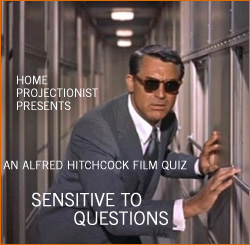
Good evening. If you’re contemplating a trip to the movies tonight, we highly recommend a picture that’s just opening. This recommendation comes, if for no other reason, because of it’s ingenious and intriguing, one-word surname title. The film concerns a famous, portly director (played by Anthony Hopkins), whose big, glossy technicolor hit, NORTH BY NORTHWEST, was followed by “a new and altogether different motion picture excitement!”. And that famous movie is the subject of the following quiz.
Good luck, Mr. Thornhill, wherever you are…
Take the Quiz!(*The quiz title was inspired by Alfred Hitchcock’s North By Northwest: “Something wrong with your eyes?” “Yes”, says the sunglass-clad Roger O. Thornhill (Cary Grant), “They’re sensitive to questions”. Later, confronting Vandamm, Leonard and Eve at an auction house, Roger inquires of them, “I wonder what subtle form of manslaughter is next on the program?”.)
ON THIS DAY in 1963, the BBC television series Doctor Who premiered. In 1965, Peter Cushing starred in a feature-length movie adaptation of the show, titled DOCTOR WHO AND THE DALEKS.
ON THIS DAY in 1935, the Pan American Airways four-engine, flying boat China Clipper, made its inaugural flight from San Francisco to Manila. The 1936 film, CHINA CLIPPER, starring Pat O’Brien and Humphrey Bogart, dramatized this event.
After the plethora of sweeping, epic melodramas in post-WWII films, the next era of innovation in moviemaking took the opposite road: exploring the “profoundly personal” experience.In Part IV of the 15-hour documentary, THE STORY OF FILM: AN ODYSSEY (2011), filmmaker and historian Mark Cousins delves into the work of cinema’s great New Wave innovators of the 1950s and 1960s.
During the beginning of this new wave in film history, Cousins cites four great directors as the movers and shakers who took film to this new, personal level: Ingmar Bergman, Robert Bresson, Jacques Tati, and Frederico Fellini. These innovators championed the role of film itself becoming an integral part of the narrative.
Citing Bergman’s SUMMER WITH MONIKA (1953), for example, there is a groundbreaking scene where Monika looks at us directly, straight into the camera, changing the audience’s relationship to the story being exposed on the screen. In Robert Bresson’s masterpiece, THE PICKPOCKET (1959), Cousins notes that the film demonstrates the “total rejection of gloss,” stripping down the story to emphasize the flatness of the everyday. Thirdly, he recognizes the briliance of visionary director Tati with MONSIEUR HULOT’S HOLIDAY (1953), a film which basically affirms that “the story doesn’t exist,” Tati preferring incidence and details to a plot line. And last but not least, Cousins highlights the work of Frederico Fellini, whose major construct was portraying life as a circus world, with films such as NIGHTS OF CABIRIA (1957), using improvisation as opposed to linear storytelling.
As the story of film evolves, these four influential filmmakers gave way to the French New Wave directors of the early sixties. Cousins calls these innovators “the film school generation,” who embraced filmmaking as an intellectual endeavor, creating even more “narrative ambiguity” in movies and focusing on the meaning of life and existentialism.
For starting an exploration of this period, go with classics such as CLEO FROM 9 -5 (1962) by Agnes Varda; LAST YEAR IN MARIENBAD (1961) by Alain Resnais; Francois Truffaut’s 400 BLOWS (1959); Jean Luc Goddard’s A MARRIED WOMAN (1964); Marco Ferreri’s THE WHEELCHAIR (1960); Sergio Leone’s FISTFUL OF DOLLARS (1964); and I AM CURIOUS YELLOW (1967) by Filgot Sjoman.
And then like every other era, the French New Wave lost its steam and made way for a new world cinema that “dazzled” the industry. Stay tuned….
THE STORY OF FILM: AN ODYSSEY (2011) is a 15-part, 15-hour documentary exploring the convergence of technology, business, intelligence, and vision that has created the remarkable and powerful art of cinema. Music Box Films is distributing this new documentary, and Chicago’s Music Box Theater is conducting a multi-week screening of this ambitious effort. The DVD will be released in November 2012. You will want to add it to your collection.
P.S. — Part of the experience of watching this series is sinking down into your seat and giving into the filmmaker’s hypnotic narration. Have a listen….
Gloria Bowman is a writer, storyteller, blogger, movie lover, freelance editor,
and author of the novel, Human Slices.
Access her blog at www.gloriabowman.com; on Twitter @GloriaBow
News concerning big screens and small…
Visit Home Projectionist on Facebook



A bucket list blog: exploring happiness, growth, and the world.
this blog will disappear on the day that my heart is alive again
Where classic films stand out above the rest
The Power of Words
Incredible tips for Classrooms and Staffrooms
Watch as I amaze and astound with opinions about what TV shows I like!
Political Co-Dependency Intervention
Tablecloths, Table Toppers, Placemats our specialty
I blog about everything and anything, never hesitate to question....
The works and artistic visions of Ken Knieling.
entertainment & belief go heart to heart
the Story within the Story
Horror With Humour
unparalleled film reviews, news, and top 10s
Mostly movies with a smattering of TV, books, and LEGO thrown in!
MUSINGS : CRITICISM : HISTORY : NEWS
Film, Comics, Music, News, You want it? We've got it!
On This Day....
Celebrate Silent Film
...a classic film and TV blog
Entertainment and Everyday News brought to you in a flash
wendy maruyama, art work, executive order 9066, the tag project
A guy with a desk...
www.attentiallupo2012.com
Improving the English language one letter at a time
Seek first the kingdom of God and his righteousness. (Matthew 6:33)
draws comics
Canadian trivia and history in bite size chunks!
“There are always two people in every picture: the photographer and the viewer.” -Ansel Adams
Independent movie reviews and more...
Stories
The life and times of Erik, Veronica and Thomas
a site for movie lovers' eyes
Short reviews on high quality films. No spoilers.
For the Love of Leading Ladies
A blog for movie enthusiasts and weed lovers
A Blog For Every Movie Lover
knitting and blogging in Italy in times of economic crisis
** OFFICIAL Site of Artist Ray Ferrer **
Not just another WordPress.com site, but an extraordinary place to spend a weekend, grill a cheese sandwich and watch a film to improve your life and stimulate a few of the grey cells.
 Home Projectionist