ON THIS DAY in 30 B.C., Cleopatra VII Philopator, last ruler of the Egyptian Ptolemaic dynasty, committed suicide, allegedly by means of an asp bite. In 1963, she was portrayed by Elizabeth Taylor in the epic CLEOPATRA, also starring Richard Burton.


ON THIS DAY in 30 B.C., Cleopatra VII Philopator, last ruler of the Egyptian Ptolemaic dynasty, committed suicide, allegedly by means of an asp bite. In 1963, she was portrayed by Elizabeth Taylor in the epic CLEOPATRA, also starring Richard Burton.
ON THIS DAY in 1926, Danish socialite Claus von Bülow was born in Copenhagen. Von Bülow was convicted of attempting to murder his wife Sunny via an overdose of insulin (thus leaving her in a lifelong vegetative state), but the conviction was reversed. The story was retold in the 1990 film, REVERSAL OF FORTUNE, starring Jeremy Irons and Glenn Close.
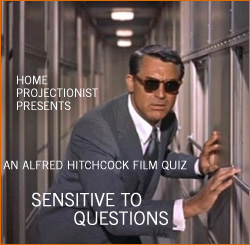
Good evening and welcome to the virtual birthday celebration for one Mr. Alfred Hitchcock. On Monday, August the 13th, Alfred will be 113 years old. Although he’s not quite as sprightly as he once was, his films haven’t aged a bit. And so to celebrate this occasion, you are being cordially invited to test your memory of Hitch’s films by taking part in this party-ish quiz. Please think responsibly.
Good luck, Mr. Thornhill, wherever you are…
Take the Quiz!(*The quiz title was inspired by Alfred Hitchcock’s North By Northwest: “Something wrong with your eyes?” “Yes”, says the sunglass-clad Roger O. Thornhill (Cary Grant), “They’re sensitive to questions”. Previously, Roger’s assailants pretended to Roger that his early, forced and drunken departure via automobile was of his own free will: “It was a dull party. You didn’t miss a thing.”)
ON THIS DAY in 1988, the United States authorized the Civil Liberties Act, which gave $20,000 payments to Japanese Americans who had been interned or relocated by the government during World War II. The 1990 documentary short subject Oscar winner, DAYS OF WAITING, tells the story of an artist who went voluntarily to one of the internment camps.
ON THIS DAY in 1942, Indian leader Mahatma Gandhi was arrested in Bombay by British forces, thereby launching the “Quit India Movement”. The incident was reenacted for the 1982 biographical film, GANDHI, starring Ben Kingsley.

I OWN A BUNCH of movie books. Well, more than a bunch. Dozens. Too many, I suppose. I think the hobby (or is it habit?) started about the time that VCRs came into being–about 1979–a milestone for my latent movie fanaticism. I had been awakened to a world of movies that previously had been unavailable for viewing.
I think the first book was Donald Spoto’s excellent film-by-film analysis, Hitchcock. I’d borrowed the Oak Lawn Public Library’s copy a couple of times, gotten completely immersed in it, and then finally plunked down the $8.95. Next, if I recall, was a little paperback, The Golden Turkey Awards-a sort of oddball collection of lists–lists of bad movies–turkeys, some of them in the so-bad-they’re-good category, a la MST3K; others just plain awful and unwatchable. A fascinating, fun read.
Eventually, my wanderings in Waldenbooks, Barnes & Noble, and Kroch & Brentano’s led me to my most treasured film book, Guide for the Film Fanatic (1986; Fireside Books) From the Introduction:
“If you flipped through the pages of this book, you may have noticed that, unlike many movie-list books, this one does not have a star rating system. I love those books, but I worry that rating systems have the adverse effect of discouraging people from seeing certain movies that should be equally recongnized. It’s only natural to choose a movie that has a three-star rating over one that has just two stars, but in many cases the two-star movie is more interesting–indeed it may have a cult made up of devoted fans who appreciate things that a particular review overlooked. I may attack a film, but that doesn’t mean I don’t want you to see it. This book is meant to encourage readers to see movies, not discourage them.”
Danny Peary’s is untypical of most movie review books in that every one of the films he discusses is worth your time, in some way or another. Each entry is a pleasure to read, even if it doesn’t convince you to watch the film. Peary might consider how absolutely great a movie is, or place some high value on it even if solely for its pure entertainment value, or occasionally only for historic reasons. Many of the book’s movies have a strong, cult-like following–not everyone’s cup of tea, but maybe it will be yours, if you give it a try. I discovered movies I would’ve otherwise overlooked–movies that Maltin gave just two stars to, that Siskel & Ebert rated “dogs of the week”, or films that arrived and burned brightly then for various reasons faded quickly from memory. Some films I had seen before, multiple times, took on a new light.
Good evening. You may have heard there are some sort of games being played in London this week. Lots of young people running hither and yon, and perspiring way too much. Doesn’t it make you feel exhausted? After a grueling, three-hour marathon of watching them on television, you may be feeling a tiny bit inspired. Perhaps you’re ready to relax and test your gamesmanship with this gamey little quiz we’ve created. But please remember to take it easy and pace yourself.
Good luck, Mr. Thornhill, wherever you are…
Take the Quiz!(*The quiz title was inspired by Alfred Hitchcock’s North By Northwest: “Something wrong with your eyes?” “Yes”, says the sunglass-clad Roger O. Thornhill (Cary Grant), “They’re sensitive to questions”. Kidnapped by thugs, Roger questions Vandamm (James Mason): “Why was I brought here?”, to which Vandamm replies, “Games? Must we?”)
“If we all went out looking like a slob, like me, it’d be a pretty dreary world.”
LAST SUMMER I met an artist who, in the course of talking about movies, mentioned a film she thought I ought to see. BILL CUNNINGHAM NEW YORK. An odd title, and so I remembered it. A month or two later, the same recommendation from another person. New York City is a place I love, so I put it in my Netflix queue. I finally got around to watching it recently. It’s great.
Bill Cunningham, 83, is a fashion photographer for The New York Times, and has been for many years. He rides an ordinary bicycle through the streets of Manhattan, camera in hand, darting here and there, wearing a beat-up poncho on rainy days, on the lookout for fashionable clothes–clothes that fit a certain theme. A theme of the week. His pictures are featured on a page in the Style section of the Times–a page composed of dozens of Cunningham’s colorful, candid shots. Stylish, fashionable and/or eccentric New Yorkers as they dash across streets, glide past shop windows, or stroll around parks. One week it might be hats, while another week’s subject is stripes.

If you’re an avid Home Projectionist and sports enthusiast (even if it’s an armchair one), then right now you’re probably dividing your time between movies and the 2012 Olympics in London. That’s perfect, because this Cinelympics Quiz has just as much to do with feature films as with the wide world of sports. We’ve chosen ten sports, all of which are part of the summer games. Sorry, but we have no actual gold medals to present. All we can offer is the thrill of victory. Best of luck to you!
Take the Cinelympics Quiz!
It might be difficult for you to appreciate the 100-degree, dog days of summer when you have a parched throat, a bad sunburn, or when your wife is after you to do something about the lawn. But perhaps you remember the one or more times she advised you to go jump in the lake. Well, now is a good time to do what she tells you. Take a deep breath and plunge into this cool, refreshing, ten-question quiz which by no means has been watered-down.
Good luck, Mr. Thornhill, wherever you are…
Take the Quiz!(*The quiz title was inspired by Alfred Hitchcock’s North By Northwest: “Something wrong with your eyes?” “Yes”, says the sunglass-clad Roger O. Thornhill (Cary Grant), “They’re sensitive to questions”. Late in the movie, Vandamm (James Mason) reveals his plan to do away with Eve (Eva Marie Saint): “This matter is best disposed of from a great height. Over water.”)
“It is the blight man was born for
It is Margaret you mourn for.”
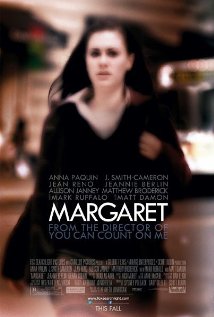
FILMED nearly six years ago by director (YOU CAN COUNT ON ME) and writer (GANGS OF NEW YORK, ANALYZE THIS, ANALYZE THAT) Kenneth Lonergan, MARGARET has only very recently been made available. Its troubled history reportedly is due to “editing problems”. It shows. Truly a mixed bag (emphasis on “mixed”) it is nevertheless worth your time if you’re open to something a little different and, at times, a bit confusing.
Lisa (Anna Paquin) is a young, bright (and just a little irritating) woman in her late teens. She lives on Manhattan’s Upper West Side with her stage actor, single mom (J. Smith Cameron) and a young brother.
Manhattan could almost be said to be a co-star in this film, similar to Woody Allen’s by the same name. MARGARET opens with some slow-motion shots of New Yorkers going about their day, just as we see Lisa doing. A young, shy fellow, from the private school she’s attending, awkwardly asks Lisa for a date. (“Are you, um, asking me… out?”, Lisa says, after several, funny attempts at clarification.)
This is the start of a theme that is present throughout MARGARET: little or no communication between characters. The most notable example being what immediately follows: a very heartbreaking and realistically portrayed accident involving a bus and a pedestrian. Which happens as a result of Lisa distracting the bus driver, Maretti (Mark Ruffalo (THE KIDS ARE ALL RIGHT), with her questions about his hat.
Within the movie’s first few minutes, we’ve already had three or four instances of miscommunication. Many more ensue, not the least of which is between director/writer and the audience.
The movie starts out well enough. In fact, it’s riveting during its first hour, as Lisa is shaken to her core by the tragedy and her decision to lie to authorities about Maretti’s responsibility for the accident. As the story progresses, Lisa becomes angry, regretful and resentful. She gets extremely moody, ornery, and combative, with her teachers (Matthew Broderick and Matt Damon, among two others) and the other private school students, but particularly with her mother, Joan.
Joan has emotional troubles of her own, as is evident after she meets, and begins to date, the dashing, debonair and very smitten Ramon (Jean Reno). Joan appears only mildly interested and, in fact, really seems to be using Ramon to fill her physical needs.
Lisa, meanwhile, confronts Maretti and his wife at their home, challenging him to admit to the police he went through a red light. Lisa also confronts police detectives, has a ferocious, very well-acted verbal battle with her mom, and, by her own request, loses her virginity.
When Lisa’s persuasions to Maretti don’t work, she enlists the help of the victim’s relative, Emily, played outstandingly and hilariously by Jeannie Berlin (daughter of Elaine May). Emily, in a heated argument with Lisa, will stand for none of her guff. “This isn’t an opera! And we are not all supporting characters to the drama of your amazing life!”. Emily introduces her to one lawyer, and then another. Legal wrangling (too much of it) is interspersed with Emily’s quips and sarcastic attitude, and they really lighten and brighten this picture which, by now, has begun to sag under its own weight.
A totally incongruous encounter between Lisa, her teacher (Damon) and his girlfriend near the movie’s end had me baffled; it appears likely that this could be a result of the film’s alleged “editing troubles”.
There are other, more tightly-knitted movies of this type–movies that have many characters, overlapping stories, and changes in tone. Some examples are SHORT CUTS, MAGNOLIA, and GRAND CANYON–all of which have surprises in them but flow smoothly and logically. MARGARET feels like a rough cut. It’s unorganized and long (2-1/2 hours*) with several dead end sequences and needless plot tangents. It could easily do without 30 minutes. It’s hard, for example, to figure out why there should be two lawyers (one’s purpose seems to be only to introduce the other), and four teachers, for instance.
Still, even with these flaws, some major, this movie is recommended. Paquin, Smith-Cameron, Ruffalo and Berlin are terrific–not a false note between them. It’s fun to see Reno, Broderick and Damon, although their parts are small and don’t pack nearly the same degrees of emotion. And then there are the panning shots of the city. Even if they were added to help patch over the editing miscues, they give MARGARET a little bit of the cohesion that it needs.
MARGARET is widely available on DVD, Blu-Ray (*with an even longer, three-hour “director’s cut) and streaming services such as iTunes 
If you happen to stumble upon this page while looking for a new job, you’ll find nine openings listed within this quiz. Unfortunately, these positions were filled a long time ago and are no longer available. (Alfred will keep you on file, however). But before you begin to search elsewhere, test your knowledge. Match the job to the Hitchcock movie character… some of whom found themselves on an unexpected career path.
Good luck, Mr. Thornhill, wherever you are…
Take the Quiz!(*The quiz title was inspired by Alfred Hitchcock’s North By Northwest: “Something wrong with your eyes?” “Yes”, says the sunglass-clad Roger O. Thornhill (Cary Grant), “They’re sensitive to questions”. Thornhill later complains to the Professor (Leo G. Carroll): “I’ve got a job, a secretary, a mother, two ex-wives, and several bartenders dependent upon me…”)
THE THIRD MAN (1949; Orson Welles, Joseph Cotten, Alida Valli; directed by Carol Reed)
Occasionally, I will be writing something I’ve dubbed “End Notes”–a very short blurb about, well, the ending of a particular movie. It’ll usually be a favorite ending, from a movie that to me has a perfect ending. Or maybe a movie I never wanted to see end. So, it goes without saying, that–even though you’ve probably seen the movie–I need to issue a Spoiler Alert. And I just did.
RECENTLY, I was fortunate to be at a Chicago Symphony Orchestra performance at which Anton Karas’ famous and unique Third Man Theme was played. A zither player was not easy for the CSO to find, so the conductor said. They searched high and low, finally locating one in… Milwaukee. He was an unassuming fellow, greeted with huge applause. Symphony Center became quiet, and then we heard the familiar opening notes.
Karas’ music gives this amazingly atmospheric movie–personally one of my all-time favorites– a melancholy, wistful tone nearly throughout. Occasionally the tune segues into a jaunty sort of rhythm, which matches Harry Lime (Orson Welles) as he goes on his merry, postwar way through the dark ruins of Vienna. But his bounciness and that of the music only emphasizes the sadness that pervades the other parts of the score, and the tragic events that ensue. We know Lime is whistling in the dark. He is doomed.
We come to the movie’s final scene. Holly Martins (Joseph Cotten) has had to reluctantly acknowledge, thanks to Major Calloway (the great Trevor Howard), that the greed and callousness of his old friend Harry has led to the deaths of many children. Since arriving in Vienna, Holly has had a romantic interest in Harry’s beautiful, sultry girlfriend, Anna (Alida Valli), but it’s obvious to everyone (except Holly) that she does not feel the same. He tries, unsuccessfully, to convince Anna of Lime’s guilt. But Anna’s heart remains with Harry. She feels Holly has betrayed both herself and Harry, and she will not forgive.
Coming full circle since the film’s beginning, we’re back at the cemetery, once again saying good bye to Harry Lime. It’s a grim and chilly fall afternoon. The funeral service has ended. Saddened friends are departing, going their separate ways.
Holly leans non-chalantly against a wooden horse cart, like one of the wagons in his cheap, Zane Grey-like novels. He strikes a pose like a Western cowboy as he awaits the approach of the grieving, disillusioned Anna. Surely she will stop and we will talk, Martins might be thinking. Calloway glances back, his expression saying, The fool will never learn.
Holly looks down the lane, towards the approaching figure. Dry leaves fall from barren trees, like tears. Anna draws nearer. Then, without a pause or acknowledgment, Anna passes Holly by…
Holly reaches for a cigarette, lights it, and tosses the match. Harry is gone. Anna has left. One can’t just leave.
Martins: Wait a minute. Let me out.
Calloway: Well, there’s not much time.
Martins: One can’t just… leave. Please.
Calloway: Be sensible, Martins.
Martins: Haven’t got a sensible name, Calloway.
(THE THIRD MAN is widely available via streaming or disk, including Blu-Ray editions  )
)
Gathering together to watch a movie this coming weekend? Still havin’ a heat wave? Then you and your guests oughta be havin’ not just whatever old beverage happens to be in the fridge, but a mixed drink that matches your Vincent Minnelli, or a cocktail to accompany that Shakespeare tale. Here are some real, crowd-pleasing drinks and the movies that made them, or that they were made in. Please drink responsibly and watch excessively.
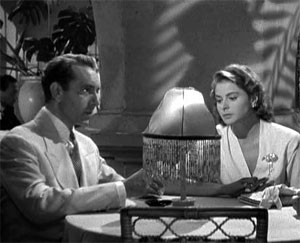
CASABLANCA (1942) Paul Henreid suavely orders one of these at Rick’s Café American.
Casablanca Champagne Cocktail
1 cube sugar
Angostura bitters
Chilled champagnePlace sugar cube at bottom of champagne flute. Splash sugar cube with Angostura bitters. Slowly fill flute with champagne. Garnish with lemon.
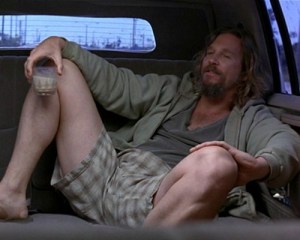
THE BIG LEBOWSKI (1998) Among other stimulants partaken by “The Dude” (Jeff Bridges) in this classic cult movie was this nifty mixture. Just don’t overdo it or you could end up in the gutter.
Lebowski’s Big White Russian
2 parts vodka
1 part Kahlúa
1 part creamPour over ice and stir
NORTH BY NORTHWEST (1959) Aboard the 20th Century Limited to Chicago, the debonair Don Draper prototype Roger O. (“stands for ‘nothing'”) Thornhill was quick to order one of these cocktails:
Grant’s Gibson
2-1/2 oz gin
1/2 oz dry vermouth
Cocktail onionMix ingredients with ice. Stir; strain into a chilled cocktail glass; garnish with onion.
CASINO ROYALE (2006) In Ian Fleming’s James Bond novel of the same name, Bond impresses his American counterpart, Felix Leiter, by ordering this concoction. “This drink’s my own invention”, says Bond. “I’m going to patent it when I can think of a good name.” Here’s the name and the recipe:
Vesper Martini
3 oz. gin
1 oz vodka
1/2 oz Lillet BlancShake over ice and strain into a martini glass. Garnish with a thin lemon peel slice.
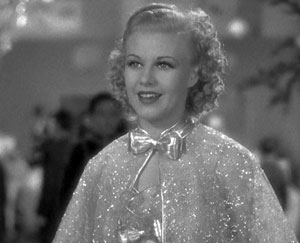
TOP HAT (1935) At the Lido, Ginger Rogers blurts out “Two Horse’s Necks!” after her companion, Helen Broderick, botches an attempt at ordering a drink in Italian.
Ginger’s Horse’s Neck
1-1/2 oz bourbon (or brandy or gin)
Lemon peel
Ginger aleCarve lemon peel in one, long spiral. Place in highball glass, one end touching bottom and the other end placed over the rim. Add ice cubes, liquor and fill remainder of glass with the ginger ale.
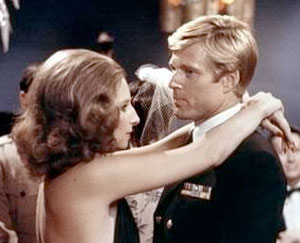
THE WAY WE WERE (1973) This was Katie Morosky’s (Barbra Streisand) favorite indulgence–next to Hubbell, that is:
Morosky’s Dubonnet Over Ice
1 oz Dubonnet
8 oz ginger ale
1 lemon peelPour Dubonnet over ice cubes in a Collins glass. Fill with ginger ale. Add lemon peel.
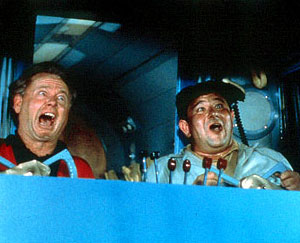
IT’S A MAD, MAD, MAD, MAD WORLD (1963) Buddy Hackett and Mickey Rooney perhaps could’ve chosen an airplane pilot whose other job wasn’t as nearsighted Mister Magoo (Jim Backus). During the flight, a suddenly thirsty Backus orders them to take over the plane’s controls while he retreats to the bar area. “I’m going to make an Old Fashioned the old-fashioned way!”, he says, “The way dear, old dad used to!!”
It’s a Mad, Mad, Mad, Mad Old-Fashioned
1 t sugar
2 small lemon peel pieces
2 oz bourbon or whiskey
A slice of orange or a maraschino cherryAdd sugar to an old fashioned glass; add the bitters, then grind the sugar, bitters and lemon. Add bourbon, ice, and then stir. Garnish with the orange slice or a cherry.
Besides cool blondes, Hitchcock was also fascinated by transportation, especially trains. But other modes of transportation appear in his films, of course, and that includes the lowly, un-glamorous bus.
For this very visual Hitchockian quiz, have your fare ready, please, and make sure you get on the right bus. Your destination: the Hitchcock film in which the vehicle appears. And leave the driving to Alfred.
Good luck, Mr. Thornhill, wherever you are…
Take the Quiz!(*The quiz title was inspired by Alfred Hitchcock’s North By Northwest: “Something wrong with your eyes?” “Yes”, says the sunglass-clad Roger O. Thornhill (Cary Grant), “They’re sensitive to questions”. Earlier, when a severely intoxicated Roger is forced by two thugs to drive a car, he says, “Don’t worry about me, fellas–I’ll take the bus.”)



A bucket list blog: exploring happiness, growth, and the world.
this blog will disappear on the day that my heart is alive again
Where classic films stand out above the rest
The Power of Words
Incredible tips for Classrooms and Staffrooms
Watch as I amaze and astound with opinions about what TV shows I like!
Political Co-Dependency Intervention
Tablecloths, Table Toppers, Placemats our specialty
I blog about everything and anything, never hesitate to question....
The works and artistic visions of Ken Knieling.
entertainment & belief go heart to heart
the Story within the Story
Horror With Humour
unparalleled film reviews, news, and top 10s
Mostly movies with a smattering of TV, books, and LEGO thrown in!
MUSINGS : CRITICISM : HISTORY : NEWS
Film, Comics, Music, News, You want it? We've got it!
On This Day....
Celebrate Silent Film
...a classic film and TV blog
Entertainment and Everyday News brought to you in a flash
wendy maruyama, art work, executive order 9066, the tag project
A guy with a desk...
www.attentiallupo2012.com
Improving the English language one letter at a time
Seek first the kingdom of God and his righteousness. (Matthew 6:33)
draws comics
Canadian trivia and history in bite size chunks!
“There are always two people in every picture: the photographer and the viewer.” -Ansel Adams
Independent movie reviews and more...
Stories
The life and times of Erik, Veronica and Thomas
a site for movie lovers' eyes
Short reviews on high quality films. No spoilers.
For the Love of Leading Ladies
A blog for movie enthusiasts and weed lovers
A Blog For Every Movie Lover
knitting and blogging in Italy in times of economic crisis
** OFFICIAL Site of Artist Ray Ferrer **
Not just another WordPress.com site, but an extraordinary place to spend a weekend, grill a cheese sandwich and watch a film to improve your life and stimulate a few of the grey cells.


 Home Projectionist