
ON THIS DAY in 1949, following a concert for civil rights by Paul Robeson at Peekskill, New York, departing concertgoers were attacked by a mob of anti-communist agitators, resulting in over 140 injuries. The 1979 biographical film, PAUL ROBESON: TRIBUTE TO AN ARTIST, documented this event.
movies
All posts tagged movies
ON THIS DAY in 1189, Richard I was crowned King of England at Westminster Abbey in London. Anthony Hopkins, in his first film role, portrayed the King (also known as “Richard the Lionhearted”) in the 1968 film, THE LION IN WINTER.

If you spent most of your time watching movies this past week, you might have missed these articles here at Home Projectionist:
- The British Film Institute Presents the Ten Greatest Films
- Dean Gives Jerry a Bath
- The Saddest Movies in the World Make Me Happy
- 10 Things About Ingrid Bergman
- Streaming Surprises: Movers and Shakers
- Kubrick Symmetric: Kogonada’s “One Point Perspective”
- Dinner at ‘21’: an Alfred Hitchcock Film Quiz
- Online Streaming Takes Over the Market
- The Curious Quaziness of the Brothers Quay
- Labors of Love: 13 Films for the Labor Day Weekend
- REEL HISTORY Archive
Visit Home Projectionist on Facebook
ON THIS DAY in 1864, Confederate forces evacuated Atlanta, Georgia, burning the city’s supplies and structures behind them. The 1939 classic film, GONE WITH THE WIND, depicted scenes of this great conflagration.
PRESIDENT GROVER CLEVELAND made Labor Day a national holiday in 1894, with the intention of preventing further worker turmoil and deaths, such as occurred during the just-ended, nationwide Pullman strike. Now, it’s a great time to gather together and relax with friends & family for food, drinks, and… movies. Celebrate worker esprit de corps with some Labor Day spirit and one or two of these recommendations (in no particular order), all of which in some way highlight both the delights, and plights, of working men and women.

ON THE WATERFRONT (1954; directed by Elia Kazan) Ex-boxer and longshoreman Marlon Brando attempts to redeem himself by confronting union boss Lee J. Cobb. Leonard Bernstein’s first movie score. “One of the most powerful films of the 50s” (Pauline Kael).
SALT OF THE EARTH (1953) Latino mine workers on strike in New Mexico. The film’s writer and producer had been on the Hollywood blacklist.
BLUE COLLAR (1978; Richard Pryor, Harvey Keitel) Auto workers are being cheated by both their management and their unions. “Strongly-written and provocative” (Danny Peary).
MODERN TIMES (1936) Charlie Chaplin vs. the Machines. An assembly line worker tries to express his humanity at work, with the help of Paulette Goddard.
MOONLIGHTING (1982) Jeremy Irons is a Warsaw construction worker ordered to London where he slowly begins to oppress the Polish laborers he’s supervising.
BLACK FURY (1935) Michael Curtiz’ film is based on a true story of a Pennsylvania coal miner (Paul Muni) who was beaten to death by company detectives. “Realistic, strikingly filmed” (Leonard Maltin).
GUNG HO (1985; directed by Ron Howard) Michael Keaton stars in this light comedy about a Japanese auto firm’s attempts to establish a factory in the U.S.
NORMA RAE (1979) Sally Field (Oscar winner) and Ron Liebman team up to unionize textile workers in this inspiring Martin Ritt film.
MOLLY MAGUIRES (1970; Sean Connery, Richard Harris) Connery leads a secret society of Irish mineworkers in late 1800s Pennsylvania. “Elegiac” (Pauline Kael).
WHICH WAY IS UP? (1977) Richard Pryor plays three roles in a story of a citrus grove worker transformed into a union hero. A remake of the Lena Wertmuller film, THE SEDUCTION OF MIMI.
F.I.S.T. (1979) A truck driver (Sylvester Stallone) becomes a Hoffa-like union organizer and subsequently tangles with gangsters. Directed by Norman Jewison.
HOFFA (1992) Jack Nicholson portrays the exploits of the infamous Teamster boss, in a script by David Mamet. “Almost affectionate biographical treatment” (Videohound).
HARLAN COUNTY, U.S.A. Oscar-winning Barbara Kopple film documents a bitter strike by United Mine Workers against a Kentucky power company. “One of the most incisive portraits of America and the ever struggling labor movement” (Danny Peary).

Little Dutch Boy detail (Photo credit: Aria Nadii)
From now through January 7, 2013, New York’s Museum of Modern Art is presenting a retrospective of the work of identical twins, Stephen and Timothy Quay, also known as the Quay Brothers.
The prolific duo’s claim to fame is their use of stop-motion puppet animation featuring foreboding dolls and machinery in surreal episodes, influenced by the likes of Joseph Cornell, Hieronymous Bosch, and Salvador Dali. Set up as a two-story maze, the MoMA installation includes hours upon hours of the brothers’ films, videos, commercials, and documentaries, along with displays featuring their original puppets and props.
Love them or not, it’s always good for Home Projectionists to have a storehouse of clips on hand to round out an evening’s experience.
Remember: Halloween is coming up….
ON THIS DAY in 1532, Lady Anne Boleyn was made England’s Marquess of Pembroke by her fiancé, King Henry VIII. In 1969, Genevieve Bujold portrayed Boleyn in the film, ANNE OF THE THOUSAND DAYS, with Richard Burton as King Henry.

9 remote controls labeled as follows, from left to right: Philips, no label, Panasonic DVD player, homecast, dreambox, aston, SilverCast, Sony AV System, Sony TV. (Photo credit: Wikipedia)
When you’re in charge of what to watch in your own living room, you’re a Home Projectionist. And online streaming is emerging as the technology tool of choice, while new services are ramping up to enhance what’s already available.
According to an August 30 Broadcast Newsroom release, online move viewing is “surpassing DVDs, Blu-Ray sales, and live theater visits.” It’s a matter of cost, convenience, and choice. When you’re at home, you’re in charge. The article states it is “estimated that 3.4 billion movies will be streamed online in 2012.”
Home Projectionists note, however, that streaming choices don’t have the supplemental behind-the-scenes materials that can enhance a viewing experience.
To fill that void, one new service, for example, DigiTitles.com, offers free “making of” and related content. According to DigiTitles, its content is created and submitted by, “People involved in the production process (e.g., concept artists, storyboard artists, makeup artists, scriptwriters, stunt coordinators, photographers, etc.); producers and content owners interested in promoting their work; and anybody else with relevant information and a desire to share.”
As Home Projectionists evolve, so will the resources available to them to produce increasingly creative viewing experiences for family and friends. Everybody wins.
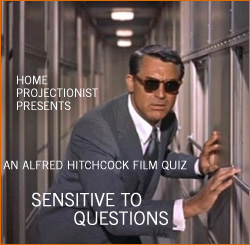
Good evening. How many in your party? One? Fine. We have a pleasant quiz over here if you’ll follow this way. Please be seated and your quizmaster will be right with you. In the meantime, may we suggest reflecting on the many drinking and dining establishments you’ve encountered within the films of Alfred Hitchcock, followed by clicking on the “Take the Quiz” button.
Good luck, Mr. Thornhill, wherever you are…
Take the Quiz!(*The quiz title was inspired by Alfred Hitchcock’s North By Northwest: “Something wrong with your eyes?” “Yes”, says the sunglass-clad Roger O. Thornhill (Cary Grant), “They’re sensitive to questions”. Early during the movie, Roger dictates a note for his secretary to give to his mother: “Dinner at ’21’. Seven O’Clock.”)
ON THIS DAY in the year 12 A.D., Roman Emperor Gaius Caligula–nephew and adopted son of Tiberius–was born. The 1980 film, CALIGULA, written by Gore Vidal and starring Malcolm McDowell, told the story of the Emperor’s rise and fall.
THIS FASCINATING, short video should remove all doubt about the power of the “one-point perspective” and who was, and probably always will be, the master of it. The impact of a precise, symmetrical point of view is very dramatic and compelling, and it is prevalent in nearly all of Stanley Kubrick’s films.
ON THIS DAY in 1963, the Moscow-Washington “hotline” or “red telephone” between Russia’s Kremlin and the White House, went into operation. In 1964, the Sidney Lumet film FAIL-SAFE featured the hotline in scenes with Henry Fonda as the President.

- Birthday: August 29, 1915
- Named after: Princess Ingrid of Sweden
- First marriage: to a dentist
- Awards for her role in Casablanca: none
- Once had a relationship with: photojournalist Robert Capa
- American Film Institute Greatest Female Star ranking: #4
- First movie appearance: as “Girl waiting in line”, in Landskamp.
- Her father: wanted Ingrid to be an opera star
- Fun fact: Woody Guthrie wrote a song about Bergman and Roberto Rossellini
- Quote: “I don’t know who I am anymore. I don’t know what I remember and what I’ve been told I remember. What is real? Am I?” —from ANASTASIA
ON THIS DAY in 1930, the last 36 remaining inhabitants of St. Kilda, Scotland, were evacuated to the mainland at their own request. Director Michael Powell’s 1937 film, THE EDGE OF THE WORLD, shot on the Shetland Island of Foula, was inspired by the the St. Kilda story.
ON THIS DAY in 1963, the March on Washington for Jobs and Freedom took place near the Lincoln Memorial in Washington, D.C. The rally called for civil and economic rights for African Americans, and featured Martin Luther King Jr.’s “I have a dream” speech. The 1963 short film, THE MARCH ON WASHINGTON, documented this historic event.



 Home Projectionist