ON THIS DAY in 1908, Wisconsin Senator Joseph “Joe” McCarthy was born. McCarthy was portrayed by Joe Don Baker in the 1992 HBO movie, CITIZEN COHN, also starring James Woods.


ON THIS DAY in 1908, Wisconsin Senator Joseph “Joe” McCarthy was born. McCarthy was portrayed by Joe Don Baker in the 1992 HBO movie, CITIZEN COHN, also starring James Woods.
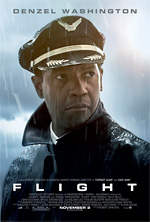 FLIGHT is an excellent movie. But a few years ago, you couldn’t have gotten me into the theater. Or onto a commercial jet–without something to calm me down.
You no doubt surmised, by the title, the trailer, or both, what FLIGHT’s subject matter is, even though, as it turns out, alcohol and drug addiction are just as much a part of its story as air travel.
Briefly, Denzel Washington is Whip Whittaker, a pilot for the fictional SouthJet Airlines. It’s a stormy morning in Orlando and, after a late night alcohol and cocaine binge, he’s behind the controls of a flight to Atlanta–a flight that ends very badly, notwithstanding the fact that he pulls off a miraculous landing, saving nearly everyone aboard. In the aftermath, Washington, while lauded as a hero, has to answer questions about his potentially incriminating blood test results, and he’s faced with some very difficult decisions.
For a long time, I have been trying to overcome a fear of flying. It’s a phobia that overtook me about 15 years ago. I’ve had this fear despite the fact that I had several hours of flying lessons in a tiny plane when I was a teenager, and despite enjoying airline travel and hanging my feet out the open doors of helicopters over Vietnam.
Now I do realize that perspective is needed. Substance abuse and dependency are more serious ailments than what I have had. And there are alternatives to flying, such as trains and cars. Those sufficed for a long while. But then the novelty, as you might put it, wore off, and the time costs (two or three days to L.A. vs. four hours by jet) became too much to pay at my lofty age. So I plunged ahead. First there were travel mugs of Bailey’s (prior to the ban on liquids). My doctor suggested classes, but I asked for, and received, some anti-anxiety medication. After several flights and some dosage adjustment, it’s worked. I’m flying again, still with some nervousness and a tiny sliver of Xanax, but the anxious anticipation of future flights is pretty much gone now.
So when a friend asked me the other day if I wanted to see FLIGHT, I didn’t hesitate to say yes, because I knew I’d be OK. And I was. Sure, there’s that one sequence that is pretty nerve-racking. However, there was an audible, collective audience exhalation at its conclusion and, in fact, my friend, who didn’t share my phobias, was more jittery than I was.
Who knows? Maybe my fear will return some day. For now though, it’s down to a minimum. I can watch clips like those below without getting sweaty palms and a quickened heartbeat. And I can recommend FLIGHT, in more ways than one, without hesitation.
Besides the edge-of-the-seat, nervous thrills in FLIGHT, what are my top 10 favorite flying film sequences, you ask?
THE SPIRIT OF ST. LOUIS (1959; with James Stewart; directed by Billy Wilder) Having flown many hours while fighting sleep, Lindbergh gradually comes to the realization that he’s approaching land, and it’s Ireland.
NIGHT FLIGHT (1933; John Barrymore, Clark Gable, Lionel Barrymore) The shadow of Clark Gable’s plane as it flies over the terrain of South America.
THE AVIATOR (2004; with Leonardo DiCaprio; directed by Martin Scorsese) Howard Hughes is nearly killed as his experimental plane crashes in Beverly Hills.
THE HIGH AND THE MIGHTY (1954; with Claire Trevor; directed by William Wellman) John Wayne lands his plane. The religious symbolism of the runway lights is corny, but it’s a nail-biting series of scenes.
FOREIGN CORRESPONDENT (1940; Joel McCrea; directed by Alfred Hitchcock) At the outset of WWII, a German warship mistakes a British passenger plane for a bomber, sending it plunging into the turbulent Atlantic. We identify with the passengers’ terror, as the entire sequence is shot from within the plane.
OUT OF AFRICA (1985; directed by Sydney Pollack) Robert Redford takes Meryl Streep for a spin, high above herds of animals on the savannah, and accompanied by John Barry’s beautiful music.
FEARLESS (1993; directed by Peter Weir) Jeff Bridges finds himself in an Iowa cornfield, walking away from a horrible crash, and walking towards a new perspective on life.
FLIGHT OF THE PHOENIX (1965; directed by Robert Aldrich) James Stewart and company and their aircraft are nearly left for dead. After struggling with the mechanisms and with themselves, they manage to rev up the cobbled-together airplane. Will it or won’t it take off?
FLYING DOWN TO RIO (1933; with Dolores Del Rio) A bevy of beauties is waiting in the wings to dance on the wings
WINGS (1927; directed by William Wellman) The first, major air battle in this unforgettable movie is breathtaking, particularly if you watch it with the latest, restored version with its magnificent, re-recording of the original score.
Happy landings!
ON THIS DAY in 1850, Scottish novelist Robert Louis Stevenson was born. Stevenson’s first major literary success, TREASURE ISLAND, was adapted for the screen in 1934 and starred Jackie Cooper and Wallace Beery.
If you spent most of your time watching movies this past week, you might have missed these articles here at Home Projectionist:
Visit Home Projectionist on Facebook
ON THIS DAY in 1912, Naval officer and polar explorer Robert Scott and his men were found frozen to death on the Ross Ice Shelf in Antarctica. The story of the expedition was dramatized in the 1948 film, SCOTT OF THE ANTARCTIC, starring John Mills.
ON THIS DAY in 1926, U.S. Route 66 was established, running from Chicago to Los Angeles. The highway was featured in the 1940 John Ford film, THE GRAPES OF WRATH, with Henry Fonda.

WITHOUT WARNING (1952; starring Adam Williams, Edward Binns; directed by Arnold Laven; 75 min.)
CAN A LOW BUDGET film noir with B-actors be as riveting as great noirs like DOUBLE INDEMNITY, WHITE HEAT or THE BIG SLEEP?
 WITHOUT WARNING is in the mold of documentary-like crime dramas such as CALL NORTHSIDE 777 (1949; James Stewart) or a Dragnet TV episode but without Jack Webb’s monotonous narration.
Although we know early on that gardener Carl Martin (Adam Williams) commits despicable crimes (he dispatches his preferred prey–loose, thrill-seeking, busty blondes–using his garden shears as a weapon), the film doesn’t portray him in what you might call the stereotypically villainous manner. On first appearance, he’s an average, blue collar, lunch pail-type worker. Martin has uncontrollable compulsions, but he generates sympathy. Note, for instance, Martin’s desperately worried expression when he’s pursued on foot by police. There may be a reason to Carl’s madness, a result of a long-harbored, yet murkily explained, grudge he carries with regards to the wife he lost.
This being a 1950s movie, there is never any doubt Martin will be caught, dead or alive. It’s the process by which he is pursued, and Williams’ earnest performance that makes this film a notch above many other B-movie film noirs. (Note that the film’s violence and its ambiguous attitude towards the protagonist foreshadows Hitchcock’s PSYCHO (1960).
Besides Williams, acting kudos should go as well to Ed Binns, who co-stars as the clever detective hot on Carl’s trail, a guy who wants to keep the human pruning down to a minimum. There is also an amusingly droll lab technician, as well as the terrific, on-location photography in and around Los Angeles, including Chávez Ravine, before it became the home of the Dodgers. Binns and Williams appeared together again-in NORTH BY NORTHWEST-8 years later, in the same roles as policeman and gardener, respectively .
Although perhaps not quite on a par with DETOUR and other bargain basement film noir classics, WITHOUT WARNING nevertheless is one that noir fans shouldn’t do without. 
When beloved music legend Levon Helm passed away in April, the world mourned the loss of a man of unique talent and character. In Helm’s honor, Chicago brewmaster Jonathan Cutler created an award-winning pale ale.
The beer is “The Weight,” named after the Helm song of the same name. “It’s all American hops and malt. We were playing The Band the whole time we were brewing it,” said Cutler in a recent Chicago Tribune article. And the beer, one of the top three national prize winners of the Great American Beer Festival, is available through the end of the year at Piece Brewery in Chicago.
Get it while you can and gather a group to watch THE LAST WALTZ (1978).

beer glass full (Photo credit: Tim Pearce, Los Gatos)
Directed by Martin Scorcese, this concert video is a true classic (so classic that it’s even aired on Turner). The film documents in 35mm the The Band’s last concert, performed on Thanksgiving Day at the Winterland venue in San Francisco.
Not only does this beautiful film deliver etched-in-your-head-forever performances like “The Weight” with the Marva Staples (below) but also riveting guest performances by Bob Dylan, Eric Clapton, Dr. John, Muddy Waters, and Joni Mitchell. Even Neil Diamond. And Van Morrison being really crazy. Really. Crazy.
If you can’t get a jug of “The Weight” to drink while revisiting this tribute to the hard life on the rock ‘n roll road, I’m sure Levon wouldn’t mind if you raised another beer in his honor. RIP.
Gloria Bowman is a writer, storyteller, blogger, movie lover, freelance editor,
and author of the novel, Human Slices.
Access her blog at www.gloriabowman.com; on Twitter @GloriaBow
ON THIS DAY in 1971, Khmer Rouge forces attacked the city of Phnom Penh, Cambodia, killing 44. Subsequent events in the aftermath of this attack were depicted in the 1984 film, THE KILLING FIELDS, with Sam Waterston.
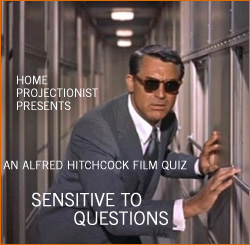
Good evening. Have you performed in Shakespeare’s King Lear recently? Or are you more of what they call a drama queen? Hitchcock’s films often contained movies-within-movies or plays-within-plays. Often these shows were the cause for stage–as well as audience–fright. In fact, you might say that these stage performances sometimes killed, literally.
Good luck, Mr. Thornhill, wherever you are…
Take the Quiz!(*The quiz title was inspired by Alfred Hitchcock’s North By Northwest: “Something wrong with your eyes?” “Yes”, says the sunglass-clad Roger O. Thornhill (Cary Grant), “They’re sensitive to questions”. When Roger turns up unexpectedly at an auction, Vandamm asks, sarcastically, “What little drama are we here for today?”)
ON THIS DAY in 1888, serial murderer Jack the Ripper killed his final victim, Mary Jane Kelly. In 2001, this event was depicted in the film, FROM HELL, with Johnny Depp, Heather Graham and Ian Holm.
ON THIS DAY in 1900, author and journalist Margaret Mitchell was born in Atlanta. The 1939 screen adaptation of Mitchell’s novel, GONE WITH THE WIND, starred Clark Gable and Vivien Leigh.

phys.org
Those loudspeakers that you can actually see and touch? History. The technology press is aflutter these days with news of innovative “sound ball” technology that gives “an illusion that sounds area being produced in the 3D space” that surrounds the audience.
According to KAIST Acoustic & Vibrations Lab, “Listeners can maneuver the location and size of sound balls to create an acoustic environment of their choice. As the sound ball forms and moves around based on the adjustment made by the listeners, they have an enhanced 3D audio perception as if the sound pops out of the TV screen.”
“We expect that this technology, which is ready for an immediate translation into commercial products, will upgrade our home and personal audio system to the level of professional settings,” said Professor Jung-Woo Choi, who worked on the project, said in a recent news release.
Read more at “Home Theater Gets Boost.”
 Recently, I did something I never thought I would get to do: See Barbra Streisand in person, in concert. In her whole 50-year career, she has performed in concert less than one hundred times. From 1969 until the mid-80s she never performed in public due to stage fright. When she did come back, the concerts were such major events that the chance to get tickets was impossible or insanely expensive. But this last month, I decided it was probably going to be my last chance to see her as she turned 70 this year. Plus, I had a little extra cash to spend the obscene amount of money needed to buy a ticket.
It was an important to me to go as well. Streisand was one of, if not the biggest, influences in my teenage years. As a meek and weak child of the 70s, who often would get picked on for being too skinny, not good at sports, a ama’s boy, so to speak, Streisand stood for the outcast who made good. The girl who they called ugly on the school yard who ended up dating handsome movie stars, who could tell everyone you can’t stop me, I’m going to do it. And then there was her voice, which is incomparable, loud, brash with a “fuck you, world, I’m going to hold this note 20 seconds because I can” attitude. There is a whole orchestra of emotions in her voice.
Before the instant world of immediate entertainment gratification, each new album I got of hers was an event. Every Christmas, my parents or sister would get me another album. And I would put my headphones on and listen to it over and over until I had squeezed every ounce of emotion out of it, until the timbre of her voice was rumbling around in my head like some wind that wouldn’t stop howling. When things got bad in high school as I suffered through bullying, I would get through the day by remembering every note of her albums.
 So, needless to say, 35 years later, there are many shades of emotion for me when it comes to her. Going to this concert was a form of closure, homecoming, and remembrance. I honestly didn’t know how I was going to react. Would I breakdown, recalling that her voice probably pulled me through those dark years, kept me alive, gave me hope? I would actually be in the same room with this person for whom I used to seek out the latest photos, thinking that seeing the newest photo brought me that much closer to being in her immediate reality. I know, that’s nuts…
Through Facebook, I’ve reconnected with a few high school friends. One friend was also a huge Streisand fan and we connected back then through our fanship. He wrote on my wall the day I was going:
“Tonight when the house lights dim and the music starts, sit back, relax, clear your mind and enjoy every frickin’ moment. Something you’ve thought about your whole life is about to happen. I’m so excited for you. Enjoy, enjoy, enjoy.”
So what happened: I had a really nice time. No catharsis, no moment where I said, “Wow… this is the moment I had been waiting for all my life.” It was just a great concert. I thought long and hard afterwards…
What happened? I’ve been to concerts where the singers took me out of myself, wrapped me in the songs and music: Peggy Lee comes to mind; seeing Keely Smith; Frank Sinatra at the Chicago Theatre, sitting in the front row of the balcony, feeling like I was watching something historic that was fading away; Rod McKuen, whose simple performance and words brought me to tears.
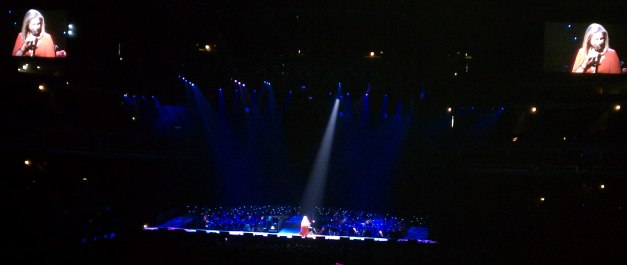
The difference? The ‘stadium show experience.’ I don’t know if it would have been different if I had paid $500 to sit in the front section, but in the $300 seats, she was just a little woman, a football field away from me. However, on both sides of her were two projection screens with multi-camera views of the concert. It was a concert that seemed to be produced with the intention that it would be sold for television.
At one point, I turned to my friend Ben who was sitting next to me and said, “ I’ve 3 letters to describe this concert…P.B.S.” Barbra sang, then introduced some guests, who sang with her then did a few songs on their own. The guests were middle of the spectrum genres: Il Volo, three very young tenors who would be at home on any summer night at Ravinia; Chris Botti, a talented trumpeter; and her son, Jason Gould. I could feel the places where the pledge breaks would naturally fit. The one surprise was how effortlessly she chatted with her guests and addressed the audience in some carefully written ad libs. However, that just reinforced the feeling of a variety show. I have to admit that when she first came out, I did feel a rush to see her and I got a little teary eyed during “Didn’t We?” but as the show went on, I less frequently looked at the stage but just looked at the giant projection screens.
Mega-Streisand comes out of the dark at the United Center
It has to be twenty years since I’ve been to one of those giant shows before the show was shown on the giant screens. (I think the last time, believe it or not, was RUSH, where I don’t think I ever even saw the band, but just the laser beams shooting over my head.) I realized that this concert was less about Streisand on stage and more about 20,000 people all having a group televised projection experience. It was live, it was happening at that moment, but it was also on television. Why look at the stage when what you really needed to see was up on the screens?
Last year, Streisand did a private concert at the Vanguard in New York, where she had last performed in 1963. Only one hundred people were able to get tickets. The Clintons, Donna Karen, Sarah Jessica Parker, and the likes were in attendance. A few months after the show, the concert was released on BluRay. I bought it and decided to watch it by myself one Friday. I ordered in dinner, got a bottle of wine and settled in to watch it on my big projection system. The clarity of the image and the quality of the sound turned my living room into the Vanguard. It was as if I was there, front row. I wept and felt that this was an amazing performer, the one who touched me when I was 14 sitting in my parent’s basement.
Regardless, I’m glad I had the experience of seeing one of the greatest singers in history. Check that off my bucket list. Now I just need to figure out how to see Connie Francis…
Thanks to Ben Alba and Aitor Mendoza for the photos.
ON THIS DAY in 2000, the controversial U.S. Presidential election took place that later resulted in the Bush v. Gore Supreme Court decision. These events were depicted in the 2008 HBO film, RECOUNT, starring Kevin Spacey, John Hurt and Laura Dern.



A bucket list blog: exploring happiness, growth, and the world.
this blog will disappear on the day that my heart is alive again
Where classic films stand out above the rest
The Power of Words
Incredible tips for Classrooms and Staffrooms
Watch as I amaze and astound with opinions about what TV shows I like!
Political Co-Dependency Intervention
Tablecloths, Table Toppers, Placemats our specialty
I blog about everything and anything, never hesitate to question....
The works and artistic visions of Ken Knieling.
entertainment & belief go heart to heart
the Story within the Story
Horror With Humour
unparalleled film reviews, news, and top 10s
Mostly movies with a smattering of TV, books, and LEGO thrown in!
MUSINGS : CRITICISM : HISTORY : NEWS
Film, Comics, Music, News, You want it? We've got it!
On This Day....
Celebrate Silent Film
...a classic film and TV blog
Entertainment and Everyday News brought to you in a flash
wendy maruyama, art work, executive order 9066, the tag project
A guy with a desk...
www.attentiallupo2012.com
Improving the English language one letter at a time
Seek first the kingdom of God and his righteousness. (Matthew 6:33)
draws comics
Canadian trivia and history in bite size chunks!
“There are always two people in every picture: the photographer and the viewer.” -Ansel Adams
Independent movie reviews and more...
Stories
The life and times of Erik, Veronica and Thomas
a site for movie lovers' eyes
Short reviews on high quality films. No spoilers.
For the Love of Leading Ladies
A blog for movie enthusiasts and weed lovers
A Blog For Every Movie Lover
knitting and blogging in Italy in times of economic crisis
** OFFICIAL Site of Artist Ray Ferrer **
Not just another WordPress.com site, but an extraordinary place to spend a weekend, grill a cheese sandwich and watch a film to improve your life and stimulate a few of the grey cells.
 Home Projectionist