Dansk: Blikdåse med reklamefilm på Statsbiblioteket. (Photo credit: Wikipedia)
The last episodes of the 15-part of THE STORY OF FILM: AN ODYSSEY(2011), filmmaker and narrator Mark Cousins continues to explore the constancy of change in cinema as it moves from celluloid to the digital era. Throughout the 1990s and onward, authenticity and artifice weave in and out of the picture as directors all over the world explore, question, and reference the realm of possibilities.
During this time, film becomes more “real” with expanded use of documentary style demonstrated in Iranian films like LIFE, AND NOTHING MORE (1992) by Abbas Kiarostami and the handheld roughness of BLAIR WITCH PROJECT(1999) by Daniel Myrick and Eduardo Sanchez. Paradoxically, directors are exploring the “unreal” with movies such as the jaw-dropping HOUSE OF FLYING DAGGERS(2004) by Yimou Zhang, horror film RINGU (1998) by Hideo Nakata; and the “mash-up” music video style of MOULIN ROUGE (2001) by Baz Luhrmann.
Of course, as time moves on, computer-generated graphics create spectacle of the kind created in GLADIATOR (2000) and AVATAR (2009) to the point that films start feeling like video games. (The utter disdain with which Cousins spits out the words “hobbits and avatars” is highly entertaining, by the way.)
On the other end of the spectrum are directors like Van Trier, Tarantino, and the Coen Brothers who erase boundaries and artifice to create films that strive to be more real — and less real — at the same time.
Like the adage goes, “Nothing is constant but change.” And film is no different. Technology will continue to influence the realm of possibilities. More corporate marketing (and perhaps less of culture) will continue to influence what’s seen on the silver screen. And directors will continue to strive to deliver their individual visions.
One of the most compelling clips in this part of STORY is the side-by-side comparison the shower scene in Hitchcock’s PSYCHO and Van Sant’s 1998 version. Like an ongoing conversation with the past, film will continue to quote film.
________
THE STORY OF FILM: AN ODYSSEY(2011) is a 15-part, 15-hour documentary exploring the convergence of technology, business, intelligence, and vision that has created the remarkable and powerful art of cinema. Music Box Films is distributing this new documentary, and Chicago’s Music Box Theater has just completed a multi-week screening of this ambitious effort. The DVD has been released. You will want to add it to your collection.
Gloria Bowman is a writer, storyteller, blogger, movie lover, freelance editor,
and author of the novel, Human Slices.
Access her blog at www.gloriabowman.com; on Twitter @GloriaBow
Movie recommendation algorithms can be interesting, but isn’t it a lot more fun to discover movies and shows by sharing what you’re watching among friends?
We’ve launched a Home Projectionist Facebook group to do just that.
(This group is an addition to the Home Projectionist blog and Facebook page.)
Our ultimate goal is to create a community of like-minded people who love movies, love being the program directors in their own living rooms, and love talking about what they’re watching.
For Home Projectionists, settling in to watch a film, show, or clip is more than a movie, it’s a passion.
Go to the Home Projectionist Facebook Group to join. And feel free to invite your friends. Anyone on Facebook is invited to participate. Who knows what you’ll discover…
Before the creation of censorship guidelines, Hollywood loved its lascivious stories. And while not every “pre-code” film is a winner, SEARCH FOR BEAUTY (1934) is a stunner, complete with laugh-out loud lines…and even naked butts!
The story follows three hapless ex-cons (brilliantly played by James Gleason, Robert Armstrong, and Gertrude Michael) who are looking to get into something “legit.” They buy a defunct business operation that includes a health magazine and a spa facility, referencing the notoriety of real-life health guru/pulp publisher Bernarr MacFadden (who is a full story in himself).
The cons attend an Olympics competition and are inspired by the bodies beautiful of Ida Lupino, a champion diver, almost unrecognizable with bleached blonde and Harlow eyebrows, and hottie Buster Crabbe, U.S. Olympic swimmer. Crabbe is delightfully innocent as Don Jackson, who makes a plea to the audience cheering the receipt of his gold medal, “You guys in the seats! Get out of the stands and exercise!”
The cons get the idea to recruit the athletes as their magazine editors to give their new “health” publication credibility. In reality though, they’re looking to market a beefcake and cheesecake rag.
While the cons start working on their ruse, they send Crabbe on a global tour to find the most beautiful bodies in the world. After coming up with a boatload of healthy and bright bathing beauties, Crabbe and Lupino quickly discover the cons’ true motive and make a deal to get out their contract. The cons negotiate and Crabbe and Lupino end up with the dilapidated health farm. But Crabbe has a big vision that he can make a spa a viable operation.
Unfortunately, trouble ensues when the cons cut back into Crabbe’s business and promote the health farm as a sexcapade getaway.
The film is funny , filled with great lines like, “You can’t treat our guests like a bunch of Bo-Hunks in a box car,” but it does border on creepy when the masher guests (both male and female) start soliciting their innocent trainers for sex. A scene in one of the hotel rooms is a disturbing cautionary tale for the “good girls” out there. “I have nothing against sex,” one of the cons says, “Either you have it or you’re looking for it.”
Not every pre-code movie is a crowd pleaser, but check out this inspired production number for opening night at the fat farm. Get ready to work out!
COLLECTION NOTES: Every film fan needs a good collection of pre-code films and they’re readily available. Warner Bros., with TCM, released “Forbidden Hollywood Collection” in 2006, and just recently Sony and TCM have recently released “Columbia Picture Pre-Code Collection” and “Frank Capra: The Early Collection.” Go to TCM for for a look.
Gloria Bowman is a writer, storyteller, blogger, movie lover, freelance editor,
and author of the novel, Human Slices.
Access her blog at www.gloriabowman.com; on Twitter @GloriaBow
WILL THE RECENT debut of Sacha Gervasi’s HITCHCOCK spawn similar films that deal with singular, cinematic efforts to create a single motion picture? The field seems ripe for exploitation. Sure, there are interviews and short documentaries with directors on many DVDs and Blu-Ray disks nowadays. But maybe someone, someday will mine the minefield that was Michael Cimino’s HEAVEN’S GATE, for instance, and turn it into a major motion picture in its own right.
Here we present eight-and-a-half films about films, by no means a definitive list, and in no particular order–directorial efforts in which a director had to struggle, take a personal journey, or by sheer force of will, will them into existence:
WHITE HUNTER, BLACK HEART (1990; directed by Clint Eastwood) Ostensibly about an adventuring movie director named John Wilson, it’s quite obvious that the hunter with the black heart really is John Huston. The film is based upon Peter Viertel’s book about the storied filming of THE AFRICAN QUEEN, which Huston shot mainly on location, and which Huston/Wilson uses as an excuse to pursue the pleasures of life, pleasures that included ending the lives of African elephants–whether those pursuits have a negative effect on the movie production or not.
~~~
HEARTS OF DARKNESS: A Filmmaker’s Apocalypse (1991) By now, everyone knows that Francis Ford Coppola’s APOCALYPSE NOW was a troubled production, to say the least. All you need to do is add together Martin Sheen’s heart trouble, the Phillipine climate and the name Marlon Brando. This fascinating documentary follows the shooting of this terrific movie-one that captures the essence of the Vietnam war experience.
~~~
CRIMES AND MISDEMEANORS (1989; directed by Woody Allen) This is a personal favorite of mine, among all of Allen’s films. Actually, several stories converge here, only one of which is really about Allen’s filming woes. His task is to create a documentary about his brother-in-law, the conceited character played by Alan Alda, who says to Allen, “You’re not my first choice”. During the course of the filming, Allen falls in love and grows to detest the obnoxious Alda, who delivers the classic line, “Comedy equals tragedy plus time.”
Ten hours into THE STORY OF FILM: AN ODYSSEY (2011), my head was reeling with “begats,” such as this-scene-was-influenced-by-this-scene-which-was-influenced-by-this-scene etc., etc. In sum, like all art — and life itself — filmmaking is influenced by what has come before, the impact of cultural and political changes, and what technology allows. As this history of film gathers steam across time, the cross-pollination of influences and innovation gets more and more diverse and less linear.In the segments of THE STORY OF FILM that explore movies of the 1960s and 1970s, filmmaker and historian Mark Cousins examines the influential directors of Europe’s New Wave, the emergence of a new, “dazzling” world cinema, and the evolution of American film post-Hollywood’s Golden Age. As this new wave of world cinema grows and matures, filmmaking around the world doesn’t just reflect culture, it attempts to change it.
Here are only just a very few of the notable films cited by Cousins from the world cinema directors of the 1960s and 1970s to add to your Watch List:
-Roman Polanski’s TWO MEN AND A WARDROBE (1958) and THE FEARLESS VAMPIRE KILLERS (1967)
-Andrei Tarkovsky’s ANDRE RUBLEV (1966)
-Milos Forman’s THE FIREMAN’S BALL (1967)
-Nagisa Oshima’s BOY (1969)
-Vera Chytilova’s DAISIES (1966)
-Ousmane Sembene’s BLACK GIRL (1969)
-Ritwik Ghatak’s THE CLOUD-CAPPED STAR (1960)
-Werner Fassbinder’s THE BITTER TEARS OF PETRA VAN KANT (1972)
-Donald Cammell & Nicholas Roeg’s PERFORMANCE(1970)
-Bernardo Bertolucci’s THE CONFORMIST (1970)
One of the most spellbinding moments in THE STORY OF FILM is watching the beautiful and imaginative continuous shot from the funeral scene in I AM CUBA (1964) by Mikhail Kalatozov. What an achievement — without computer-generated graphics. You can watch this one again and again.
Following the growth in world cinema, Cousins opines that American film of the ’70s was next up for a sea change, emphasizing the cynical and dissident films, such as Mike Nichols’ THE GRADUATE (1967) and CATCH 22 (1970); the “assimilationist” film, like Peter Bogdanovich’s THE LAST PICTURE SHOW (1971), which simultaneously pays homage to film’s past and its future; and identity films, such as Martin Scorsese’e ITALIANAMERICAN(1974).
The next era covered in THE STORY OF FILM “ushers in the age of the multiplex,” with blockbusters like JAWS, STAR WARS, and THE EXORCIST from the States, and Bollywood and Bruce Lee from Asia. Stay tuned….just a few more hours to go!
______
THE STORY OF FILM: AN ODYSSEY (2011) is a 15-part, 15-hour documentary exploring the convergence of technology, business, intelligence, and vision that has created the remarkable and powerful art of cinema. Music Box Films is distributing this new documentary, and Chicago’s Music Box Theater has just completed a multi-week screening of this ambitious effort. The DVD will be released in November 2012. You will want to add it to your collection.
Gloria Bowman is a writer, storyteller, blogger, movie lover, freelance editor,
and author of the novel, Human Slices.
Access her blog at www.gloriabowman.com; on Twitter @GloriaBow
After the plethora of sweeping, epic melodramas in post-WWII films, the next era of innovation in moviemaking took the opposite road: exploring the “profoundly personal” experience.In Part IV of the 15-hour documentary, THE STORY OF FILM: AN ODYSSEY (2011), filmmaker and historian Mark Cousins delves into the work of cinema’s great New Wave innovators of the 1950s and 1960s.
During the beginning of this new wave in film history, Cousins cites four great directors as the movers and shakers who took film to this new, personal level: Ingmar Bergman, Robert Bresson, Jacques Tati, and Frederico Fellini. These innovators championed the role of film itself becoming an integral part of the narrative.
Citing Bergman’s SUMMER WITH MONIKA (1953), for example, there is a groundbreaking scene where Monika looks at us directly, straight into the camera, changing the audience’s relationship to the story being exposed on the screen. In Robert Bresson’s masterpiece, THE PICKPOCKET (1959), Cousins notes that the film demonstrates the “total rejection of gloss,” stripping down the story to emphasize the flatness of the everyday. Thirdly, he recognizes the briliance of visionary director Tati with MONSIEUR HULOT’S HOLIDAY (1953), a film which basically affirms that “the story doesn’t exist,” Tati preferring incidence and details to a plot line. And last but not least, Cousins highlights the work of Frederico Fellini, whose major construct was portraying life as a circus world, with films such as NIGHTS OF CABIRIA(1957), using improvisation as opposed to linear storytelling.
As the story of film evolves, these four influential filmmakers gave way to the French New Wave directors of the early sixties. Cousins calls these innovators “the film school generation,” who embraced filmmaking as an intellectual endeavor, creating even more “narrative ambiguity” in movies and focusing on the meaning of life and existentialism.
For starting an exploration of this period, go with classics such as CLEO FROM 9 -5(1962) by Agnes Varda; LAST YEAR IN MARIENBAD (1961) by Alain Resnais; Francois Truffaut’s 400 BLOWS (1959); Jean Luc Goddard’s A MARRIED WOMAN (1964); Marco Ferreri’s THE WHEELCHAIR (1960); Sergio Leone’s FISTFUL OF DOLLARS(1964); and I AM CURIOUS YELLOW (1967) by Filgot Sjoman.
And then like every other era, the French New Wave lost its steam and made way for a new world cinema that “dazzled” the industry. Stay tuned….
THE STORY OF FILM: AN ODYSSEY (2011) is a 15-part, 15-hour documentary exploring the convergence of technology, business, intelligence, and vision that has created the remarkable and powerful art of cinema. Music Box Films is distributing this new documentary, and Chicago’s Music Box Theater is conducting a multi-week screening of this ambitious effort. The DVD will be released in November 2012. You will want to add it to your collection.
P.S. — Part of the experience of watching this series is sinking down into your seat and giving into the filmmaker’s hypnotic narration. Have a listen….
Gloria Bowman is a writer, storyteller, blogger, movie lover, freelance editor,
and author of the novel, Human Slices.
Access her blog at www.gloriabowman.com; on Twitter @GloriaBow
If your Thanksgiving Day involves film watching and family and friends of “a certain age,” say, fifty-plus, you could do no better than select THE BEST EXOTIC MARIGOLD HOTEL (2011) for a feel-good, heart- warming tale about the power of the present.This British film by director John Madden (SHAKESPEARE IN LOVE, for example) brings together an outstanding cast of seven characters is search of meaning in the next stage of their lives. And they indeed find new beginnings, along with the help of the young, bungling, and idealistic hotel manager, played by Dev Patel (of SLUMDOG MILLIONAIRE fame).
One unifying dilemma brings most of the characters together: getting older without the right resources. Maggie Smith’s character needs a new hip and a better frame of mind. She has lost her job and her purpose. Her inability to feel needed has turned her sour and hard. Judi Dench, recently widowed, has discovered that her husband left her totally broke. Bill Nighy and Penelope Wilson play a retired couple whose minimal government pension has left them disillusioned with their lives and with each other. Tom Wilkinson has abruptly exited his unfulfilling job to re-establish contact with his past. Celia Imrie defies being relegated to the role of grandma, and Ronald Pickup isn’t ready to go down anytime soon (and he’s got the Viagra to prove it).
They all end up at the Best Exotic Marigold Hotel in Jaipur, India. Their money will go further here in this strange land…and so will their understanding of who they are and who they are yet to be.
The charming, bittersweet script is part brilliant and part self-help-motivation speak. One of my favorite lines is Dench’s sensible character, Evelyn, philosophizing, “There is no past that we can bring back by longing for it. Only a present that builds and creates itself as the past withdraws.” We watch each of the characters face their present realities and continue to grow with grace, and most importantly, with spirit and strength.
The film isn’t without its faults. But the very few weak or predictable moments are salvaged by the impeccable cast whose performances are painfully real and honest. Bill Nighy is flawless in his portrayal of a kind and curious man who keeps being surprised by himself. Adding additional depth to the story are the glorious colors and chaos of India.
Dev Patel’s character relies on the words of his father to help him through his struggles. He often says, “Everything will be all right in the end… if it’s not all right, then it’s not the end.”
And so the characters learn, too, that they have until their end, and until that time comes, there is still opportunity to create joy and happiness. What a lesson for Thanksgiving.
THE BEST EXOTIC MARIGOLD HOTEL ia delicious morsel to add to your holiday weekend.
With STAGECOACH (1939), John Ford introduced a new cinematic vision using deep staging and deep focus “that allowed the audience to choose where to look” on the screen.
This innovation, according to Mark Cousins, creator of THE STORY OF FILM: AN ODYSSEY, changed film forever, influencing Orson Welles to take “deep staging as far as it could go” in creating his masterpiece, CITIZEN KANE (1941). Film had never looked like this before.
In the opening of Part 3 of THE STORY OF FILM: AN ODYSSEY, we see a quick newsreel clip of Hitler and Mussolini sharing a lighter moment. The voiceover provided by Cousins recognizes that these two men wreaked havoc on the world, and then just like that, we’re off to “Post-War Cinema.” Maybe film of the war years is a separate story for another time.
Nonetheless, the saga of THE STORY OF FILMis a compelling commentary on the constant evolution of film, a reflection of the ever-changing human experience. There has been war. Barriers are going up. Some barriers are coming down.
After the war, the Italian cinema made an indelible mark on filmmaking, with its “rubble” films, presenting the stark, bleak reality of post-war destruction, changing the nature of beauty in cinema, from soft focus romance to dark and dreary reality. The Italian neo-realists, per Cousins, created “cinema that features the boring bits of life,” as opposed to Hitchcock who said that “cinema is life but without the boring bits.”
The convergence of new directorial styles and gloomy world views gave us a Hollywood that began emphasizing film noir, with films like SCARLET STREET (1945) by Fritz Lang; GUN CRAZY (1950) by Joseph Lewis; THE HITCH-HIKER (1953) by Ida Lupino, Hollywood’s only female film noir director; and the pitch-perfect noir classic, THE THIRD MAN(1949) by Carol Reed.
As much as noir became the Hollywood norm during this post-war period, the American film industry still created vibrant stunners such as SINGING IN THE RAIN(1952) and AN AMERICAN IN PARIS (1951), ensuring audiences that joy could still be found in this neo-realist world.
And while the brooding vision of the post-war years went on, borders were redrawn and decolonialization was happening. As a result, the faces of world cinema came to the forefront in Egypt, India, China, Mexico, Britain, and Japan. In the 1950s, the human story went global, and in the film world, the emphasis moved to grand melodramas about the perils of life, love, lust, and survival.
David Lean delivered big drama with GREAT EXPECTATIONS (1946). And American movies certainly had their own glossy tortured tales like Nicholas Ray’s REBEL WITHOUT A CAUSE (1955) and JOHNNY GUITAR(1954). The world saw other groundbreaking weepers, such as PATHER PANCHALI (1955) by Satyajit Ray and DONA BARBARA (1943) by Fernando Fuentes and Miguel Delgado.
As with each segment of THE STORY OF FILM: AN ODYSSEY,mylist of must-see films expands. I’m starting with CAIRO STATION(1958), with Youssel Chahine, which Cousins taga as “the first great African/Middle Eastern film,” and a revisit to the ultimate sexy melodrama of the 1950s, ...AND GOD CREATED WOMAN(1956) by Roger Vadim and starring Brigitte Bardot.
THE STORY OF FILM: AN ODYSSEY(2011) is a 15-part, 15-hour documentary exploring the convergence of technology, business, intelligence, and vision that has created the remarkable and powerful art of cinema. Music Box Films is distributing this new documentary, and Chicago’s Music Box Theater is conducting a multi-week screening of this ambitious effort. The DVD will be released in November 2012. You will want to add it to your collection.
Gloria Bowman is a writer, storyteller, blogger, movie lover, freelance editor,
and author of the novel, Human Slices.
Access her blog at www.gloriabowman.com; on Twitter @GloriaBow
Recently, I did something I never thought I would get to do: See Barbra Streisand in person, in concert. In her whole 50-year career, she has performed in concert less than one hundred times. From 1969 until the mid-80s she never performed in public due to stage fright. When she did come back, the concerts were such major events that the chance to get tickets was impossible or insanely expensive. But this last month, I decided it was probably going to be my last chance to see her as she turned 70 this year. Plus, I had a little extra cash to spend the obscene amount of money needed to buy a ticket.
It was an important to me to go as well. Streisand was one of, if not the biggest, influences in my teenage years. As a meek and weak child of the 70s, who often would get picked on for being too skinny, not good at sports, a ama’s boy, so to speak, Streisand stood for the outcast who made good. The girl who they called ugly on the school yard who ended up dating handsome movie stars, who could tell everyone you can’t stop me, I’m going to do it. And then there was her voice, which is incomparable, loud, brash with a “fuck you, world, I’m going to hold this note 20 seconds because I can” attitude. There is a whole orchestra of emotions in her voice.
Before the instant world of immediate entertainment gratification, each new album I got of hers was an event. Every Christmas, my parents or sister would get me another album. And I would put my headphones on and listen to it over and over until I had squeezed every ounce of emotion out of it, until the timbre of her voice was rumbling around in my head like some wind that wouldn’t stop howling. When things got bad in high school as I suffered through bullying, I would get through the day by remembering every note of her albums.
So, needless to say, 35 years later, there are many shades of emotion for me when it comes to her. Going to this concert was a form of closure, homecoming, and remembrance. I honestly didn’t know how I was going to react. Would I breakdown, recalling that her voice probably pulled me through those dark years, kept me alive, gave me hope? I would actually be in the same room with this person for whom I used to seek out the latest photos, thinking that seeing the newest photo brought me that much closer to being in her immediate reality. I know, that’s nuts…
Through Facebook, I’ve reconnected with a few high school friends. One friend was also a huge Streisand fan and we connected back then through our fanship. He wrote on my wall the day I was going:
“Tonight when the house lights dim and the music starts, sit back, relax, clear your mind and enjoy every frickin’ moment. Something you’ve thought about your whole life is about to happen. I’m so excited for you. Enjoy, enjoy, enjoy.”
So what happened: I had a really nice time. No catharsis, no moment where I said, “Wow… this is the moment I had been waiting for all my life.” It was just a great concert. I thought long and hard afterwards…
What happened? I’ve been to concerts where the singers took me out of myself, wrapped me in the songs and music: Peggy Lee comes to mind; seeing Keely Smith; Frank Sinatra at the Chicago Theatre, sitting in the front row of the balcony, feeling like I was watching something historic that was fading away; Rod McKuen, whose simple performance and words brought me to tears.
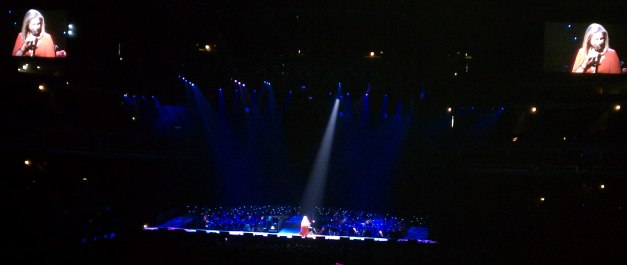
The difference? The ‘stadium show experience.’ I don’t know if it would have been different if I had paid $500 to sit in the front section, but in the $300 seats, she was just a little woman, a football field away from me. However, on both sides of her were two projection screens with multi-camera views of the concert. It was a concert that seemed to be produced with the intention that it would be sold for television.
At one point, I turned to my friend Ben who was sitting next to me and said, “ I’ve 3 letters to describe this concert…P.B.S.” Barbra sang, then introduced some guests, who sang with her then did a few songs on their own. The guests were middle of the spectrum genres: Il Volo, three very young tenors who would be at home on any summer night at Ravinia; Chris Botti, a talented trumpeter; and her son, Jason Gould. I could feel the places where the pledge breaks would naturally fit. The one surprise was how effortlessly she chatted with her guests and addressed the audience in some carefully written ad libs. However, that just reinforced the feeling of a variety show. I have to admit that when she first came out, I did feel a rush to see her and I got a little teary eyed during “Didn’t We?” but as the show went on, I less frequently looked at the stage but just looked at the giant projection screens.
Mega-Streisand comes out of the dark at the United Center
It has to be twenty years since I’ve been to one of those giant shows before the show was shown on the giant screens. (I think the last time, believe it or not, was RUSH, where I don’t think I ever even saw the band, but just the laser beams shooting over my head.) I realized that this concert was less about Streisand on stage and more about 20,000 people all having a group televised projection experience. It was live, it was happening at that moment, but it was also on television. Why look at the stage when what you really needed to see was up on the screens?
Last year, Streisand did a private concert at the Vanguard in New York, where she had last performed in 1963. Only one hundred people were able to get tickets. The Clintons, Donna Karen, Sarah Jessica Parker, and the likes were in attendance. A few months after the show, the concert was released on BluRay. I bought it and decided to watch it by myself one Friday. I ordered in dinner, got a bottle of wine and settled in to watch it on my big projection system. The clarity of the image and the quality of the sound turned my living room into the Vanguard. It was as if I was there, front row. I wept and felt that this was an amazing performer, the one who touched me when I was 14 sitting in my parent’s basement.
Regardless, I’m glad I had the experience of seeing one of the greatest singers in history. Check that off my bucket list. Now I just need to figure out how to see Connie Francis…
Thanks to Ben Alba and Aitor Mendoza for the photos.
David Mitchell, author of CLOUD ATLAS, is apparently happy with how the movie turned out. He should be. The movie—faithful in spirit but unfaithful in many details—does something I would have sworn was impossible: it soars like the book.
Enjoy the humor, the witty visual transitions, and the glorious writing. Savor the Sonmi-451 narrative—the strongest of the six—which is beautiful, stunning, and powerful (it is in the book, too). Stay for the credits to find out which actors played which roles. I was astonished to see who did what.
The key: life itself
To understand CLOUD ATLAS, look at life. Helpful or harmful actions birth other helpful or harmful actions, which birth other actions, and so on forever. Some you know about; most you will never know.
A casual encounter turns out to be life-altering. A job falls out of the sky. A song gets to you. Some would call these chance encounters. Neither the filmmakers, David Mitchell, nor I would call them chance, but whatever they are, life runs by them.
In the movie, connections go forward, backward, and sideways (this is what drives some viewers crazy). Past acts reverberate in the future. Music sounds familiar to a character who could not have heard it before. An act of kindness or cruelty changes the direction of someone’s life forever, which changes another person’s life forever, and so on. As the movie’s trailer says: “everything is connected.”
The individual CLOUD ATLAS stories move in one direction: forward. But they interlock in ways that sometimes suggest reincarnation and sometimes the simple truth that the present is connected to both the past and the future. Everything matters, which leads to the next point:
Actions matter forever
The central conflict between selfishness/predation and love is a little more obvious in the novel, because Mitchell is explicit about it, but it is fairly straightforward in the movie, too.
The common ground of all six narratives is exploitation of some people by others. All six narratives make the same turn, too: the exploited ones break their chains and reach toward something good (freedom, justice, truth, God, their beloved). They head out into a future either happy or dangerous, but in every case allied with good. For this reason CLOUD ATLAS is a buoyant, hopeful movie.
“If I had remained invisible,” Sonmi-451 says shortly before her death, “the truth would have remained hidden. I couldn’t allow that.”
I love it that Tom Tykwer and Lana and Andy Wachowski made this movie. They must have known from the beginning it was going to ask everything of them and not necessarily pay them back. Their work is heroic that way.
One last bit of advice
If you can bring a drink into the theater, do so. Alcohol will loosen your grip on narrative expectations.
Lindsay Edmunds blogs about robots, writing, life in southwestern Pennsylvania, and sometimes books and movies at Writer’s Rest. She is the author of a novel about love in the age of artificial intelligence: Cel & Anna.
Like bones in a graveyard, hundreds and hundreds of Halloween movie lists are scattered across the Web, touting the scariest, the best, the goriest, you name it. But long lists can be overwhelming. Here are four must-watch movies to add to your freaky list. File them under “Disturbing,” “Chilling,” “Terrifying,” and “Sort of Stupid.”
IT’S OK TO BE AFRAID OF YOUNG BLONDE TWINS
When people talk about movies that have stayed with them for days and days, I recall THE OTHER (1972). This disturbing, rarely shown classic, stayed with me for not just days, but for years. Because of THE OTHER, I still have a need to avoid blonde twin boys. Never trusted them; never will. And I’m slightly afraid of farms as well.
With direction by Robert Mulligan (he of TO KILL A MOCKINGBIRD, for one), score by Jerry Goldsmith, and star power like Uta Hagen and Diana Muldaur, how can this movie miss? There are no ghosts or demons, but sheer suspense, true to the nail-biting novel by Thomas Tryon by the same name.
YOUR PATHETIC, BANAL LIFE ISN’T SO BAD SECONDS (1966) is unquestionably one of the most chilling films I have ever seen. What were my parents thinking when they took me to see it when I was only 12 years old? I think they were thinking that if it starred Rock Hudson, it must be a happy family film. In reality, it is a decadent, modern twist on making a pact with the devil.
This stylistic thriller, complete with skewed camera angles and distorted images, was directed by John Frankenheimer of MANCHURIAN CANDIDATE fame.
Rock Hudson totally pulls out his acting chops for this one, playing unhappy and down trodden Arthur. He is so beat up by life that he likes the sound of an enticing proposal. From workaday drone to swinging playboy? What could go wrong?
As soon as the drill goes into Hudson’s neck, you know that Arthur should have consider his decision a little more carefully. This film also has one of the best drunk scenes ever recorded (and in reality, Hudson was totally tanked during the filming of it).
DON’T ENTER THE SUBWAY IF YOU HEAR SCREAMING LIKE THIS GOING ON
Filed under “What Are You Watching?” Home Projectionist fan Jonathan Stacy writes:
“If you want a truly terrifying Halloween movie with cult status (particularly in Europe), try POSSESSION (1981) by Polish director Adrezej Zulawski with Isabella Adjani and Sam Neil. It’s a strange hybrid of marital drama, ROSEMARY’S BABY, and early eighties freak out. (And in my opinion, it was a major influence on Lars von Trier and his ability to cull strong performances from women despite dubious feminist interpretations; Gainsbourg in ANTICHRIST is the obvious daughter of this work). Think a mish-mash of KRAMER VS. KRAMERand IT’S ALIVE!
Adjani won best actress at Cannes for this film, the central piece being her miscarriage (from a demon?) in a subway. Frighteningly over the top and horrifyingly real all at the same the same time.”
You’ll want to watch this scene more than a few times:
CURIOUS CASTING COMBINATIONS WORK FOR NO REASON WHATSOEVER, LIKE JOAN COLLINS AND A DWARF And like a trainwreck you shouldn’t watch, THE DEVIL WITHIN HER (1975) is custom made for when you’re in the mood for hootin’ and hollerin’ and makin’ wisecracks. The world doesn’t need another cheap imitation of ROSEMARY’S BABY but there’s Joan, a demon dwarf, a devilish baby, and a dastardly wig — plus sex!
Happy Halloween! May the demons be with you.
Gloria Bowman is a writer, storyteller, blogger, movie lover, freelance editor,
and author of the novel, Human Slices.
Access her blog at www.gloriabowman.com; on Twitter @GloriaBow
The THRILLER television series (1960 – 1962) is an under-appreciated treasure trove for your Halloween watch list. The expertly crafted episodes feature compelling tales with twists and turns and startling, dark images that can be much more disturbing than big blobs of blood, guts, and over-the-top gore.
Boris Karloff hosted this 67-episode tv series, featuring stories by some of the best writers of the thriller genre, including Robert Bloch of PSYCHO fame. Production quality is top notch from the spot-on, spine-tingling music to the lineup of directors, including Ida Lupino, actress and one of the first female film directors.
These stories scared me when I was young, and they still have staying power. A few of my favorite episodes are “The Grim Reaper,” starring William Shatner, who shows off his best Shanter-esque acting chops in the closing sequence. Invite your friends and ghouls over to hunker down for the “The Grim Reaper” episode, along with “A Wig for Miss Devore, “The Hungry Glass,” and “La Strega.”
They may want to leave the lights on when it’s time for bed.
Gloria Bowman is a writer, storyteller, blogger, movie lover, freelance editor,
and author of the novel, Human Slices.
Access her blog at www.gloriabowman.com; on Twitter @GloriaBow
The teenaged me received quite an education in life from the movies of 1969.
There were MIDNIGHT COWBOY, THE MAGIC CHRISTIAN, LOCK UP YOUR DAUGHTERS, EASY RIDER, THE WILD BUNCH, DE SADE, WOMEN IN LOVE, BUTCH CASSIDY AND THE SUNDANCE KID, BOB & CAROL & TED & ALICE, MAROONED, THE STEWARDESSES, MEDEA, and SWEET CHARITY – just to name a few of the most memorable. Scenes from each of these films — feats of daring! blood splatters! nude male wrestlers! beheadings! bare breasts! — are permanently etched into my brain.
But the one film that still resonates the most strongly after all of these years is THE STERILE CUCKOO, a heartbreaking story of young love, longing, and loneliness. Liza Minnelli shines in the role of Pookie Adams, a fragile and kookie college coed desperate to make an impression and a connection.
Liza’s performance, for which she received an Academy Award nomination, is riveting in its honesty and depth. In fact, ever since 1969, I have used her portrayal Pookie as the benchmark to compare other actress’s acting chops, as in, “She was OK in the role, but she sure wasn’t Liza in THE STERILE CUCKOO.” Consider the telephone call scene….
Director Alan Pakula created a visually stunning environment to frame the development of this quiet story and Ms. Minnelli’s fragile character. And to add even more intensity to the sad tale of young love lost is the film’s theme song, “Come Saturday Morning,” by Fred Karlin and Dory Previn, which was also nominated for best song.
This little crystal of a movie was released on DVD just yesterday, October 16. If you have never seen it and you have a fondness for coming of age stories that will break your heart, put THE STERILE CUCKOO on your to-be-watched list today.
Gloria Bowman is a writer, storyteller, blogger, movie lover, freelance editor,
and author of the novel, Human Slices.
Access her blog at www.gloriabowman.com; on Twitter @GloriaBow
Not just another WordPress.com site, but an extraordinary place to spend a weekend, grill a cheese sandwich and watch a film to improve your life and stimulate a few of the grey cells.







 David Mitchell, author of



 Home Projectionist