ON THIS DAY in 1189, Richard I was crowned King of England at Westminster Abbey in London. Anthony Hopkins, in his first film role, portrayed the King (also known as “Richard the Lionhearted”) in the 1968 film, THE LION IN WINTER.


ON THIS DAY in 1189, Richard I was crowned King of England at Westminster Abbey in London. Anthony Hopkins, in his first film role, portrayed the King (also known as “Richard the Lionhearted”) in the 1968 film, THE LION IN WINTER.

If you spent most of your time watching movies this past week, you might have missed these articles here at Home Projectionist:
Visit Home Projectionist on Facebook
ON THIS DAY in 1864, Confederate forces evacuated Atlanta, Georgia, burning the city’s supplies and structures behind them. The 1939 classic film, GONE WITH THE WIND, depicted scenes of this great conflagration.
PRESIDENT GROVER CLEVELAND made Labor Day a national holiday in 1894, with the intention of preventing further worker turmoil and deaths, such as occurred during the just-ended, nationwide Pullman strike. Now, it’s a great time to gather together and relax with friends & family for food, drinks, and… movies. Celebrate worker esprit de corps with some Labor Day spirit and one or two of these recommendations (in no particular order), all of which in some way highlight both the delights, and plights, of working men and women.

ON THE WATERFRONT (1954; directed by Elia Kazan) Ex-boxer and longshoreman Marlon Brando attempts to redeem himself by confronting union boss Lee J. Cobb. Leonard Bernstein’s first movie score. “One of the most powerful films of the 50s” (Pauline Kael).
SALT OF THE EARTH (1953) Latino mine workers on strike in New Mexico. The film’s writer and producer had been on the Hollywood blacklist.
BLUE COLLAR (1978; Richard Pryor, Harvey Keitel) Auto workers are being cheated by both their management and their unions. “Strongly-written and provocative” (Danny Peary).
MODERN TIMES (1936) Charlie Chaplin vs. the Machines. An assembly line worker tries to express his humanity at work, with the help of Paulette Goddard.
MOONLIGHTING (1982) Jeremy Irons is a Warsaw construction worker ordered to London where he slowly begins to oppress the Polish laborers he’s supervising.
BLACK FURY (1935) Michael Curtiz’ film is based on a true story of a Pennsylvania coal miner (Paul Muni) who was beaten to death by company detectives. “Realistic, strikingly filmed” (Leonard Maltin).
GUNG HO (1985; directed by Ron Howard) Michael Keaton stars in this light comedy about a Japanese auto firm’s attempts to establish a factory in the U.S.
NORMA RAE (1979) Sally Field (Oscar winner) and Ron Liebman team up to unionize textile workers in this inspiring Martin Ritt film.
MOLLY MAGUIRES (1970; Sean Connery, Richard Harris) Connery leads a secret society of Irish mineworkers in late 1800s Pennsylvania. “Elegiac” (Pauline Kael).
WHICH WAY IS UP? (1977) Richard Pryor plays three roles in a story of a citrus grove worker transformed into a union hero. A remake of the Lena Wertmuller film, THE SEDUCTION OF MIMI.
F.I.S.T. (1979) A truck driver (Sylvester Stallone) becomes a Hoffa-like union organizer and subsequently tangles with gangsters. Directed by Norman Jewison.
HOFFA (1992) Jack Nicholson portrays the exploits of the infamous Teamster boss, in a script by David Mamet. “Almost affectionate biographical treatment” (Videohound).
HARLAN COUNTY, U.S.A. Oscar-winning Barbara Kopple film documents a bitter strike by United Mine Workers against a Kentucky power company. “One of the most incisive portraits of America and the ever struggling labor movement” (Danny Peary).

Little Dutch Boy detail (Photo credit: Aria Nadii)
From now through January 7, 2013, New York’s Museum of Modern Art is presenting a retrospective of the work of identical twins, Stephen and Timothy Quay, also known as the Quay Brothers.
The prolific duo’s claim to fame is their use of stop-motion puppet animation featuring foreboding dolls and machinery in surreal episodes, influenced by the likes of Joseph Cornell, Hieronymous Bosch, and Salvador Dali. Set up as a two-story maze, the MoMA installation includes hours upon hours of the brothers’ films, videos, commercials, and documentaries, along with displays featuring their original puppets and props.
Love them or not, it’s always good for Home Projectionists to have a storehouse of clips on hand to round out an evening’s experience.
Remember: Halloween is coming up….
ON THIS DAY in 1532, Lady Anne Boleyn was made England’s Marquess of Pembroke by her fiancé, King Henry VIII. In 1969, Genevieve Bujold portrayed Boleyn in the film, ANNE OF THE THOUSAND DAYS, with Richard Burton as King Henry.

9 remote controls labeled as follows, from left to right: Philips, no label, Panasonic DVD player, homecast, dreambox, aston, SilverCast, Sony AV System, Sony TV. (Photo credit: Wikipedia)
When you’re in charge of what to watch in your own living room, you’re a Home Projectionist. And online streaming is emerging as the technology tool of choice, while new services are ramping up to enhance what’s already available.
According to an August 30 Broadcast Newsroom release, online move viewing is “surpassing DVDs, Blu-Ray sales, and live theater visits.” It’s a matter of cost, convenience, and choice. When you’re at home, you’re in charge. The article states it is “estimated that 3.4 billion movies will be streamed online in 2012.”
Home Projectionists note, however, that streaming choices don’t have the supplemental behind-the-scenes materials that can enhance a viewing experience.
To fill that void, one new service, for example, DigiTitles.com, offers free “making of” and related content. According to DigiTitles, its content is created and submitted by, “People involved in the production process (e.g., concept artists, storyboard artists, makeup artists, scriptwriters, stunt coordinators, photographers, etc.); producers and content owners interested in promoting their work; and anybody else with relevant information and a desire to share.”
As Home Projectionists evolve, so will the resources available to them to produce increasingly creative viewing experiences for family and friends. Everybody wins.
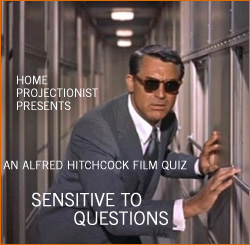
Good evening. How many in your party? One? Fine. We have a pleasant quiz over here if you’ll follow this way. Please be seated and your quizmaster will be right with you. In the meantime, may we suggest reflecting on the many drinking and dining establishments you’ve encountered within the films of Alfred Hitchcock, followed by clicking on the “Take the Quiz” button.
Good luck, Mr. Thornhill, wherever you are…
Take the Quiz!(*The quiz title was inspired by Alfred Hitchcock’s North By Northwest: “Something wrong with your eyes?” “Yes”, says the sunglass-clad Roger O. Thornhill (Cary Grant), “They’re sensitive to questions”. Early during the movie, Roger dictates a note for his secretary to give to his mother: “Dinner at ’21’. Seven O’Clock.”)
ON THIS DAY in the year 12 A.D., Roman Emperor Gaius Caligula–nephew and adopted son of Tiberius–was born. The 1980 film, CALIGULA, written by Gore Vidal and starring Malcolm McDowell, told the story of the Emperor’s rise and fall.
THIS FASCINATING, short video should remove all doubt about the power of the “one-point perspective” and who was, and probably always will be, the master of it. The impact of a precise, symmetrical point of view is very dramatic and compelling, and it is prevalent in nearly all of Stanley Kubrick’s films.
Several years ago I held my own personal one-person film fest through Netflix. One day after watching The Odd Couple, I put in every single film that starred Walter Matthau or Jack Lemmon. Even though a fraction of Matthau’s 104 Jack Lemmon’s 97 film or television appearances were on DVD and available it still took months to watch them. It was a great film adventure which got me to watch some wonderful films with Jack Lemmon such as Glengarry Glen Ross, Missing, Tuesdays with Morrie; and Walter Matthau in Charlie Varrick, House Calls, The Laughing Detective, Hopscotch.
After I’d squeezed every last bit out of my queue my conclusion was that Jack Lemmon movies were overall better films, and Walter Matthau was in a bunch of terrible films, but always seemed to rise above the materal.
 So I was a little surprised to run across Walter’s craggy face on Netflix streaming in a movie called Movers and Shakers (1985). It went to the top of my list of must sees; it has a pretty interesting cast: Charles Grodin (who wrote it), Gilda Radner, Vincent Gardenia, Bill Macy (Walter from Maude), Tyne Daly. It clocks in at just an hour and twenty minutes. I figured this had to be a quick wild romp.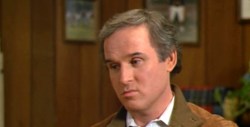
Let me tell you, its a very, very long eighty minutes! This movie falls flat on so many levels I don’t know where to start… But I must start with the star and writer whose shoulders this leaden so-called comedy must fall. I’m sure Charles Grodin is a smart guy; I read one of his auto-biographies and found him to be funny and insightful, so how could he write a movie that doesn’t have one solid laugh in it?
The plot goes like this… Matthau plays an executive at a major studio, Gardenia is dying and tells him to make a movie out of a sex manual called Love and Sex. Grodin is a writer who hasn’t had sex in years because his wife Tyne Daly just stares into space when he talks, Bill Macy is an insane director and Gilda Radner is his cheating girlfriend. 
Gilder Radner screams at her agent for putting her in this movie.
Like Luigi Pirandello’s Seven Characters in Search of an Author, all our players just wander around from scene to scene, sometimes by themselves, sometimes in groups; they sit in a conference rooms and talk about what ‘positions’ should be in the movie, they go walk along the beach, eat ice cream, go for a ride in a limo, sit and watch old movies. Maybe Charles Grodin is a genius, because he wrote a pointless, humorless, flop film desecting the process it takes to make terrible movie. The moral of the story is that its amazing that any movies get made at all because everyone is so incompetent.

Steve Martin is one wild and crazy guy whose name isn’t in the credits
One of the high (low points) in the film is where all the characters go visit an aging silent movie star named Fabio, played by an uncredited Steve Martin. Steve wears a Bea Arthur wig and a smoking jacket and does his ‘wild and crazy guy’ voice while getting Guava juice for everyone. Meanwhile, Penny Marshall in a negligee runs through the scene shreeking and ordering everyone out of the house. This is ten minutes of the running time of the film. Why do they visit him, who knows, he’s not going to be in their movie, he’s just there and then he’s gone. Then Grodin and Macy run along the beach, Tyne Daly reads a book. Gilda makes funny faces. All the while holding this mish mash of random plotlines together is the droning voice of Charles Grodin a la Blade Runner explaining who everyone is, what they are doing, and why we should be interested.
The voice over is non-stop.
Seriously non-stop!

Tyne Daly demonstrates the audience reaction to Movers and Shakers
And as if to throw salt on our wounds the film ends with a musical montage of Charles and Tyne being playful on the beach while Stephen (Tootsie) Bishop sings “Can’t We Go Home Again” which must have been in the thoughts of the poor audience members who saw this stinker in an actual theatre.
However, riding the wave of this cinematic equivant of a flooded basement is Walter. He smirks delivering his lines like a wise, old owl, while thinking, ‘I don’t know why I’m saying this inane dialogue, but I got top billing and a check!’.
And speaking of check. Check one more off my Walter Matthau list…
ON THIS DAY in 1963, the Moscow-Washington “hotline” or “red telephone” between Russia’s Kremlin and the White House, went into operation. In 1964, the Sidney Lumet film FAIL-SAFE featured the hotline in scenes with Henry Fonda as the President.

I remember how my father and I cried at the end of CLOSE ENCOUNTERS OF THE THIRD KIND (1977) when the wide-eyed humans and big-headed aliens make contact for the first time. My dad and I sat in the dark theater, wiping big crocodile tears from our cheeks. We were still a little broken up as we walked out to the car after the movie. My mother rolled her eyes at us. “You two,” she said, shaking her head.
Not everything is sad to the same people.
The other day, I started thinking about how much I don’t like watching sad movies in the summertime. It just seems wrong, in a way, to be all mopey and teary-eyed when we’re in the happy days of summer. I mostly love watching sad movies on the dark and dreary late afternoons of winter.
I decided that maybe now is the time to plan ahead and start building my storehouse of sadness for winter (it’s not that far off, you know). Or was this an excuse to give in to my strange new obsession of scrolling through lists about movies? Either way, I happened upon a MovieFanFare blog list of “The 10 Saddest Movies That I’ve Watched,” written by Clara Fercovic.
I agree with a number of Ms. Fercovic’s selections: THE UMBRELLAS OF CHERBOURG (1964) and THE WEDDING NIGHT (1935) with Gary Cooper. But Garbo’s CAMILLE (1936) never quite got to me. It’s all a matter of taste, as I learned from my mother.
Some of my all-time favorite movies would also find a place on my Saddest List: CINEMA PARADISO (1988), WEST SIDE STORY (1961), WUTHERING HEIGHTS (1939), THE EDDY DUCHIN STORY (1956), and BRIEF ENCOUNTER (1945). Yes, and oddly enough, CLOSE ENCOUNTERS OF THE THIRD KIND.
What makes a movie sad to us? Certainly, my mother and I didn’t have the same emotional response to first contact with aliens. It turns out that scientists wondered about the emotional response to sad movies as well.
According to an article in the Smithsonian Magazine, back in 1988, Robert Levenson, a psychology professor at the University of California, Berkeley, and his graduate student, James Gross, “started soliciting movie recommendations from colleagues, film critics, video store employees and movie buffs. They were trying to identify short film clips that could reliably elicit a strong emotional response in laboratory settings.”
What they thought would be a research project of a few months ended up taking them years, and what they discovered is that “two-minute, 51-second clip of Schroder weeping over his father’s dead body in The Champ…produced more sadness in laboratory subjects than the death of Bambi’s mom.”
Sadder than the death of Bambi’s mom??? I cannot agree.
I’m compiling my own selection of deliciously sad movies to watch this winter on those cold, dark days coming up ahead. I’ll be watching these weepers all alone, just me in my pajamas…and absolutely loving every minute of it. And I’m not going to be watching THE CHAMP, even if scientists say it’s the saddest one there is.
Gloria Bowman is a writer, storyteller, blogger, movie lover, freelance editor,
and author of the novel, Human Slices.
Access her blog at www.gloriabowman.com; on Twitter @GloriaBow
ON THIS DAY in 1930, the last 36 remaining inhabitants of St. Kilda, Scotland, were evacuated to the mainland at their own request. Director Michael Powell’s 1937 film, THE EDGE OF THE WORLD, shot on the Shetland Island of Foula, was inspired by the the St. Kilda story.



A bucket list blog: exploring happiness, growth, and the world.
this blog will disappear on the day that my heart is alive again
Where classic films stand out above the rest
The Power of Words
Incredible tips for Classrooms and Staffrooms
Watch as I amaze and astound with opinions about what TV shows I like!
Political Co-Dependency Intervention
Tablecloths, Table Toppers, Placemats our specialty
I blog about everything and anything, never hesitate to question....
The works and artistic visions of Ken Knieling.
entertainment & belief go heart to heart
the Story within the Story
Horror With Humour
unparalleled film reviews, news, and top 10s
Mostly movies with a smattering of TV, books, and LEGO thrown in!
MUSINGS : CRITICISM : HISTORY : NEWS
Film, Comics, Music, News, You want it? We've got it!
On This Day....
Celebrate Silent Film
...a classic film and TV blog
Entertainment and Everyday News brought to you in a flash
wendy maruyama, art work, executive order 9066, the tag project
A guy with a desk...
www.attentiallupo2012.com
Improving the English language one letter at a time
Seek first the kingdom of God and his righteousness. (Matthew 6:33)
draws comics
Canadian trivia and history in bite size chunks!
“There are always two people in every picture: the photographer and the viewer.” -Ansel Adams
Independent movie reviews and more...
Stories
The life and times of Erik, Veronica and Thomas
a site for movie lovers' eyes
Short reviews on high quality films. No spoilers.
For the Love of Leading Ladies
A blog for movie enthusiasts and weed lovers
A Blog For Every Movie Lover
knitting and blogging in Italy in times of economic crisis
** OFFICIAL Site of Artist Ray Ferrer **
Not just another WordPress.com site, but an extraordinary place to spend a weekend, grill a cheese sandwich and watch a film to improve your life and stimulate a few of the grey cells.
 Home Projectionist