Just the other day on my morning walk, I noticed a restaurant two blocks away from where I live. It is the only commercial establishment along four consecutive blocks of tree-lined residential streets. I was surprised that I never noticed this restaurant, even though the place has been there an entire year. When I asked the owner why he didn’t do any promotion directly to the neighbors, he shrugged and said people would find it with their phone apps.
I continue to fret about algorithms taking away our ability to discover and create, improvise and fail, learn and innovate. I like to walk down the street and find new places to go. I don’t want my phone to have all the fun.
With all the recommendation programs out there, you can easily get lists of books, movies, and music that the algorithms will say you will like. Netflix uses something called “pragmatic chaos” to determine what we should see. And while the mathematical calculations may choose right answers, what happens to my need to hunt and gather? Isn’t that part of our human destiny?
Epagogix analyzes scripts and estimates (correctly) the potential box office draw for the movie studios.
You can submit your musical composition to MusicXray, which will run it through a set of algorithms and see if there is any hit potential with the song in your head.
One of the most interesting TED Talks features Kevin Slavin, game developer, discussing algorithms and their emergence as a powerful third force in our world. Beyond man and beyond nature, the algorithms are coming and we don’t know what to do with them. Sure, they can help us find restaurants and recommend movies. But they’re defining our culture and our lives in ways we have yet to discover.
ON THIS DAY in 1475, cardinal Cesare Borgia–son of Pope Alexander VI and Vannozza dei Cattanei, and brother of Lucrezia Borgia–was born in Rome, Italy. Borgia was portrayed by Orson Welles in the 1949 film, PRINCE OF FOXES, also starring Tyrone Power.
One of the best things about my trip to Italy this summer was being introduced to the Aperol spritz. Three parts Prosecco, two parts Aperol (an orange-hued bittersweet aperitif), and a splash of club soda. It’s a perfect libation for that golden time of day when life slows down and people start to fill the piazzas.
With the long days of summer fading fast, it seemed like a good idea to enjoy a double feature of Italian romances, reflect a bit on my travels, and serve up the last of my Aperol stash. (I had discovered that I could buy it stateside at my local Binny’s.)
Our night was off to a great start with ROMAN HOLIDAY, the 1953 William Wyler classic starring Gregory Peck, Eddie Albert, and “introducing” Audrey Hepburn. (Her first film role for which she also won an Academy Award.)
This stunning black-and-white film, shot entirely on location, gives Rome itself a grayscale, velvety role. In a nutshell, this film is perfection — and Hepburn brings absolute magic to the screen. From the moment she appears, you cannot keep your eyes off of her. You witness a star being born.
The pseudo fairy tale tells the story of Hepburn’s bored but dutiful Princess Ann, who escapes her daily grind and hits the streets of Rome with reporter Gregory Peck and his sidekick photographer, played by Eddie Albert, who, by the way, steals the scenes playing this renegade character. Trouble ensues because Princess Ann doesn’t know that her newfound “friends” are just trying to get a big story about the missing princess and give their careers — and their wallets — a big boost.
But, of course, how could Mr. Peck not fall for Hepburn’s sheer loveliness, openness, vulnerability, and strength?
There’s a bit of an “ewwww” factor in the fact that Gregory Peck is too old for our sunny and beaming princess, but we can overlook that little matter. The two are delightful together, and there is impeccable honesty in their performances.
Unfortunately, this charming romantic comedy ends badly, and the princess chooses to head back to the castle. Love with a commoner is not to be. In the heart-breaking closing scene, Hepburn is all ceremony and steel as she says good bye, and she and Peck share looks that speak volumes of I-will-treasure-the memory-of-you-always sentiments. You keep thinking there will be a happy, fairy tale ending. You will be thinking wrong.
(It’s interesting to note that when ROMAN HOLIDAYwas released, Britain’s Princess Margaret was facing the same royal dilemma of having to end her love affair with a member of the common class. What a brilliant bit of serendipity to tie a movie promotion on!)
After we dried our eyes and refilled the spritz glasses, we looked forward to the second film in our lineup, ROME ADVENTURE(1962), starring Suzanne Pleshette (in her first film role too), Troy Donahue, Angie Dickinson, and Rossano Brassi. I remembered seeing this film as a young girl and I thought it was the most romantic movie ever. Sometimes memories don’t hold up.
Pleshette’s Prudence, a librarian at a girls’ school, starts out strong and compelling. After being reprimanded for lending a student a book that the administration considers obscene, Prudence resigns in that singular husky voice of hers and says, “I’m going to Italy where they know what love is about.”
So off she goes across the sea seeking an understanding of what it means to surrender to love and passion. Before she even gets to Rome, Prudence attracts two suitors, a young American and a middle-aged Italian, who present extreme options — one is too immature and inexperienced and the other is too old and uninspiring. She’s looking for someone who is “just right.” Enter the brooding Troy Donahue who looks cute in his red sweater and matching red Vespa (just like a Ken doll), but he certainly is dull and clueless. And as we say now, he is strikingly “emotionally unavailable.” Poor Prudence.
In spite of an intriguing setup — and a heavy dose of Technicolor glamor that especially suits a slutty and manipulative Angie Dickinson — writer and director Delmer Davis (of SUMMER PLACE fame) somehow loses focus. Prudence devolves from being a confident and curious young woman to being an unsure and silly girl. Her quest to understand lust and love goes flat.
It soon became apparent to us that this was going to be one of those film-watching experiences where there would be some wisecracking and collective groaning going on. About the same time we realized that the film was leaning more toward campy than classic, we also starting noticing interesting touches of the color orange appearing on the sets. An orange pillow here, an orange scarf there, an orange plate, an orange vase — the same striking color of our Aperol spritzes.
How could we not have a movie drinking game? So it was agreed: Every time there was a splash of the color orange on the screen, it was time to savor your spritz.
It was a great way to pass the time as Prudence and Don (the Donahue character) go off on a journey to tour the stunning Italian countryside. As Prudence wrestles with her carnal desires and her need to protect her virtue, the film becomes more of a travelogue. And what great fun for me to see so many of the places I had just visited — Orvieto, Lake Maggiore, the Dolomite Mountains. There is even big drama at the Piazza Erbe in Verona, which was the exact place I encountered my first Aperol spritz. What a coincidence!
One of the oddest scenes is a creepy cameo by trumpet player Al Hirt who has his date parade her stuff in a tight dress for the benefit(?) of Prudence and Don. An ensuing bar fight is priceless in its inanity.
But there is a lovely score by Max Steiner, and one of the most romantic songs in the world, Al Di La.
In both films, the young women learn about the trials and tribulations of love, and serious mistakes area made. In ROMAN HOLIDAY, Hepburn probably shouldn’t have forsaken Gregory Peck for her royal duties. Ditto in ROME ADVENTURE. By the time Pleshette’s Prudence gets the guy she thinks she wants, you know she’ll eventually realize that she’s making one of the worst choices of her life. (In a case of life imitating art, Pleshette and Donahue married after making this film, and the marriage lasted about a month.)
What we learned during this double feature is that romantic miscalculations can be made a little easier to bear with a few Aperol spritzes.
Salute!
Gloria Bowman is a writer, storyteller, blogger, movie lover, freelance editor,
and author of the novel, Human Slices.
Access her blog at www.gloriabowman.com; on Twitter @GloriaBow
ON THIS DAY in 1953, Jacqueline Lee Bouvier married U.S. Representative John Fitzgerald Kennedy at St. Mary’s Church in Newport, Rhode Island. The Kennedy wedding was depicted in the 1991 television mini-series, A WOMAN NAMED JACKIE, with Roma Downey and Sarah Michelle Gellar.
ON THIS DAY in 2001, terrorists flew two, hijacked jet aircraft into New York City’s World Trade Center, destroying the towers and killing over 2,750. Director Oliver Stone’s 2006 film, WORLD TRADE CENTER, documented the day’s events.
ON THIS DAY in 1934, New York Yankees right fielder Roger Maris was born. Maris broke Babe Ruth’s record by hitting 61 home runs during the 1961 season. In 2001, 61*, directed by Billy Crystal, documented the season’s events.
ON THIS DAY in 1971, a riot began at a state prison in Attica, New York, eventually resulting in the deaths of 39 prisoners. In 1980, the made-for-TV movie, ATTICA, starring George Grizzard, Morgan Freeman and Charles Durning, documented this four-day event.
English: The Alamo Drafthouse sign outside of the original location in downtown Austin. (Photo credit: Wikipedia)
Back in the day, Tim League and his friends watched a lot of horror movies on VHS. From those humble beginnings, League took his love of film and created Austin’s Alamo Drafthouse. He is now looking to expand the organization’s presence nationwide.
[See the complete article about League’s journey in the September issue of Entrepreneur magazine, written by Chicago-based writer Jason Ankeny, executive editor of FierceMobileContent.]
Alamo has created its astounding success by delivering unique compelling movie programming along with themed entertainment. The audiences rave.
With Alamo’s Signature Series, for example, programming includes events such as Food & Film nights (with offerings such as a screening of CASABLANCA accompanied by a Moroccan feast); Weird Wednesdays for the best in classic trash; and its Cinema Club that showcases classic films along with discussions led by filmmakers, film historians, and academics.
In addition to its emphasis on unique programming, Alamo Drafthouse sponsors a Fantastic Fest film festival, distributes its own Drafthouse Films, and manages its Mondo film art boutique. To see what’s coming up, go to http://drafthouse.com/events/austin.
League has also been responsible for some behavior modification, raising a national storm last year when Drafthouse banned texting and talking.
When you’re a Home Projectionist, you love to plan programming — from making film choices to selelcting accompanying shorts, cartoons and whatever else might strike your fancy — to create signature at-home viewing events for your family and friends. Alamo Drafthouse can be a model to which Home Projectionists aspire.
ON THIS DAY in 1935, Senator Huey Long was assassinated during a session at the Louisiana capitol building. The story of Huey Long’s career inspired a novel and the 1949 dramatic film ALL THE KING’S MEN, starring Broderick Crawford.
Good evening. If you take this quiz within the next five minutes, for a limited time you will be offered, free of charge, the correct answers to the ten questions (afterwards, not before). But wait, there’s more. We’ll also add an exciting final grade-which, if if you get half or more correct, will be a passing one. This offer void where prohibited.
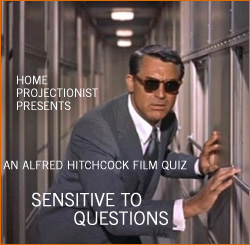
(*The quiz title was inspired by Alfred Hitchcock’s North By Northwest:“Something wrong with your eyes?” “Yes”, says the sunglass-clad Roger O. Thornhill (Cary Grant), “They’re sensitive to questions”. During the opening scenes of the movie, ad executive Roger advises his secretary: “Maggie, in the world of advertising, there is no such thing as a lie. Only expedient exaggeration.”)
The options of what we can watch continue to expand at a frenetic pace. We can thank the power of online video streaming, and the competition for content that’s heating up.
According to a Wall Street Journal article, Amazon has “more than doubled the number of television shows and movies it offers its video-streaming subscribers.” And by executing a new licensing deal with the cable channel Epix, as well as its recent content deals with Warner Bros. and MGM, Amazon is powering up its ability to compete with Netflix and Hulu LLC. According to the same WSJ article, Netflix has “roughly 50,000 shows and movies” and Hulu offers “more than 58,400 videos.”
In a recent Home Projectionist post, it was reported that, according to Broadcast Newsroom, an “estimated 3.4 billion movies will be streamed online in 2012.” The numbers are staggering.
Could it be that the days of red envelopes and red machines may come to a close sooner than was ever expected?
More options are great for people at home (Home Projectionists!) who are constantly on the prowl for compelling programming to share with their family and friends.
What he called “black months”: When he was a friendly witness at HUAC, naming names
Academy Awards for Best Director: two (Gentlemen’s Agreement, On the Waterfront), plus three nominations
His favorite of all his films: America America
Fun fact: Was a bartender at college fraternities, but never joined one
Quote: “When I wasn’t working, I didn’t know who I was or what I was supposed to do. This is general in the film world. You are so absorbed in making a film, you can’t think of anything else. It’s your identity, and when it’s done you are nobody.”
ON THIS DAY in 1869, Felix Salten, author of Bambi, was born in Vienna, Austria. In 1942, Salten’s book was adapted by Walt Disney for his animated classic, BAMBI.
Not just another WordPress.com site, but an extraordinary place to spend a weekend, grill a cheese sandwich and watch a film to improve your life and stimulate a few of the grey cells.











 Home Projectionist