Not every one of these dads is a happy one, but here’s wishing them (and yours) a Happy Fathers Day anyway. This is by no means a list of definitive dad movies. They’re all good for a Fathers Day family screening, depending on how much of a sense of humor your dad has, and whether he and you can tolerate subtitles. (All of these films are widely available.)
MY FATHER’S GLORY (1991; France; directed by Yves Robert; subtitled) “A sweet, beautiful memory of a young boy’s favorite summer in the French countryside of the early 1900s.” –Video Hound. Followed by its equally as good companion film, MY MOTHER’S CASTLE.
THE SHINING (1980; directed by Stanley Kubrick; with Jack Nicholson, Shelley Duvall) Nicholson takes time to be with his family, including his son (Danny Lloyd) and, apparently, with other people. I’d like to see the post-trip, Trip Advisor review.
FATHER OF THE BRIDE(1950; Spencer Tracy, Elizabeth Taylor; directed by Vincent Minnelli) The Steve Martin remake is OK, but the original bride is irreplaceable. Tracy is the walking definition of the word, “curmudgeonly”.
RIVER OF NO RETURN (1954; Robert Mitchum, Marilyn Monroe; directed by Otto Preminger) “Wilder then river fury, wilder than all the savage wilderness of America, was the savageness of their love!” Dad Robert Mitchum has more than he can handle with both his son (Tommy Rettig, co-star of the TV show Lassie) and frontier showgirl Marilyn, not to mention the raging river and several, money-grubbing bad guys.
BIGGER THAN LIFE(1956; James Mason, Barbara Rush, Walter Matthau; directed by Nicholas Ray) Father thinks he knows best, but he doesn’t–it’s the drugs talking. In a way, Mason’s portrayal of a dad is scarier than Nicholson’s in THE SHINING.
DEKALOG IV(1988; Poland; directed by Krystof Kieslowski; subtitled) There’s a lot going on under the surface in this 55-min. movie. It’s thought-provoking and fun trying to figure it all out–and you might not, until the end. Part of a series of ten films, all very loosely (and mostly not all that religiously) based on the Ten Commandments, this concerns the close relationship a young woman has with the architect father she’s living with.
REBEL WITHOUT A CAUSE(1955; James Dean, Natalie Wood, Sal Mineo, Jim Backus, Dennis Hopper; directed by Nicholas Ray) Yes, another Nicholas Ray film. But no one had a better hand on the pulse of 1950s American suburban life. Backus is out of touch with his pessimistic son, who refuses his dad’s advice to wait “ten years!” for his life to change and get better.
Celebrate Fathers Day by reuniting dad with his son or daughter. In true Hitchcock fashion, these paternal figures were sometimes model parents to their offspring, sometimes not. This quiz has a fairly high difficulty level. Good luck, Mr. Thornhill, wherever you are…
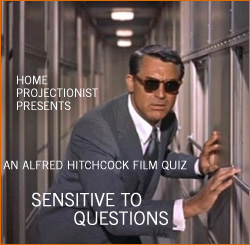
*Our quiz title was inspired by Alfred Hitchcock’s North By Northwest:“Something wrong with your eyes?” “Yes”, says the sunglass-clad Roger O. Thornhill (Cary Grant), “They’re sensitive to questions”. Later in the film, the Professor (Leo G. Carroll)-responding to Thornhill’s description of Phillip Vandamm-describes Vandamm as “A rather formidable kind of gentleman, eh?”
FAHRENHEIT 451 (1966; Oscar Werner, Julie Christie; directed by Francois Truffaut; widely available)
“You see, it’s… it’s no good, Montag. We’ve all got to be alike. The only way to be happy is for everyone to be made equal. ”
Author Ray Bradbury passed away last week at the age of 91. He wrote for television, including for Alfred Hitchcock, but the most famous movie to be adapted from one of his books was Fahrenheit 451. The best-selling Bradbury novel (which I read way back when) was directed by Francois Truffaut (his first and only English film) and released in 1966. Its critical reputation has improved (“meandering narrative…”, “pretentious and pedantic…”, “an interesting miss”, in the words of critics then). I’d seen Fahrenheit before, but in light of Bradbury passing away, I wanted to re-watch it. It’s gotten better with each viewing. A very good film; not quite perfect though.
From the start, Truffaut startles with quick zooms towards what appear to be ordinary, old rooftop TV antennas. But upon closer look, they are not. They’re a little bit different. This is the future. Over these dramatic shots, we hear the credits being read by an ominous, off-screen voice. The absence of the printed word is in keeping with Bradbury’s novel (a 1984-like future in which fire departments-in-reverse burn all books–“even this one (Mein Kampf)”–and sometimes their owners, with extreme prejudice. I don’t recall seeing (actually, hearing) this technique anywhere except in Welles’ Magnificent Ambersons (readers may want to help me out here…). Composer Bernard Herrmann created one of his best scores for Fahrenheit 451, and to his credit he (reportedly) resisted requests to use it during these opening “titles’. Immediately after these credits, however, Herrmann’s music gets underway. It’s urgent, unique, oppressive and authoritarian, all at once. The childlike xylophone has an accompanying visual: a bright red fire truck carrying a squad of fire lighters. It looks remarkably like a child’s toy as it races through the countryside–not to put out a blaze but to start one.
With the exception of glimpses of the pages of books, and “The End”, there is no text anywhere in the film. Not on or in any building (the fire station exterior simply reads “451”). Not during the odd, intrusive and sterile television programs Linda Montag (Julie Christie) watches on her “wall screen”. Christie’s husband, Guy, (Oscar Werner), aspires to a second screen (and, being a “guy”, he will most likely want a bigger one).
Christie also plays the part of Clarisse, a free spirit compared to the Stepford Wife behavior of her Linda character. She’s very direct while commuting via the monorail, initiating a conversation with the reclusive fellow traveler Montag, who is intrigued by her persistence. “Why do you burn books?”, she questions cheerily.
This is a thought-provoking film. Books in Fahrenheit 451 are looked upon much like how we view illegal drugs today. Books in this book-less new world are “used” even though they can “cause unhappiness”. They’re hidden away in homes. People who’ve read them all their lives, can’t stop–and would rather die than withdraw from reading. Confiscations of books are announced by weight (“Today’s figures for operations in the urban area alone account for the elimination of a total of 2,750 pounds of conventional editions…”). Whether you’re a casual or an avid reader, these firemen are not your friends.
A middle-aged “book lady” says, “These books were alive; they spoke to me!”. She meets, voluntarily, a horrible fate. Perhaps she didn’t know that books could continue to speak to her, in the true sense of the word. Some distance away from this restrictive society, there is a place where books are kept alive. A precious few have memorized one book a piece. With these wandering souls, books will live forever. They’ll be passed on to other, younger people.
Questions remain. There are only so many folks out there in that forest along the river and abandoned railroad tracks. Just how many books can possibly be saved? Why do the authorities leave them alone? Wouldn’t they suspect Montag (who is not as sympathetic a character as he should be) would be hiding among them? With helicopters and men in jet packs (an unfortunately poor special effect) at their disposal, how could the authorities miss this community–a community that could easily be wiped out without consequence.
Then there’s the two, trouble-prone young firemen at the station. What are the misdeeds they are berated for? It’s sort of funny that it’s never explained; it appears as though it might be a subplot left on the cutting room floor–one of a few plot threads that don’t go anywhere. There’s also Montag’s surprise (or is he faking it?) that there could be such a thing as a non-fireproof house, and his response to Clarisse’s astonishment that fireman once extinguished fires. (Surely large fires must still occur… .)
In the end, the literary scofflaws who’ve become the books they’ve read and memorized, walk through the snow-covered, leafless woods–woods that once, in a way, were the carriers of those words. It’s a moving and unforgettable scene, sad and yet a little hopeful, with beautiful, moody music to match. But the pace is off a bit there, too–the film ends a little bit abruptly. The romance here is about our love of books. The romance between Clarisse and Guy, which needs some resolution or fulfillment–one more chapter–is a loose end that is not tied-up.
This dark, cold movie is not going to be everyone’s cup of tea. But it’s a thoughtful, cautionary story, and it’s not to be missed by anyone who’s ever read a book they wished would never end. Machines are gradually intruding on the lives of the film’s inhabitants, says one character, slowly taking them over. It’s the future in Fahrenheit, but that line was written 50 years ago. “Wall screens” (big, LCD and plasma sets), street corner cameras, satellite views, mindless TV programming and drone surveillance are a reality here in 2012. This is entertainment for us in the here and now, but once the movie’s over, you’ll wonder if the bleak future the movie depicted is as far-fetched as it seemed in 1966.
A toast to Dino, who might’ve celebrated his 95th birthday today by visiting the beverage cart and fixing himself “a salad”. Five recommended movies; all are widely available:
THE YOUNG LIONS(1958; directed by Edward Dmytryk) Martin plays “the Broadway wise-guy” in this seriously underrated WWII picture. Also starring Marlon Brando and Montgomery Clift.
.
HOLLYWOOD OR BUST (1956; directed by Frank Tashlin) Dean and Jerry’s last picture. It’s a lighthearted, colorful, cross-country road trip, with a dog who almost steals the show. Martin’s annoyance with Lewis sometimes appears to be more than just acting. Lots of fun.
.
KISS ME STUPID (1964; directed by Billy Wilder) Dino plays himself as a visitor to Climax, Nevada, in this dark and suggestive Billy Wilder comedy. Great lines, like “I need another Italian song like a giraffe needs a strep throat” and “You ain’t heard nothin’ sung until you heard me sung it!”. Also with Kim Novak.
.
RIO BRAVO (1959; directed by Howard Hawks) Terrific western with Angie Dickinson, John Wayne, Walter Brennan and Ricky Nelson. Dean is a cowboy with a drinking problem and a reputation to repair.
.
SOME CAME RUNNING (1959; directed by Vincent Minnelli) Bitter WWII vet Frank Sinatra (“Buy yourself a Quonset hut!”) bumps into Bama Dillert (Martin), a professional gambler. Dillert wears a big hat–no matter what he’s doing. Also with Shirley MacLaine.
If I ever write a Ten Tearjerkers list for Home Projectionist, The Umbrellas of Cherbourg (1964) will be on it. Its director, Jacques Demy, died too young (1990); he would’ve been 81 years old today. Because it has its very sad moments (in addition to many joyous ones), I hesitate to say it’s a “crowd pleaser” but, it is–so long as you have a box of Kleenex near your guests in addition to the popcorn. Make it a Demy double feature by showing its equally-as-good sequel, The Young Girls of Rochefort. (Starring Catherine Deneuve; Music by Michel Legrand; both films are widely available.)
How well do you know Alfred’s authors? We’re talking about Alfred Hitchcock, of course. For this ten-question quiz, the first in a series, you’ll have to match the Master of Suspense’s movie with the writer whose book the film was based on. I’d rate the quiz moderately difficult, but let me know what you think. Good luck, Mr. Thornhill, wherever you are…
*Our quiz title was inspired by Alfred Hitchcock’s North By Northwest (Dave’s favorite movie): “Something wrong with your eyes?” “Yes”, says the sunglass-clad Roger O. Thornhill (Cary Grant), “They’re sensitive to questions”. Locked in the villainous Van Damme’s (James Mason’s) elegant and fully-stocked library, Grant cracks, “Don’t worry about me, I’ll catch up on my reading.”
This is the second of my reviews of the 16 films I saw over the course of four days at the TCM Festival this past April.
FALL GUY 1947; Leo Penn, Elisha Cook, Jr.; directed by Reginald Le Borg; Chinese #4; Saturday, 9 a.m.
The lure: A rarely-screened film noir; Walter Mirisch in attendance.
If I could’ve cloned myself: This was not as difficult a decision as others, such as HTWWW. The festival’s main theme was “Style”, and this was “Noir Style”, but there were not that many noirs on the schedule. Running concurrently with Fall Guy was the very long The Longest Day, with a post-screening discussion featuring Robert Wagner, an Abbott & Costello feature, Who Done It (I never was a fan of A&C), and Auntie Mame. There also was the footprint ceremony with Kim Novak in front of Graumann’s, but I’d seen Kim the previous afternoon at Vertigo.
Thoughts: The legendary producer Walter Mirisch (The Apartment, West Side Story and many more) appeared on stage prior to the screening of this terrific film. Fall Guy was adapted from author Cornell Woolrich’s Cocaine. Mirisch, contrary to what one might expect, was very charming and humble (“I was lucky to be a story teller”). He shot the film in just eight days on very small sets, with a miniscule budget of $85,000 (“I was paid $2,500 and was very displeased with the music”; “It’s very similar to Phantom Lady”) all while skirting the era’s restrictive Production Code.
Leo Penn (father of Chris and Sean) plays a returning and bitter WWII veteran who finds himself confronted with charges of murder, when he awakens at a party from a drug-induced blackout. Great lines, such as “I’m even seeing him in my soup!”, and “Nothing makes you forget a woman faster than another woman.” During the discussion, Mirisch proclaimed, for the record, that his Invasion of the Body Snatchers was–contrary to popular belief–“not about Communism!” A dazzling and very funny Columbia Pictures cartoon, Rooty Toot Toot, preceded this film.
No dice, guys:Fall Guy is unavailable at the present time, although TCM will probably be showing it. Rooty Toot Toot is part of a new set of UPA animated films, available through TCM’s online store. It’s also on YouTube:
Beginning July 9, 2012, the Academy of Motion Picture Arts and Sciences will be hosting a 70mm Film Festival at the Goldwyn Theater, Beverly Hills, Calif. The films: It’s a Mad, Mad, Mad, Mad World*, Sleeping Beauty, Grand Prix*, The Sound of Music, 2001: A Space Odyssey*, and a new print of Spartacus (* films originally shown in Cinerama).
These two films have one thing very much in common: a man on a ledge. And they have one major difference: one of them is not good, and should be ejected.
EJECT!Man on a Ledge(2011; Sam Worthington; directed by Pablo J. Fenves; widely available) “Uninspired acting and preposterous plotlines defuse Man on a Ledge’s mildly intriguing premise” is the summation on RottenTomatoes.com, where this descriptively-titled film (which adds a heist element) managed only a 31% rating but is currently a top DVD rental. Some of the not-so-hot reviews: “The ledge is the movie’s most dynamic performer”; “The solution to ‘now what do we do for 103 minutes?’ is to pile as many silly distractions into the running time as possible”; “Nobody should be this hard up for entertainment”.
PLAY!14 Hours(1951; Richard Basehart; Barbara Bel Geddes; Paul Douglas; directed by Henry Hathaway; widely available) There is the usual workday hustle and bustle on the streets of Manhattan, mixed with a St. Patrick’s Day spirit, when we hear a woman’s penetrating scream. There’s a man in a white shirt and tie perched precariously on the ledge of a tall building, and he’s looking downward as if he’s preparing to jump. From there, this tense film proceeds to uncover this troubled man’s motives, building sympathy for him along the way. Focusing on the characters and the basic idea of will he or won’t he, the movie will keep you on the edge, too–without overloading you with distractions.
Everyone will have a different way of reflecting (cinematically and otherwise) today upon the sacrifices so many have made. As for me, I’d prefer the “war movies” that don’t glorify war. My favorites are ones which depict war’s anguish, loneliness, and longing, all of which are present in these films. (All are widely available via streaming or disc.)
Saving Private Ryan (1998; Tom Hanks) Spielberg was inspired by Lewis Milestone’s All Quiet on the Western Front.
Sahara(1943; Humphrey Bogart) Cross-section of desperate soldiers find a common humanity.
Twelve O’Clock High (1949; Gregory Peck) Moving, wistful, other-worldy (“You’re already dead”) portrayal of a WWII bomber group. Peck is terrific.
Guns of Navarone (1961; Gregory Peck, David Niven) Another great Peck performance; an almost perfect film from start to finish. Gripping, tense, emotional.
The Great Escape (1963; Steve McQueen) Amazing cast in the story of a Nazi prison camp. Tragedy and humor blend perfectly together.
Dr. Strangelove (1964; Peter Sellers, George C. Scott) Disturbingly real in spite of a ridiculous story. Contrary to the movie’s full title, you won’t stop worrying.
The Dirty Dozen (1967; Lee Marvin) At times horrifying, at times funny. No film captures the camaraderie of soldiers better.
Casualties of War (1989; Sean Penn, Michael J. Fox) Underrated Brian DePalma. Beautiful Ennio Morricone score. Powerful final scene.
Apocalypse Now (1979; Marlon Brando) Even with some albeit interesting flaws (Brando), other than Platoon, this movie replicates the Vietnam experience better than any other.
Platoon (1986; Charlie Sheen) The most realistic portrayal of day-to-day soldiering in Vietnam.
Paths of Glory(1957; Kirk Douglas) Amazing, brutal, honest, maddening. Closing sequence is unforgettable.
All Quiet on the Western Front(1930; Lew Ayres) My personal choice as the finest “war movie”, but one with a definite anti-war message that cuts to the bone. Once again, there’s a final scene that’s as moving as anything ever put on the screen.
This is the first of my reviews of the 16 films I saw over the course of four days at the TCM Festival this past April.
HOW THE WEST WAS WON(1962; James Stewart, Debbie Reynolds) at Hollywood’s Cinerama Dome, Sunday April 15, 9 a.m.
The lure: A restoration; 1st time!; Cinerama print! Cinerama Dome theater!!
If I could’ve cloned myself: (In order to see HTWWW, I had to miss all these Festival films, which were playing concurrently): To Catch a Thief and Black Narcissus (painful to have to pass on those two…), A Trip to the Moon, Rosemary’s Baby, The Grapes of Wrath, Trouble in Paradise, Charade).
Thoughts: Loved it. It was far from the plodding, talky “horse opera” I’d anticipated. I’d almost decided against going, partly due to the movie’s length (close to four hours with one intermission) and partly because Black Narcissus and To Catch a Thief (along with some others) were playing at the same time. It was a tough choice. But after all, this was Cinerama!, to paraphrase Lowell Thomas, and it was the Cinerama Dome. A once-in-a-lifetime chance.
On the Dome’s big, curved screen, the sweeping, episodic film was breathtaking. Some of the fun was wondering which Hollywood star would make their appearance next. Henry Fonda, Richard Widmark, Robert Preston, Gregory Peck, Walter Brennan. (John Wayne’s had an impact similar to Welles’ in The Third Man).
Debbie Reynolds chatted with TCM host Robert Osborne afterwards. She recalled having had a lot of fun with co-star Thelma Ritter (“she was a sonofabitch with the horses”), and how director Henry Hathaway gave Reynolds a slug of whisky before she had to shoot some of the more dangerous scenes (Reynolds’ double was in the audience as well). Hathaway wrote scenes during the filming, and “really pulled the picture together”.
Two stunt doubles died during the river raft sequence; another lost his leg while filming the movie’s spectacular, concluding train wreck–a sequence which received applause from the sold-out, very appreciative audience. This was a truly unique experience. The film’s big, bulky Cinerama camera was on display in the lobby.
Meanwhile, back at the ranch: The restored version of HTWWW is widely available, including on Blu-Ray. Obviously, this movie will be much better on the biggest screen possible. Even better–if you have a projection system–would be a wide, white, inwardly-curving wall. (If you have three projectors, feel creative, and want to experiment, see if you can set them up so that you recreate Cinerama’s three-film-strip presentation. Then let us know the results!) The movie’s long. I mean really long (164 minutes), but there are very few dull moments, and if your guests are classic movie fans, they’ll love the endless parade of cameos. For vittles, I’d serve this film with–what else–anything cooked with BBQ sauce, preferably outdoors on the grill, beans, and a jug of powerful likker. Suggested shorts: Droopy in The Shooting of Dan McGoo, or Devilwood ( available on iTunes).
Not just another WordPress.com site, but an extraordinary place to spend a weekend, grill a cheese sandwich and watch a film to improve your life and stimulate a few of the grey cells.


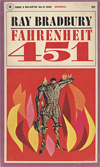 Author Ray Bradbury passed away last week at the age of 91. He wrote for television, including for Alfred Hitchcock, but the most famous movie to be adapted from one of his books was Fahrenheit 451. The best-selling Bradbury novel (which I read way back when) was directed by Francois Truffaut (his first and only English film) and released in 1966. Its critical reputation has improved (“meandering narrative…”, “pretentious and pedantic…”, “an interesting miss”, in the words of critics then). I’d seen Fahrenheit before, but in light of Bradbury passing away, I wanted to re-watch it. It’s gotten better with each viewing. A very good film; not quite perfect though.
 Then there’s the two, trouble-prone young firemen at the station. What are the misdeeds they are berated for? It’s sort of funny that it’s never explained; it appears as though it might be a subplot left on the cutting room floor–one of a few plot threads that don’t go anywhere. There’s also Montag’s surprise (or is he faking it?) that there could be such a thing as a non-fireproof house, and his response to Clarisse’s astonishment that fireman once extinguished fires. (Surely large fires must still occur… .)

 Beginning July 9, 2012, the Academy of Motion Picture Arts and Sciences will be hosting a

 EJECT!





 Home Projectionist