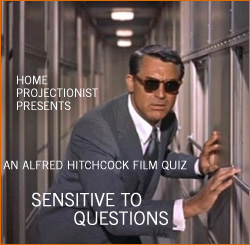
Good evening and welcome to the virtual birthday celebration for one Mr. Alfred Hitchcock. On Monday, August the 13th, Alfred will be 113 years old. Although he’s not quite as sprightly as he once was, his films haven’t aged a bit. And so to celebrate this occasion, you are being cordially invited to test your memory of Hitch’s films by taking part in this party-ish quiz. Please think responsibly.
(*The quiz title was inspired by Alfred Hitchcock’s North By Northwest:“Something wrong with your eyes?” “Yes”, says the sunglass-clad Roger O. Thornhill (Cary Grant), “They’re sensitive to questions”. Previously, Roger’s assailants pretended to Roger that his early, forced and drunken departure via automobile was of his own free will: “It was a dull party. You didn’t miss a thing.”)
ON THIS DAY in 1988, the United States authorized the Civil Liberties Act, which gave $20,000 payments to Japanese Americans who had been interned or relocated by the government during World War II. The 1990 documentary short subject Oscar winner, DAYS OF WAITING, tells the story of an artist who went voluntarily to one of the internment camps.
Several years ago when Netflix started streaming some of their content via the Internet I would occasionally. It was only available to me on my computer and sitting in my office chair watching a movie seemed uncomfortable and awkward. Then about a year ago, I purchased a Roku which allowed instant viewing of the Netflix library through my projector system and to my television. Also at this same time, Netflix started adding the mother load of movies. Things that haven’t seen the light of day in decades, movies that had never nor would ever have a chance of being released on DVD.
There are so many movies that are on there now that I thought it might be helpful to start sorting through them for future group movie nights. Some are truly buried treasures, and some should have remained buried.
Last night I came upon something that I thought I’d never see… a Jerry Lewis movie I’d never heard of: It’s Only Money.
Combining two of my guilty pleasures, Film Noir and Jerry Lewis! Even though I completely see why people would hate Jerry Lewis, his boy/man character, Borscht Belt humor, gags that are so predictable you can see them coming a mile away… But he stil makes me laugh; especially his work with the wonderful director Frank Tashlin. Tashlin was an animator before a director and this film in particular brings the exaggerated styling of a Warner Brothers cartoon to life. Mix that with some dark and stunning cinematography, some brilliant characters like Jack Weston, Jessie White and Mae (Olive Oil) Questel, and you have a classic comedy that seems to have slipped through the cracks.
(One odd moment was that although I didn’t remember anything about this film; I did recall the horrifying lawnmowers featured in the climax. Monstrous machines with large grinding teeth that chase everyone around. I remembered the feeling of being terrified of them; but nothing else about the film. The lawnmowers are out a Stephen King novel. And made me wonder if he recalled them when he wrote his short story, The Mangler about a killer machine.)
Granted this film might not be for a group if you have people who hate Lewis, because Jerry is as Jerry as you can get. I gave up counting the number of times he did his ‘Hey Lady’ routine or made his Jerry-Lewis-being-funny face. But if you grew up with these slightly innocent romps they don’t disappoint.
ON THIS DAY in 1942, Indian leader Mahatma Gandhi was arrested in Bombay by British forces, thereby launching the “Quit India Movement”. The incident was reenacted for the 1982 biographical film, GANDHI, starring Ben Kingsley.
Composer Marvin Hamlisch passed away on Monday, August 6, leaving behind memories of songs like “The Way We Were” and “What I Did for Love,” songs that can still make me instantly weepy, even when I’m annoyed by them.
One of Hamlisch’s earliest uber-dramatic scores was composed for THE SWIMMER (1968). The film, based on a story by John Cheever, is awash with Hamlischian musical interpretations of a variety of human emotions — triumph, distress, tenderness, wonder, grooviness, foreboding, dreaminess, despair. While the emotive bits are mostly over-the-top or silly cliches, there is a lovely Hamlisch theme that survives. It’s a glimpse into the beginning of a legendary career.
In THE SWIMMER, Burt Lancaster is perfectly cast as Neddy Merrill, a virile, proud man in a bathing suit (and for a few minutes, no bathing suit at all) who is on a “vision quest,” attempting a journey home by swimming pool-to-pool and jogging across the pretty backyards of his wealthy Connecticut neighborhood. In between dips, he has time for a few martinis and interactions with his neighbors, all of whom are surprised to see him. Neddy has been gone for a couple of years. We slowly discover he’s not at all who he first seems to be. He admires himself as a man of integrity and strength, and he is reduced to nothing but a big lie.
The film is a visual treat of sixties’ style and an indictment of the shallow people who live in a particular space in time. Neddy, too, is a visual treat, but he’s no prize either. He’s at first charming, but then as his journey continues, we get glimpses into a man with a lost soul. We have some sympathy for him because he has been betrayed by people he loves and there is a heart of gold in there somewhere, but we also learn that Neddy is an opportunist, narcissist, philanderer, a bit of a pervert, potential pedophile and rapist, unknowing racist, and generally delusional loser. He has nowhere to go but down the drain.
The film is filled with unsavory moments, especially between Neddy and his former babysitter, who at least has sense enough to run away from him. But the ultimate creepiness occurs when a guard at a public pool demands that Neddy “spread his toes” so he can inspect them to make sure they’re clean. Neddy simply obeys. It’s a scene that is seriously gasp-inducing. (Wonderfully jarring and groan-worthy moments like these make THE SWIMMERan excellent choice for a group watch.)
An additional reason for watching this film now is that there’s a little homage to the Olympics when Neddy and his former babysitter run some hurdles — in slow motion! — while accompanied by the swelling Hamlisch score.
The ending of this movie will deflate the end of an evening soiree so make sure you have drinks ready to lighten up your audience after Neddy faces his dismal reality in the rain. Everyone will eventually cheer up.
Gloria Bowman is a writer, storyteller, blogger, movie lover, freelance editor,
and author of the novel, Human Slices.
Access her blog at www.gloriabowman.com; on Twitter @GloriaBow
I OWN A BUNCH of movie books. Well, more than a bunch. Dozens. Too many, I suppose. I think the hobby (or is it habit?) started about the time that VCRs came into being–about 1979–a milestone for my latent movie fanaticism. I had been awakened to a world of movies that previously had been unavailable for viewing.
I think the first book was Donald Spoto’s excellent film-by-film analysis, Hitchcock. I’d borrowed the Oak Lawn Public Library’s copy a couple of times, gotten completely immersed in it, and then finally plunked down the $8.95. Next, if I recall, was a little paperback, The Golden Turkey Awards-a sort of oddball collection of lists–lists of bad movies–turkeys, some of them in the so-bad-they’re-good category, a la MST3K; others just plain awful and unwatchable. A fascinating, fun read.
Eventually, my wanderings in Waldenbooks, Barnes & Noble, and Kroch & Brentano’s led me to my most treasured film book, Guide for the Film Fanatic (1986; Fireside Books) From the Introduction:
“If you flipped through the pages of this book, you may have noticed that, unlike many movie-list books, this one does not have a star rating system. I love those books, but I worry that rating systems have the adverse effect of discouraging people from seeing certain movies that should be equally recongnized. It’s only natural to choose a movie that has a three-star rating over one that has just two stars, but in many cases the two-star movie is more interesting–indeed it may have a cult made up of devoted fans who appreciate things that a particular review overlooked. I may attack a film, but that doesn’t mean I don’t want you to see it. This book is meant to encourage readers to see movies, not discourage them.”
Danny Peary’s is untypical of most movie review books in that every one of the films he discusses is worth your time, in some way or another. Each entry is a pleasure to read, even if it doesn’t convince you to watch the film. Peary might consider how absolutely great a movie is, or place some high value on it even if solely for its pure entertainment value, or occasionally only for historic reasons. Many of the book’s movies have a strong, cult-like following–not everyone’s cup of tea, but maybe it will be yours, if you give it a try. I discovered movies I would’ve otherwise overlooked–movies that Maltin gave just two stars to, that Siskel & Ebert rated “dogs of the week”, or films that arrived and burned brightly then for various reasons faded quickly from memory. Some films I had seen before, multiple times, took on a new light.
I visited Colorado’s Mesa Verde National Park many years ago and can still clearly recall the haunting, magical feeling that permeates the air there. Nearly a thousand years ago, the Anasazi ancients abandoned their cliff dwellings and moved on to the spiritual world, but their handprints and their energy remain.
The same sort of transcendent, surreal experience happens when you are touched by the images in the ELECTRIC EDWARDIANS – THE LOST FILMS OF MITCHELL & KENYON (1900). You don’t just watch a collection of old-timey “home movie” clips from the past, you submit to a sort of time travel sorcery of other worldly-proportions.
ELECTRIC EDWARDIANS is a compilation of lost footage that was miraculously found after being stored for 100 years in someone’s basement. During the turn of the century, filmmakers Sagar Mitchell and James Kenyon took to the streets of England and Ireland and captured images of the mundane — people going to work, people walking down the street, people standing around, people cheering at sporting events, children lining up at school. Dreadfully boring, one might understandably think. But in the activities of the every day, there is an ethereal magic. The soundtrack by In The Nursery is impeccable and adds a brilliant dimension to the scenes of daily life in the Industrial Age.
What makes the images so hypnotic is that the individuals being filmed, most of whom probably don’t even know what this thing “film” is, are directly looking into the camera and somehow their souls are being captured in a moment in time for us to meet and connect with.
“Aren’t you a very curious person?” they seem to ask as they look out at us from the screen. And we look back at them in the same curious way.
These clips are mesmerizing, but they are also a bit mournful as well – the people we are watching are gone. But we also are reminded that they once were here. And that’s the mystical part of this viewing experience.
Along the same theme, I was thinking (wrongly) that CAVE OF FORGOTTEN DREAMS (2010) would be a moving and appropriate double bill with ELECTRIC EDWARDIANS. In the trailer, director Werner Herzog says that the spirits of the Cave of Chauvet are so palpable that it is “as if the modern human soul has awakened here.”
Unfortunately, the film just doesn’t quite deliver that sense of spiritual awakening. The famous cave, located in southern France, had been hidden from civilization for eons; a landslide had buried its entranceway. When the cave was discovered in 1994, its perfectly preserved, awe-inspiring ancient paintings and handprints — more than 20,000 years old — open a door to a truly lost world.
This award-winning documentary allows us a peak into this realm, and the scientists and the filmmakers are certainly stirred by their experiences in the cave, on both the academic and metaphysical levels. “A strange, irrational sensation – like eyes upon us,” they say. Here, “time and space lose their meaning.” But the film doesn’t award us, the viewers, with a similarly enchanting experience. We just have to believe them. Frankly, the film is most visually interesting when the stunningly attractive scientists talk about the caves in their French-accented English. Ooh la la.
While CAVE is certainly thought-provoking (albeit way too long), it delivers very little of the soulful punch that the ELECTRIC EDWARDIANShas.
CAVE is worth a watch. ELECTRIC EDWARDIANSis worth watching over and over.
Gloria Bowman is a writer, storyteller, blogger, movie lover, freelance editor,
and author of the novel, Human Slices.
Access her blog at www.gloriabowman.com; on Twitter @GloriaBow
Good evening. You may have heard there are some sort of games being played in London this week. Lots of young people running hither and yon, and perspiring way too much. Doesn’t it make you feel exhausted? After a grueling, three-hour marathon of watching them on television, you may be feeling a tiny bit inspired. Perhaps you’re ready to relax and test your gamesmanship with this gamey little quiz we’ve created. But please remember to take it easy and pace yourself.
(*The quiz title was inspired by Alfred Hitchcock’s North By Northwest:“Something wrong with your eyes?” “Yes”, says the sunglass-clad Roger O. Thornhill (Cary Grant), “They’re sensitive to questions”. Kidnapped by thugs, Roger questions Vandamm (James Mason): “Why was I brought here?”, to which Vandamm replies, “Games? Must we?”)
How do we decide what to watch? That is the question.
You’re making decisions by consensus, but are you collaborating? (Photo credit: opensourceway)
When we’re ready to choose the lineup for a movie night, we can totally roll the dice and end up being pleasantly surprised or gravely disappointed. We can read reviews and get recommendations from our friends or on sites like Home Projectionist, for example. And we can use Netflix and Filmaster, among others, that offer suggestion tools as well.
It’s all part of the quest to find that next great movie to watch.
The new web site FOUNDD not only helps an individual identify a match for what he or she should like, but it also provides the ability for group decision making on the subject.
If I’m hosting an at-home movie night, I just don’t know if I want to base my movie night selections on a collaborative decision-making process.
Recommendation tools are intriguing, and they can lead us to some compelling options. But will algorithms make us lazy? Will they lead us to bad — or worse — boring and safe decisions? Will they limit our ability to evolve our tastes and world views? Will no one ever get the blame for choosing a stinker???
I’m going to be stewing on pro’s and con’s of group decision making when creating a shared experience for an at-home movie night.
What do you think? When you are in the process of selecting the programming for your own home viewing events, would you prefer a collaborative decision process or do you want to retain rights as a benevolent dictator?
“If we all went out looking like a slob, like me, it’d be a pretty dreary world.”
LAST SUMMER I met an artist who, in the course of talking about movies, mentioned a film she thought I ought to see. BILL CUNNINGHAM NEW YORK. An odd title, and so I remembered it. A month or two later, the same recommendation from another person. New York City is a place I love, so I put it in my Netflix queue. I finally got around to watching it recently. It’s great.
Bill Cunningham, 83, is a fashion photographer for The New York Times, and has been for many years. He rides an ordinary bicycle through the streets of Manhattan, camera in hand, darting here and there, wearing a beat-up poncho on rainy days, on the lookout for fashionable clothes–clothes that fit a certain theme. A theme of the week. His pictures are featured on a page in the Style section of the Times–a page composed of dozens of Cunningham’s colorful, candid shots. Stylish, fashionable and/or eccentric New Yorkers as they dash across streets, glide past shop windows, or stroll around parks. One week it might be hats, while another week’s subject is stripes.
If you’re an avid Home Projectionist and sports enthusiast (even if it’s an armchair one), then right now you’re probably dividing your time between movies and the 2012 Olympics in London. That’s perfect, because this Cinelympics Quiz has just as much to do with feature films as with the wide world of sports. We’ve chosen ten sports, all of which are part of the summer games. Sorry, but we have no actual gold medals to present. All we can offer is the thrill of victory. Best of luck to you!
When picking movies for people to see I always try to go with something fast paced, with lots of good lines that people can remember afterwards, and at least one gasp worthy moment. Detour, directed by Edgar G. Ulmer in 1945 hits the mark every time. This film has floated around in the public domain for years. You can see it for free on YouTube, pick it up at the local dollar store, or stumble across a dusty VHS at any garage sale. It’s one of those movies that once you’ve seen it you’ll never forget it.
It’s the quintessential Film Noir, with economical cinematography, dark shadows, impressionistic set pieces, and a story of a man caught up in situations that drive him deeper and deeper into a web of lies that he can never get out. As he says: Yes. Fate, or some mysterious force, can put the finger on you or me for no good
reason at all.
Tom Neal plays Al, the down on his luck piano player who tries to hitchhike across the country to see his girl. Ann Savage, plays the pick-up whose seen it all and who is looking for the quick way out of her terrible life. “Life’s like a ball game. You gotta take a swing at whatever comes along before you find it’s the ninth inning.”
Detour is one of the quickest 68 minutes that I’ve ever seen. Like its name it starts out on the straight and narrow like a B-movie romance and quickly turns off into a dangerous side road filled with twists, turns and a lot of bumps. Add to the film’s history that Tom Neal ended up shooting his own wife in the head, and his son played the same role in a 1992 remake, and you have a true Noir classic that defines the genre.
“What’d you do, kiss him with a wrench?”
In addition, the extreme close-ups, and odd angles of the film look fantastic when projected. Just try to find a good copy. I recommend the Alpha Video version. It seems to be the most complete.
Detour is the perfect 2nd feature for any movie night.
VALERIE AND HER WEEK OF WONDERS (1970) is a visual stunner—enchanting, perplexing, and totally entertaining all at the same time.
The film is formally categorized in the fantasy/horror genre but that seems ill-fitting and misleading. Fantasy implies that Valerie is consciously involved in the goings-on; and horror, well, that means scary.
The film is neither. It is, quite simply, a dream–and probably the most pure reflection of a dream in cinema that I’ve ever seen.
By New Wave Czech filmmaker Jaromil Jires, based on a 1935 novel by Vitezslav Nezval, VALERIEis one of those movies that you just surrender to, like you surrender to your dreams. You try to make sense of the narrative, but it’s really not important or even possible. What matters is the mystery and metaphor.
I watched this with friends (and members of the Bleeping Ravenswood Manor Film Society, which is headed up by fellow Home Projectionist blogger John Connors). Both during and after the film, we made periodic attempts to try to make sense of the narrative, but we would just sort of shrug and give up. It was reminiscent of when you try to tell an entire dream to a friend, and you end up saying something along the lines of , “And then I looked up and there was this dead priest hanging out of the window, but then we were suddenly making love in the chicken coop, but I had to leave to help my brother who was tied down in these river rapids,” and your friend listens and nods because you’re telling him about a dream and that’s how dreams go.
The role of young Valerie is played with perfection by a Jaroslava Schallerova. As in a dream, she is present in the story, but at the same time, she is not present and moves through the events as a spectator.
At the opening of her story, Valerie’s magical earrings are stolen (her innocence?), and we also discover that Valerie has had her first menstrual period, an event immortalized by simple drops of blood on a small white flower. Valerie confides what has happened to her stern, uptight grannie.
And that’s when all the “wonders” — both beautiful and diabolical — start to happen.
With Valerie’s induction into this mysterious world of womanhood, her young girl subsconscious swarms with images and traditions that feature the letting of blood — from vampires, of course, to religious ceremonies, hunting, butchering, and losing one’s virginity.
And then there are so many sexual identity questions that arise about who is who and what is what. In this dream, shapeshifting is a matter of course. Grannie goes vampire to regain her youth and fulfill her repressed sexual desires. And Eagle — her brother/her lover! her brother/her lover! — needs her to rescue him from his bondage encounters while at the same time he becomes Valerie’s rescuer as well.
In and around Valerie’s journey, there are shirtless dancing boys, bare-breasted and writhing wenches, happy acrobats and nuns, a lesbian encounter with a newlywed, some fun self-flagellation, lots of lascivious fruit eating, and a jumble of other erotic scenarios, each one gorgeously composed and shot, especially with the compelling, strategic use of overhead angles.
But through it all, Valerie remains unscathed, even from the threats of being raped by a pedophile priest and being burned at the stake as a witch, because she is protected by her magical “pearl” and later, her recovered magical earrings that somehow end up on the corpse of a weasel who is her father but not her father but whatever….it’s a dream.
What is incredibly interesting to me is that this film worked as a home theater event. It is spellbinding, but also lends itself to a few wisecracks and comments here and there that create the kind of camarderie that happens when a good film watching “shared experience” goes on in the living room.
In an unplanned late-night add-on selected by John Connors, we watched NIGHT MONSTER(1942), featuring Bela Lugosi in a hang-around role as the shifty-eyed butler. Just by serendipity, the film opens with a housekeeper cleaning blood off a staircase. What an odd coincidence, having just seen VALERIE open with the image of blood. But the blood in this film isn’t the stuff of a young girl’s first period. It turns out to be some inexplicable bleeding from the stumps of a diabolical amputee who has learned to spiritually conjure up legs. This film features a lot of swirling fog, off-camera screams, way too many murders, and a swami with a skeleton friend.
NIGHT MONSTER was a surprisingly appropriate selection for a double feature. But the dreamy non-narrative of VALERIE made much more sense.
Gloria Bowman is a writer, storyteller, blogger, movie lover, freelance editor,
and author of the novel, Human Slices.
Access her blog at www.gloriabowman.com; on Twitter @GloriaBow
It might be difficult for you to appreciate the 100-degree, dog days of summer when you have a parched throat, a bad sunburn, or when your wife is after you to do something about the lawn. But perhaps you remember the one or more times she advised you to go jump in the lake. Well, now is a good time to do what she tells you. Take a deep breath and plunge into this cool, refreshing, ten-question quiz which by no means has been watered-down.
(*The quiz title was inspired by Alfred Hitchcock’s North By Northwest:“Something wrong with your eyes?” “Yes”, says the sunglass-clad Roger O. Thornhill (Cary Grant), “They’re sensitive to questions”. Late in the movie, Vandamm (James Mason) reveals his plan to do away with Eve (Eva Marie Saint): “This matter is best disposed of from a great height. Over water.”)
While we were watching fireworks this last Fourth of July weekend, scientists around the world were swilling champagne, celebrating the official detection of the Higgs boson. It’s a very big deal. The Higgs is a subatomic particle that gives mass to the universe. Without it, nothing would exist.
The discovery happened in Switzerland at CERN, the European Organization for Nuclear Research — and not at U.S.-based Fermilab, where scientists had been relentlessly dedicated to the quest for the Higgs.
If you’re up for a proud nerd night at home, The Atom Smashers (2008) provides an inside look at how scientists in Illinois were trying to beat the clock and discover the Higgs before CERN could do it.
Who knew there was so much drama in the world of physics?
The Atom Smasherswas produced by Chicago’s 137 Films organization, a group dedicated to “creating films out of the stories found in the world of science.” With this documentary, 137 Films succeeds in creating a tale compelling enough that I just may try to read “Physics for Non-Scientists” one more time.
Whatever hesitation I had about a watching a film about super colliders faded to black as soon as the quirky techno opening music began. The soundtrack, by composer Kate Simko, provides a sort of magical segue into the film, where Fermilab looms, surrounded by a herd of buffalo and cracked pavement. It doesn’t seem an inspirational place. The environment actually looks a little sad, with its ’60s-era wood panelling and drop ceilings. The scientists’ offices are small and rickety. This is the home of groundbreaking research?
We are introduced to a cast of characters who are intriguing, incredibly smart (of course), and, well, extremely likable, if not even lovable. They are working together toward a “discovery of a lifetime,” yet they still find time for diversions like their tango club, writing rock music with lyrics based on Unix programming commands, and finding romance.
I became instantly and absolutely smitten with Leon Lederman, Nobel Laureate and director emeritus of Fermilab, with his bright-eyed curiosity and excitement about the Higgs work. A flashback clip of a young Lederman on the Phil Donahue show (!?!) congenially discussing particle physics and defending its cost to the American taxpayer made me long for those days when television talk went far beyond what’s-new-with-the-Kardashians.
I now understand how a particle accelerator works!
I also know how to pronounce boson. It rhymes with “hose on,” not “possum.”
The race to find the Higgs accelerates as do the demands made upon the Tevatron accelerator itself (faster! faster!). And while the velocity of the research expands, federal budget cuts loom and the Tevatron operations at Fermilab are scheduled to close. Layoffs begin; scientists start to seek new opportunities. In spite of all of the forces at odds with their quest, the determination of the scientists prevails. (Unfortunately, while we watch, we feel a little beaten, knowing that, in the end, CERN will succeed.)
Upon this year’s celebration of the Higgs, Paul Tipton, professor of physics at Yale University, wrote, “As exciting as this discovery is, and as meaningful as it is to the field of physics, the broader lessons of this human endeavor should not be lost on us…The Higgs discovery also represents a triumph of human curiosity. “
And also, if I may sound corny, it represents the power of the human spirit. The Atom Smashersis a gem of a film giving an inside look into a world of intense curiosity, painstaking commitment, and human collaboration that few of us will ever know.
Not just another WordPress.com site, but an extraordinary place to spend a weekend, grill a cheese sandwich and watch a film to improve your life and stimulate a few of the grey cells.