ON THIS DAY in 1871, the Great Chicago Fire began, killing hundreds and destroying over 34 blocks of the city. The 1937 drama, IN OLD CHICAGO, starring Tyrone Power and Don Ameche, depicted the conflagration.


ON THIS DAY in 1871, the Great Chicago Fire began, killing hundreds and destroying over 34 blocks of the city. The 1937 drama, IN OLD CHICAGO, starring Tyrone Power and Don Ameche, depicted the conflagration.

Who wants to wait until the 31st to wallow in Halloween indulgences and scary movies?! Home Projectionist doesn’t! And so we’ll have pairings of 31 Frights and 31 Bites every one of October’s 31 nights: a scary, snack size movie “trick”, and a delicious “treat” to go along with it.

HOUSE ON HAUNTED HILL (1959; Vincent Price; directed by William Castle) Debonair millionaire Fredrick Loren (Price) is having a birthday party for his fourth wife, Annabelle. Since it is well known that Fredrick and Annabelle’s house on the hill has been the site of seven (give or take) horrible deaths, Fredrick is compelled to offer invitees an incentive to RSVP besides the birthday cake. The enticement: $10,000 in cash for each of the five, if they’ll spend the entire night. Feeling it’s better to receive than to give, they accept Fredrick’s generosity, and the five guests gather at the house. When midnight arrives, the doors of the Loren home are locked tight, and the dour party games begin. In light of the fact that Fredrick parts with only $50,000 and not 100, we suggest eating only one-half of your 100 Grand candy bar, and save the other 50 grand to consume tomorrow. If, that is, you make it through the night… 
If you spent most of your time watching movies this past week, you might have missed these articles here at Home Projectionist:
Visit Home Projectionist on Facebook
ON THIS DAY in 1955, American poet Allen Ginsberg debuted his landmark poem Howl at the Six Gallery in San Francisco. This event was depicted in the 2010 film, HOWL, starring James Franco, David Strathairn, and Jon Hamm.

Today I learned that the first real movie star, Florence Lawrence, committed suicide with ant poison, that the first close up in cinema featured a sick kitty, and there was some hot erotic dancing going on in the silent movies.
Of course, the history of cinema is comprised of much more than the stuff of cocktail conversations. It’s a vast collection of stories that have impacted each and every one of our lives.
THE STORY OF FILM: AN ODYSSEY (2011) is a 15-part, 15-hour documentary exploring the convergence of technology, business, intelligence, and vision that has created the remarkable and powerful art of cinema.
THE STORY OF FILM is quietly narrated by its creator, film critic and historian Mark Cousins. Part I of STORY includes “The Birth of the Cinema (1900 – 1920)” and “The Hollywood Dream (1920s),” which provides a sequence of mini tales featuring the inventors, the stars, the breakthroughs, and the innovations that started it all, from the Lumieres to Lloyd. The segments on the evolution of film editing are particularly strong.
Like a professor, Cousins will periodically veer into non-essential territory (like fretting over the glamour and the glossy veneer of Hollywood), which doesn’t particularly add to the narrative, but no matter. He has compiled an anthology of information and resources that will be turned to again and again.
Of course, because of the sheer breadth of material, Cousins must alight on some topics for only moments of time, leaving us wanting more. After seeing the shocking clip of Asta Nielsen’s erotic dance from the 1910 silent film THE ABYSS, for example, I am hoping that someone has created a documentary on THE HISTORY OF EROTIC DANCE IN SILENT FILMS.
(You can view the entire film at http://archive.org/details/Afgrunden_1910. The dance begins at 20:11 and there’s much more to it than in the clip above.)
Music Box Films is distributing the documentary, and Chicago’s Music Box Theater has just begun its multi-week screening of this ambitious effort. The DVD will be released in November 2012.
Next up is Part 2, “Expressionism, Impressionism and Surrealism: Golden Age of World Cinema (1920’s).” 
Gloria Bowman is a writer, storyteller, blogger, movie lover, freelance editor,
and author of the novel, Human Slices.
Access her blog at www.gloriabowman.com; on Twitter @GloriaBow
Who wants to wait until the 31st to wallow in Halloween indulgences and scary movies?! Home Projectionist doesn’t! And so we’ll have pairings of 31 Frights and 31 Bites every one of October’s 31 nights: a scary, snack size movie “trick”, and a delicious “treat” to go along with it.

CIRCUS OF HORRORS (1960; with Anton Diffring, Donald Pleasance; directed by Sidney Hayers) You’ve heard of people who are dying to get into the world of the circus? Well, hurry, hurry, hurry, to this fast-paced, British horror film, where they’re dying to get out of it! Or, to put it another way, they’re dying because they want out. And for good reasons. It seems that the big top’s owner (who also happens to be a plastic surgeon of dubious reputation) might be responsible for certain, ghastly “unscheduled performances”. Namely, freakish “accidents” that befall the women of the circus. If this underrated and frightening movie isn’t freakish and ghastly enough for you, just bite into a few circus peanuts.
ON THIS DAY in 1927, THE JAZZ SINGER, the first feature film with synchronized dialogue, starring Al Jolson, premiered at the Warners’ Theater in New York City. The event was dramatized in the 1946 biographical film, THE JOLSON STORY, starring Larry Parks.
Who wants to wait until the 31st to wallow in Halloween indulgences and scary movies?! Home Projectionist doesn’t! And so we’ll have pairings of 31 Frights and 31 Bites every one of October’s 31 nights: a scary, snack size movie “trick”, and a delicious “treat” to go along with it.

REPULSION (1965; with Catherine Deneuve; directed by Roman Polanski) We’ve all had lost weekends, spent alone in our apartments eating candy bars. However, it is hoped that none of us have had one like that which Catherine Deneuve’s character, Carole, experiences in this, one of Polanski’s earliest films. The director at the time was very broke; perhaps he was on the verge of a collapse, which would help explain what this troubled Belgian manicurist endures. Despite living in an upbeat, swinging part of London, we see her slowly but surely, over the course of a Saturday and Sunday, have a complete mental breakdown. What happens to, and around, Carole, will explain why our suggested treat is a Krackel.
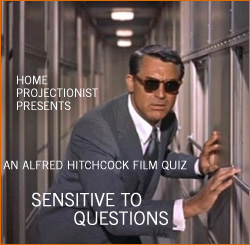
Good evening. Have you had a good week? Have you had a bad week? No matter. Whether it’s been good or bad, it calls for a libation–a little bubbly perhaps. Champagne can be “notoriously” dangerous though, as you know. So be careful. We do want to afford you the chance of surviving the evening.
Good luck, Mr. Thornhill, wherever you are…
Take the Quiz!(*The quiz title was inspired by Alfred Hitchcock’s North By Northwest: “Something wrong with your eyes?” “Yes”, says the sunglass-clad Roger O. Thornhill (Cary Grant), “They’re sensitive to questions”. When the kidnapped Roger asks whether he’ll be given a ride back to town, Vandamm’s sidekick, Leonard (Martin Landau) answers by handing Roger a very tall glass of bourbon: “Oh, that has been arranged. But first, a libation.”)
ON THIS DAY in 1877, Chief Joseph, Native American leader of the Wallowa Valley (Oregon) Nez Perce band, surrendered to the U.S. Army’s General Nelson A. Miles. This event was depicted in the 1975 made-for-TV movie, I WILL FIGHT NO MORE FOREVER, starring Ned Romero, James Whitmore and Sam Elliott.
Who wants to wait until the 31st to wallow in Halloween indulgences and scary movies?! Home Projectionist doesn’t! And so we’ll have pairings of 31 Frights and 31 Bites every one of October’s 31 nights: a scary, snack size movie “trick”, and a delicious “treat” to go along with it.
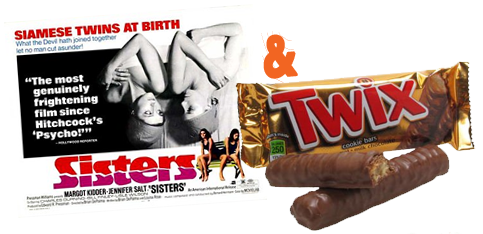
SISTERS (1973; Margot Kidder, Jennifer Salt; directed by Brian DePalma) Twix: Is it a cookie, or is it a candy bar? Where does Danielle end, and Dominque begin? These are the questions. Separated, but living together, Siamese twins Danielle and Dominque appear to have a very troubled relationship. Dominique is very unhappy, to say the least, when her sister brings Emil, a male acquaintance, home to their Staten Island apartment. When a neighboring, ambitious young journalist (Jennifer Salt) eyes the sisterly spat from her rear window, she senses a story, becomes inquisitive, and subsequently gets much, much more than she bargained for. This terrifying thriller–one of DePalma’s earliest and best, and with a chilling score by Bernard Herrmann–will probably bring to mind Hitchcock’s PSYCHO and REAR WINDOW. “What the Devil hath joined together, let no man cut asunder.” Think about that during this movie, and when you’re ready to devour that Twix. 
 AFTER I SAW the 2002 film version of THE QUIET AMERICAN, I read the Graham Greene novel on which it was based. Then I saw 1958 film version. To see both movies is an odd experience—not good, just odd—because they use the same story structure, the same characters, and sometimes the same dialogue to tell opposite stories.
The Quiet American was published in 1955. Greene based it on his experiences as a Saigon-based war correspondent in Vietnam from 1951 to 1954. At that point the French were fighting the First Indochina War. The American government was starting to take an interest in the place.
 The plot concerns a clash of world views: the cynical, burned-out, middle-aged British journalist Thomas Fowler versus the idealistic, Harvard-educated young American Alden Pyle. It is implied that Pyle works for Office of Strategic Services, precursor to the CIA. Pyle makes Fowler crazy with exasperation, not least because Pyle is in love with Fowler’s beautiful young Vietnamese mistress Phuong—an enigmatic character.
Because Pyle and his ideals cause a lot of harm, the book was widely and unsurprisingly perceived as anti-American. After its publication Greene—a British citizen—was watched by US intelligence agencies for about 35 years.
One wonders what Greene thought was going to happen when he sold the rights to MGM. Did he really believe they would film his book as written? Whatever his motives, he hated the finished product, saying that it was “deliberately made to attack the book and the author.”
 Filmed in Saigon, the first version of THE QUIET AMERICAN conveys a strong sense of place (its cinematographer, Robert Krasker, also shot THE THIRD MAN). It features a brilliant performance by Michael Redgrave as Fowler.
Pyle is a private citizen on a mission for good. He is honorable, brave, and always right. Fowler is an adulterer and an atheist. Worse, he is a bad reporter who is easily duped.
The clash of world views and the love triangle are the same as in the book. The difference is that writer-director Joseph L. Mankiewicz gave Pyle the last word, every time. Even after Pyle is dead, he manages to get the last word: Fowler loses Phuong for good (in the book he gets her back).
The Second Movie (2002)
The 2002 remake of THE QUIET AMERICAN is more faithful to Greene’s characterization of Pyle. How faithful? Although the movie was completed in 2001, US distribution was held up more than a year because of fears of seeming anti-American after the terrorist attacks on 9/11.
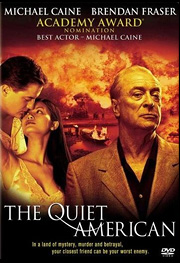 The filmmakers simplified the plot and turned up the heat a bit under the main characters: Pyle is more obviously up to no good, and Fowler is more sympathetic.
Like its predecessor, this movie has at its heart is a brilliant performance: Michael Caine was justly nominated for an Academy Award for his portrayal of Fowler. The book’s sensuality, drained out of the 1958 version, was restored. The 2002 version is more graphic than the 1958 version; this too represents fidelity to the book.
I like the 2002 version because it uses the power of Greene’s story rather than working against it. “Isms and ocracies,” Fowler says wearily to Pyle. “Give me facts.”
in 2002 Michael Caine talked about his role in THE QUIET AMERICAN in this interview.
The Quiet American is available in several editions, including one that includes essays by Greene, historical writings, and reviews.
ON THIS DAY in 1957, the Soviet Union launched the first artificial Earth satellite, Sputnik, into a low orbit around the Earth. This event was dramatized in the 1999 film, OCTOBER SKY, starring Jake Gyllenhaal, Chris Cooper, and Laura Dern.
Who wants to wait until the 31st to wallow in Halloween indulgences and scary movies?! Home Projectionist doesn’t! And so we’ll have pairings of 31 Frights and 31 Bites every one of October’s 31 nights: a scary, snack size movie “trick”, and a delicious “treat” to go along with it.

SON OF FRANKENSTEIN (1939; Basil Rathbone, Boris Karloff, Béla Lugosi) Villagers are mincing no words: they are none too pleased now that Frankenstein, Jr. (Rathbone) is back in town. Unwilling to forgive and forget. Junior, however, attempts to assuage their fears. He vows that he will not pick up where dad left off. But the remnants of his father’s legacy are all around him. The Frankenstein monster (Karloff) left a local constable (Lionel Atwill) with a rather acute injury. Then there’s the slightly off-kilter shepherd (a very creepy Béla Lugosi), who carries a grudge over the neck pains he incurred during that attempted hanging. With some self-serving revenge in mind, Lugosi persuades Jr. to take up dad’s old hobby. Predictably, it becomes quite a mess, and not a chocolaty one either. (Mel Brooks drew upon this excellent sequel for YOUNG FRANKENSTEIN.) 
A must-see for Beatles fans just released on DVD. BEATLES STORIES: A FAB FOUR FAN’S ULTIMATE ROAD TRIP features a collection of 90-second stories shared by celebrities, musicians, execs, groupies, and assorted other fans who had the good fortune to share a moment in time with John, Paul, George, and Ringo.
Filmmaker and super Beatle fan Seth Swirsky spent seven years collecting these personal tales. The film premiered last night (October 2, 2012) at L.A.’s Egyptian Theater.
I still get goose bumps when I see the Beatles in A HARD DAY’S NIGHT (1964). I imagine I’ll get goose bumps just hearing people talk about the times they connected with the absolutely Fabulous Four.



A bucket list blog: exploring happiness, growth, and the world.
this blog will disappear on the day that my heart is alive again
Where classic films stand out above the rest
The Power of Words
Incredible tips for Classrooms and Staffrooms
Watch as I amaze and astound with opinions about what TV shows I like!
Political Co-Dependency Intervention
Tablecloths, Table Toppers, Placemats our specialty
I blog about everything and anything, never hesitate to question....
The works and artistic visions of Ken Knieling.
entertainment & belief go heart to heart
the Story within the Story
Horror With Humour
unparalleled film reviews, news, and top 10s
Mostly movies with a smattering of TV, books, and LEGO thrown in!
MUSINGS : CRITICISM : HISTORY : NEWS
Film, Comics, Music, News, You want it? We've got it!
On This Day....
Celebrate Silent Film
...a classic film and TV blog
Entertainment and Everyday News brought to you in a flash
wendy maruyama, art work, executive order 9066, the tag project
A guy with a desk...
www.attentiallupo2012.com
Improving the English language one letter at a time
Seek first the kingdom of God and his righteousness. (Matthew 6:33)
draws comics
Canadian trivia and history in bite size chunks!
“There are always two people in every picture: the photographer and the viewer.” -Ansel Adams
Independent movie reviews and more...
Stories
The life and times of Erik, Veronica and Thomas
a site for movie lovers' eyes
Short reviews on high quality films. No spoilers.
For the Love of Leading Ladies
A blog for movie enthusiasts and weed lovers
A Blog For Every Movie Lover
knitting and blogging in Italy in times of economic crisis
** OFFICIAL Site of Artist Ray Ferrer **
Not just another WordPress.com site, but an extraordinary place to spend a weekend, grill a cheese sandwich and watch a film to improve your life and stimulate a few of the grey cells.

