Good evening. We all have a favorite food. Maybe it’s something dear, old mom used to make for you. Hitchcock loved food, and of course had his own, favorite dishes. So did the characters in his films, who often sat down to delicious meals, sometimes under not-so-pleasant conditions. The following quiz boils down to matching the actor or actress to their appetite’s delight.
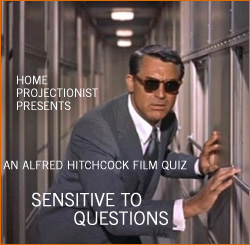
(*The quiz title was inspired by Alfred Hitchcock’s North By Northwest:“Something wrong with your eyes?” “Yes”, says the sunglass-clad Roger O. Thornhill (Cary Grant), “They’re sensitive to questions”. In the dining car aboard the 20th Century, Roger peers at the menu and says to Eve, “Recommend anything?”)
ON THIS DAY in 1959, Charles Van Doren, a contestant on the TV game show Twenty One, testified before Congress that he’d been given the questions and answers ahead of time. The incident was dramatized in the 1994 Robert Redford film, QUIZ SHOW, with Ralph Fiennes.
Sitting in a cab the other day, I glanced at the odd image that appeared on the small television screen mounted on the back of the front seat. “What in the world is that?” I wondered as I looked at the closeup of some beige and bumpy blob. Was it a meteor? an enlarged fat cell? a mutant virus?
The mystery began to unravel as each of the ensuing shots zoomed out to reveal more and more information. As the camera moved back, I saw that the blob was one of many oyster shells chilling on ice. Then a hand holding a knife appeared; the hand belonged to a man who picked up the oyster and pried it open. It turned out that the man was casually sitting at a bar, the atmosphere dark and woody. The big conclusion at the last cut: A restaurant logo and operating hours flashed on the screen.
In Part 1 of THE STORY OF FILM, filmmaker Mark Cousins reminds us how Hitchcock created tension through his “brilliant use of closeups” to start a scene and would then zoom out to reveal place, rather than relying on the traditional establishing shot and moving to closeups from there.
“The guy who directed that restaurant commercial was a Hitchcock fan,” I thought to myself.
My education in the history of filmmaking continues with Part 2 of THE STORY OF FIILM: AN ODYSSEY. (Comments on Part I may be accessed at http://wp.me/pfwMd-ZE)
Part 2 includes the segments “Expressionism, Impressionism and Surrealism: Golden Age of World Cinema” and “The Arrival of Sound,” featuring a collection of insights, observations, and trivia by Cousins, the intrepid film historian, director, writer, and narrator of this newly released primer on the evolution of film.
Cousins narrates the series in his lulling, quiet voice, as if he is imparting special secrets, chock full of analysis and comparison/contrast with a big dose of hyperbole. He says that the the 1920s were “the greatest era in film”; that Japanese director Yasujiro Ozu was “perhaps the greatest film director that ever lived”; and that Alfred Hitchcock was “the greatest image maker of the 20th century.” I couldn’t quite keep up with all of the testimonials to greatness he brings to his commentary, but I have to admit that I enjoy those kinds of big, dramatic statements in his narrative, including pronouncements along the lines of “Cinema can be broken into two periods, before LA ROUE (1923) by Gance and after LA ROUE.”
Nonetheless, Cousins does provide illustrations to support his declarations, doling out a relentless — and fascinating — selection of clips from more than 40 films include Dreyer’s THE PASSION OF JOAN OF ARC(1928), Murnau’s SUNRISE (1927), Buneul’s UN CHIEN ANDALOU (1929), and Disney’s SNOW WHITE AND THE SEVEN DWARFS (1937), just to name a few. Each selection illustrates the innovations in story, action, and technique that dramatically widened the possibilities in filmmaking during “the golden age of world cinema,” and how this world of visual innovation abruptly changed when sound came into the picture. From the dadaists to the realists, we go bouncing around from innovation to innovation like the crazy journey of the baby carriage in BATTLESHIP POTEMKIN (1925) to the great musical journey of the song “Isn’t It Romantic” from Mamoulian’s LOVE ME TONIGHT (1930).
I am especially intrigued by the movie trivia that Cousins peppers in between his cinema history lessons: That there were 36,000 extras in METROPOLIS. That silent films in France were referred to as “deaf cinema.” That 90 percent of Japanese silent films have been destroyed. That Howard Hawks was responsible for bringing intense speed to cinema (recall the overlapping dialogue in BRINGING UP BABY). That the tragic demise of forgotten Chinese movie star Ruan Lingyu created a national mourning event of historic proportions. That the memorable camera angles in L’ATALANTE were a result of director Jean Vigo not wanting to show the newly fallen snow on the ground. That director Abel Gance watched the restoration of his NAPOLEAN at the 1979 Telluride Film Festival from the window in his hotel room. So many movies, so many footnotes….
As we follow Cousins’ journey through the movie business of the 1930s, he tells us that this era gave rise to the “great genres” of musicals, westerns, horror, gangster films, and comedies. And, at the conclusion of Part 2, Cousins asserts that three key films of 1939 — GONE WITH THE WIND, NINOTCHKA, and THE WIZARD OF OZ — bring “the end of escapism in films.” This statement still stumps me.
The world is heading to war, and won’t there be plenty of escapist films during the tumultuous times ahead? But for some reason, we won’t get Cousins’ perspective on the films of the war years. The next episode of the series begins with a segment entitled “Post-War Cinema.”
Music Box Films is distributing this new documentary, and Chicago’s Music Box Theater is conducting a multi-week screening of this ambitious effort. The DVD will be released in November 2012. You will want to add it to your collection.
Gloria Bowman is a writer, storyteller, blogger, movie lover, freelance editor,
and author of the novel, Human Slices.
Access her blog at www.gloriabowman.com; on Twitter @GloriaBow
ON THIS DAY in 1938, in “the match of the century”, the thoroughbred horse Seabiscuit defeated War Admiral at Pimlico Race Course in Maryland. This race was depicted in the 2003 film, SEABISCUIT, with Tobey Maguire and Jeff Bridges.
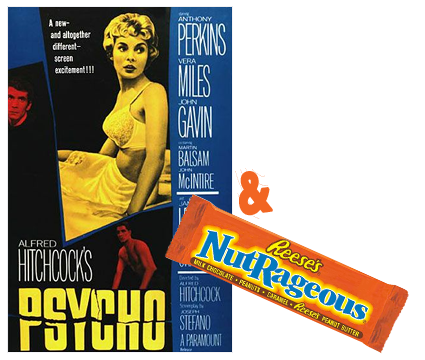
PSYCHO(1960; with Anthony Perkins, Janet Leigh, Vera Miles; directed by Alfred Hitchcock)
“We all go a little mad sometimes. Haven’t you?” –Norman Bates “Yes, and just one time can be enough.” –Marion Crane
This horror film, “the picture you must see from the beginning”, introduced the modern era of horror films. Hitchcock’s PSYCHO has frights, thievery, suspicion, despair, desperation, disease, sadness, foreboding and decay. Unlike many of the contemporary films it set the stage for, it’s not afraid to be subtle and very, very serious. (What few funny spots there are are of the nervous-laughter variety). We’re only a few minutes into the film when we’re greeted with a familiar Hitchcock obsession–mothers–a subject introduced by none other than Alfred’s surrogate, his daughter, Patricia. Later, of course, there are some real issues with nervous Norman Bates’ mom. She looms over her son in the same manner as her sinisterly ornate, gloomy house dominates over the very plain and unassuming, prostrate Bates Motel below.
When you’re not being scared by the showery murder in cabin number one, or creeped-out by Bernard Herrmann’s music, you can have fun noting the various “doubles” and moments of foreshadowing. Such as the painting behind Marion at the real estate office, offering a glimpse of the landscape Marion will soon encounter on her frantic flight from Phoenix. Then there is Norman’s reflection in the dark motel window as he speaks to Marion (“Mother… isn’t herself today”), and the similarity of the names, Norman/Marion. Besides the obvious bird reference in Norman’s taxidermy, there is Marion’s surname, “Crane”, and Norman’s, “Bates”, and also his munching of candy as if he were a bird–a predatory one.
Even if you don’t pass the time like Norman (“My hobby is stuffing things…”), we can think of no better way to conclude 31 Bites and 31 Frights than to suggest you gather friends together to watch perhaps the most outrageous cinematic nut of all, while you, um, stuff yourself–with a NutRageous.
“You know what I think? I think we’re all in our private traps, clamped in them, and none of us can ever climb out. We scratch and claw… but only at the air, only at each other, and for all of it, we never budge an inch.” –Norman Bates
Who wants to wait until the 31st to wallow in Halloween indulgences and scary movies?! Home Projectionist doesn’t! And so we’ll have pairings of 31 Frights and 31 Bites every one of October’s 31 nights: a scary, snack size movie “trick”, and a delicious “treat” to go along with it.
Like bones in a graveyard, hundreds and hundreds of Halloween movie lists are scattered across the Web, touting the scariest, the best, the goriest, you name it. But long lists can be overwhelming. Here are four must-watch movies to add to your freaky list. File them under “Disturbing,” “Chilling,” “Terrifying,” and “Sort of Stupid.”
IT’S OK TO BE AFRAID OF YOUNG BLONDE TWINS
When people talk about movies that have stayed with them for days and days, I recall THE OTHER (1972). This disturbing, rarely shown classic, stayed with me for not just days, but for years. Because of THE OTHER, I still have a need to avoid blonde twin boys. Never trusted them; never will. And I’m slightly afraid of farms as well.
With direction by Robert Mulligan (he of TO KILL A MOCKINGBIRD, for one), score by Jerry Goldsmith, and star power like Uta Hagen and Diana Muldaur, how can this movie miss? There are no ghosts or demons, but sheer suspense, true to the nail-biting novel by Thomas Tryon by the same name.
YOUR PATHETIC, BANAL LIFE ISN’T SO BAD SECONDS (1966) is unquestionably one of the most chilling films I have ever seen. What were my parents thinking when they took me to see it when I was only 12 years old? I think they were thinking that if it starred Rock Hudson, it must be a happy family film. In reality, it is a decadent, modern twist on making a pact with the devil.
This stylistic thriller, complete with skewed camera angles and distorted images, was directed by John Frankenheimer of MANCHURIAN CANDIDATE fame.
Rock Hudson totally pulls out his acting chops for this one, playing unhappy and down trodden Arthur. He is so beat up by life that he likes the sound of an enticing proposal. From workaday drone to swinging playboy? What could go wrong?
As soon as the drill goes into Hudson’s neck, you know that Arthur should have consider his decision a little more carefully. This film also has one of the best drunk scenes ever recorded (and in reality, Hudson was totally tanked during the filming of it).
DON’T ENTER THE SUBWAY IF YOU HEAR SCREAMING LIKE THIS GOING ON
Filed under “What Are You Watching?” Home Projectionist fan Jonathan Stacy writes:
“If you want a truly terrifying Halloween movie with cult status (particularly in Europe), try POSSESSION (1981) by Polish director Adrezej Zulawski with Isabella Adjani and Sam Neil. It’s a strange hybrid of marital drama, ROSEMARY’S BABY, and early eighties freak out. (And in my opinion, it was a major influence on Lars von Trier and his ability to cull strong performances from women despite dubious feminist interpretations; Gainsbourg in ANTICHRIST is the obvious daughter of this work). Think a mish-mash of KRAMER VS. KRAMERand IT’S ALIVE!
Adjani won best actress at Cannes for this film, the central piece being her miscarriage (from a demon?) in a subway. Frighteningly over the top and horrifyingly real all at the same the same time.”
You’ll want to watch this scene more than a few times:
CURIOUS CASTING COMBINATIONS WORK FOR NO REASON WHATSOEVER, LIKE JOAN COLLINS AND A DWARF And like a trainwreck you shouldn’t watch, THE DEVIL WITHIN HER (1975) is custom made for when you’re in the mood for hootin’ and hollerin’ and makin’ wisecracks. The world doesn’t need another cheap imitation of ROSEMARY’S BABY but there’s Joan, a demon dwarf, a devilish baby, and a dastardly wig — plus sex!
Happy Halloween! May the demons be with you.
Gloria Bowman is a writer, storyteller, blogger, movie lover, freelance editor,
and author of the novel, Human Slices.
Access her blog at www.gloriabowman.com; on Twitter @GloriaBow
ON THIS DAY in 1926, magician and escape artist Harry Houdini died from complications due to a ruptured appendix. His death was portrayed in the 1953 biographical film, HOUDINI, starring Tony Curtis and Janet Leigh.
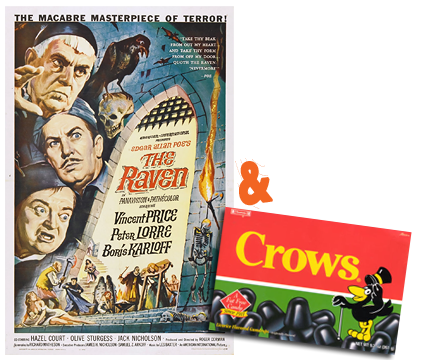
THE RAVEN(1963; with Vincent Price, Boris Karloff, Peter Lorre, Jack Nicholson; directed by Roger Corman)
Richard Matheson (TRILOGY OF TERROR, SOMEWHERE IN TIME, DUEL) wrote the script for this loose and goofy adaptation of the famously spooky Poe poem. Vincent Price portrays magician Erasmus Craven. Craven is visited by a raven–a raven that later, thanks to Craven, takes the form of wizard Bedlo, played by Peter Lorre. Bedlo and his son (a very young Jack Nicholson) helps Craven locate Craven’s allegedly deceased wife (Hazel Court), who has now made her nest with Craven’s nemesis, the evil Scarabus (Boris Karloff). A battle royal rages between the two rival sorcerers, all done tongue-in-cheek, Roger Corman style. This was the first time the “triumvirate of terror”–Price, Lorre and Karloff–had appeared together in a movie. The jolly “raven” on your box of Crows will set the mood for this not-so-serious Halloween film. As for “nevermore”, don’t be concerned about your ravenous appetite. Crows are fat free.
Who wants to wait until the 31st to wallow in Halloween indulgences and scary movies?! Home Projectionist doesn’t! And so we’ll have pairings of 31 Frights and 31 Bites every one of October’s 31 nights: a scary, snack size movie “trick”, and a delicious “treat” to go along with it.
ON THIS DAY in 1938, Orson Welles’ Mercury Theater radio company performed H.G. Wells’ The War of the Worlds, causing widespread panic among the general public. In 1957, Welles’ broadcast and the ensuing events were recreated for the 1957 Westinghouse Studio One show titled THE NIGHT AMERICA TREMBLED.
BRIDE OF CHUCKY(1998; with Jennifer Tilly, Brad Dourif; directed by Ronny Yu)
Here’s an example of how it’s often best to leave well enough alone. It applies here in terms of this movie’s story, and the movie itself. A sequel to the mysteriously successful CHILD’S PLAY movies, BRIDE OF CHUCKY features Jennifer Tilly as Tiffany, the former girlfriend of a serial killer who became embodied within an extremely disturbing-looking doll named, of course, Chucky. Tiffany tampers in the doll’s domain when she decides to put Chucky back together again. Chucky shows his gratitude to Tiffany by tossing an electrical device into her bathwater, like James Bond did in the prologue to GOLDFINGER. This causes Tiffany to cast her fate with Chucky as his bride (long story), unlike in GOLDFINGER. The happy couple, for better or (mostly) worse, make their way to New Jersey for a honeymoon from Hell. We suggest you ease your pain by chewing on Chuckles, as you watch, jaw agape, Chucky and company chew the scenery.
Who wants to wait until the 31st to wallow in Halloween indulgences and scary movies?! Home Projectionist doesn’t! And so we’ll have pairings of 31 Frights and 31 Bites every one of October’s 31 nights: a scary, snack size movie “trick”, and a delicious “treat” to go along with it.
ON THIS DAY in 1787, Wolfgang Amadeus Mozart’s opera Don Giovanni was performed for the first time at the Teatro di Pragain in Prague. In 1979, Joseph Losey directed DON GIOVANNI, a cinematic adaptation of the opera.
DONOVAN’S BRAIN(1953; with Lew Ayres, Nancy Davis; directed by Felix Feist)
No doubt you’ve encountered bodies without brains in your daily life. Like that lummox who cut in front of you in line. But how about a brain without a body? Can it exist on its own, with a little help from a brainy brain doctor? Lew Ayres plays that specialist with the good intentions of saving the cranium of accident victim Donovan, an industrial tycoon. However, things go awry (you didn’t expect a situation like this to go smoothly, did you?). Ayres, once a peaceful personality (as he famously was in real life) becomes aggressive and cruel, and it’s soon apparent that the disembodied brain is causing the side effects. DONOVAN’S BRAIN is a very good movie–creepy and intelligently written. Maybe not the “most fantastic story your startled eyes have ever beheld!”, as it’s billed, but there is an added layer of interest. Nancy Davis, future First Lady Nancy Reagan, plays Ayres’ wife in the movie. Davis by this time was married to Reagan, his second wife. Reagan’s first wife, Jane Wyman, had left Reagan for a relationship with Ayres, one that did not result in marriage. (Note: When I was little, my friends and I thought that eating Smarties would make us smart. Some would say that I am now living proof that our theory was flawed.)
Who wants to wait until the 31st to wallow in Halloween indulgences and scary movies?! Home Projectionist doesn’t! And so we’ll have pairings of 31 Frights and 31 Bites every one of October’s 31 nights: a scary, snack size movie “trick”, and a delicious “treat” to go along with it.
ON THIS DAY in 1903, author and journalist Evelyn Waugh was born. Waugh’s novel, BRIDESHEAD REVISITED, was adapted by the BBC for a 1981 TV series starring Jeremy Irons.
English: Screenshot from Le Voyage dans la lune (A Trip to the Moon) (1902) (Photo credit: Wikipedia)
George Méliès, magician and magical filmmaker, made 520 short films from 1896 to 1913. What an honor and thrill it is to see a collection of these works of art narrated by his great granddaughter Marie-Hélène Lehérissey-Méliès. To make this ciné-concert even more special, the films are shown with brilliant piano accompaniment provided by his great-great grandson Lawrence Lehérissey-Méliès, who, by the way, is a spittin’ image of his legendary grandpa.
Home Projectionists thrive on creating cinematic experiences in their own abodes. This one, however, would be impossible to duplicate. Plan to get to Minneapolis, Ann Arbor, or Boston in the next couple of days to experience this must-see event. For a complete schedule, go to http://www.live-boutique.com/site/-Cine-concert-Georges-Melies-.html?mode=agenda
The ciné-concert features 15 of his masterful films, including my favorites, “The Man with the Rubber Head,” “Bluebeard,” “The Fairy Caraboose,” “Cake Walk Infernal,” and a fascinating re-enactment of the “Coronation of Edward VII.” Each and every one is a delight and treasure, showcasing the genius, spirit, and magic of Méliès brought to life by his innovative use of stop motion, time lapses, and dissolves, not to mention the beautiful hand tinting that appears in a few of the films.
It’s been more than 100 years since George Méliès brought his artistic visions to life. They’re still sheer cinema magic.
Gloria Bowman is a writer, storyteller, blogger, movie lover, freelance editor,
and author of the novel, Human Slices.
Access her blog at www.gloriabowman.com; on Twitter @GloriaBow
Not just another WordPress.com site, but an extraordinary place to spend a weekend, grill a cheese sandwich and watch a film to improve your life and stimulate a few of the grey cells.










 Home Projectionist